DIY All-Purpose Cleaner (Homemade, 3 Ingredients)
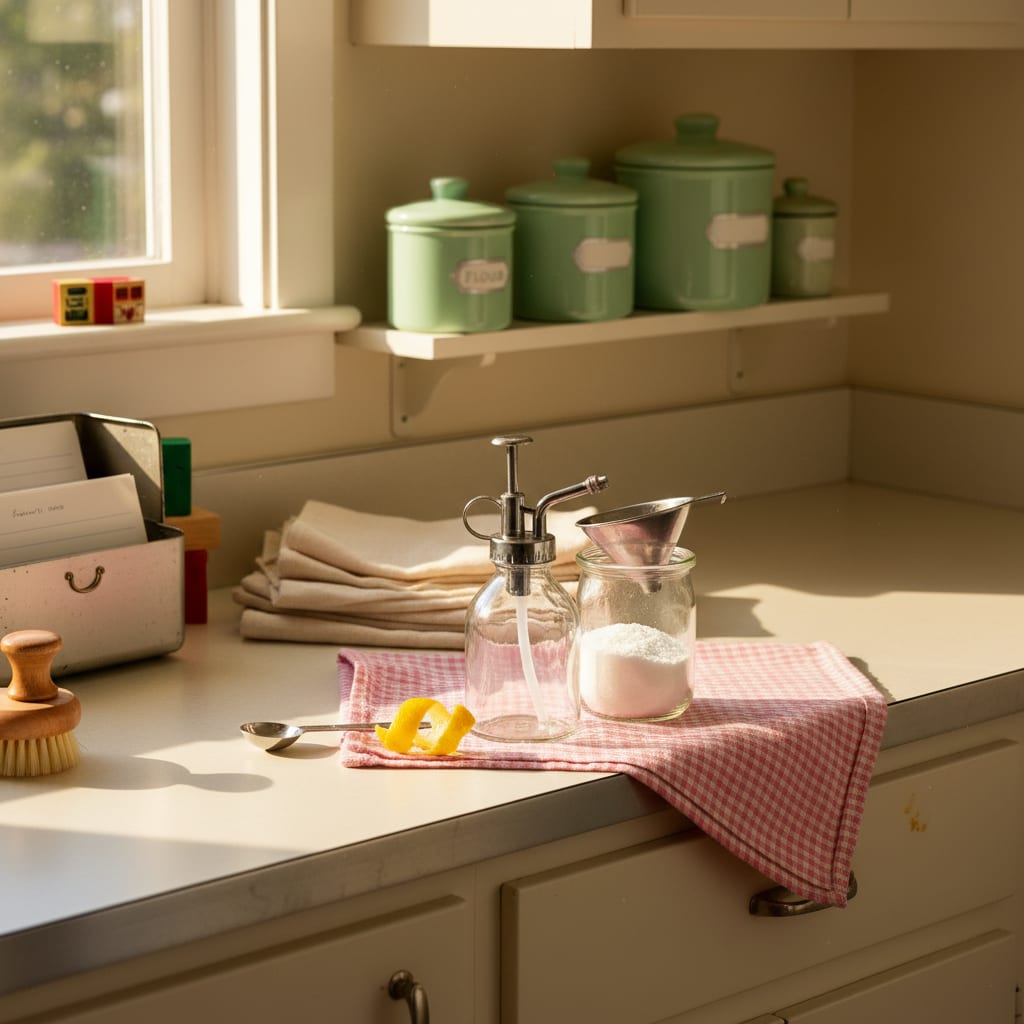
The DIY all-purpose cleaner that actually replaced the store bottle in this house is three ingredients: two cups of warm water, half a teaspoon of washing soda, and half a teaspoon of liquid castile soap, shaken gently in a spray bottle. (DIY all-purpose cleaner and homemade all-purpose cleaner are the same thing — the recipe below answers to both names.) It cuts kitchen film, wipes tables and painted surfaces, and costs pennies a bottle. It is a cleaner, not a registered disinfectant — an honest distinction this post keeps throughout — and it earns its shelf space on the everyday-wipe jobs, which are most jobs. Here’s the recipe, why each ingredient is there, and the results of running it against a family kitchen for a season.
The recipe
- 2 cups warm water (warm helps the washing soda dissolve)
- ½ teaspoon washing soda (sodium carbonate — the degreasing muscle; Arm & Hammer’s Super Washing Soda is the laundry-aisle box)
- ½ teaspoon liquid castile soap (the grime-lifter; Dr. Bronner’s unscented is the standard)
- Optional: a strip of lemon peel steeped in the finished bottle for scent — peel, not juice
Dissolve the washing soda in the warm water first, add the soap last, cap and tip gently to mix (hard shaking just makes foam). Label the bottle — my grandmother’s card file is emphatic about labeling, and she was right; a house with kids should contain zero mystery spray bottles.
DIY all-purpose cleaner dilution, job by job
One strength does not fit every surface, and most disappointing homemade sprays are the right recipe at the wrong dilution. Everything below uses the same two ingredients in two cups of warm water — only the ratio moves.
| Job | Washing soda | Castile soap | Notes |
|---|---|---|---|
| Everyday wipe-down (the default) | ½ tsp | ½ tsp | Counters, table, cabinet fronts, handles |
| Greasy stove surround, hood underside | 1 tsp | 1 tsp | Spray, wait two minutes, then wipe — dwell time does the work |
| Painted walls and trim | ¼ tsp | ½ tsp | Weaker alkali; test an out-of-sight patch first |
| High chair, toy trays, anything mouthed | none | ½ tsp | Soap-only solution, then a clear-water wipe |
| Sealed stone counters | none | ½ tsp | Stone makers want pH-neutral — leave the washing soda out |
Two ratios worth remembering: doubling the washing soda roughly doubles the degreasing bite and roughly doubles the residue, so a strong mix wants a plain-water wipe behind it. And more soap is not more cleaning — past about a teaspoon per two cups you are mostly making suds you then have to rinse off.
Why these three ingredients
Washing soda is the old laundry-aisle workhorse: strongly alkaline, which is exactly what dissolves the greasy film that settles on every kitchen surface. But alone it’s harsh and gritty-feeling. The castile soap wraps that alkalinity in a gentler grime-lifting vehicle and helps everything rinse away — the same one-bar logic covered in castile soap uses. Water does the diluting, because at spray strength this pair is effective without being hostile to skin or paint. Notice what’s not in it: vinegar. Acid plus soap in one bottle cancels both — the classic Pinterest recipe mistake, explained in the vinegar post — so this cleaner stays alkaline and lets vinegar keep its own separate jobs.
Per-surface safety, and the two things never to mix
Gentle ingredients still have a few hard edges, and they are worth stating once rather than discovering on a floor.
- Never mix vinegar and bleach, in this bottle or any other — the combination releases chlorine gas. That rule stands across every recipe on this site.
- Never add bleach to the soap mix either. Soap plus bleach is a mess at best and unpredictable at worst; a bleach solution is its own separate bottle, made fresh, used alone.
- Unsealed wood, waxed wood and unsealed stone do not want a wet alkaline spray. Damp cloth, then dry.
- Aluminium pans and trays discolour in a strong alkaline solution. Use the soap-only mix.
- Test paint before you commit. Matte and chalk finishes lift; an inside-the-cabinet-door patch tells you in thirty seconds.
- Keep it out of reach and keep it labelled, exactly like any cleaner, gentle ingredients or not.
The gentler side of the same shelf — a paste rather than a spray, for scouring rather than wiping — is baking soda cleaning, which handles the jobs where you want abrasion instead of solution.
A scent variant that doesn’t wreck the recipe
The unscented bottle smells like nothing, which most people find they prefer within a week. If you want scent, there are two ways that work and one that doesn’t.
Citrus peel, steeped. A strip of lemon or orange peel dropped into the finished bottle for a few days gives a light, genuine scent and costs nothing. Peel only — juice is acidic and will curdle the soap.
Essential oil, 5–10 drops per two cups, added last and shaken in. Lemon, sweet orange and lavender all hold up; tea tree smells medicinal in a kitchen. Oil and water separate, so this bottle needs a tip-and-swirl before each use, and the scent fades in a few weeks rather than lasting like a commercial fragrance.
What doesn’t work: adding anything acidic for “freshness” — vinegar, lemon juice, citric acid. It cancels the alkali, curdles the soap, and you end up with a cloudy bottle of nothing. Households with cats, or anyone with asthma or a small baby, are usually better off with the unscented version; scent is the one ingredient here that does no cleaning at all.
What it’s for (and not for)
Reaches for it: counters after cooking, the table after every meal involving a toddler, cabinet fronts, painted walls and trim, door handles, the high chair, appliance exteriors, the sticky mystery zone around the trash can. In the weekly rhythm it’s the star of Friday kitchen day and the utility player the rest of the week — see how the days divide in the weekly cleaning schedule.
Passes on: glass and mirrors (streaks — that is vinegar’s job), and anything needing genuine disinfection. After raw chicken or during a stomach bug, clean first with this, then follow with a registered disinfectant used per its label. A homemade spray that claims to disinfect is the one kind of retro thrift this site won’t sell you.
The season-long test
I ran this bottle head-to-head against the name-brand spray for a season of Fridays. Results, honestly: on fresh messes and daily film, indistinguishable. On aged grease — the hood vent’s underside, the splatter zone behind the stove — the homemade bottle needed a second pass or a minute of dwell time where the commercial degreaser won on the first wipe. On smell, the homemade bottle wins by forfeit: it smells like nothing, then like clean. On cost it isn’t close. Verdict: the homemade bottle took the everyday slot permanently; a commercial degreaser stays under the sink for the twice-a-year hood-vent reckoning, which is a fair division of labor between centuries.
Storage and shelf life
Made with tap water, mix quantities you’ll use within a few weeks — it’s soap and mineral salt, not a preserved product. If a batch clouds oddly or separates into curds, dump it and remix (curds usually mean it met an acid — someone “improved” it with vinegar). Keep it out of toddler reach like any cleaner: gentle ingredients are still not a beverage.
FAQ: homemade all-purpose cleaner
Does homemade all-purpose cleaner really work?
For everyday cleaning — grease film, food mess, fingerprints — yes, on par with commercial sprays in my season of testing. Heavy aged grease and true disinfection are the two jobs where store products still earn their keep.
Can I add vinegar to make it stronger?
No — vinegar (an acid) reacts with the castile soap and washing soda (alkalis) and cancels all three, leaving curdled residue. Keep acid cleaners and soap cleaners in separate bottles, used for separate jobs.
Is washing soda the same as baking soda?
No. Washing soda (sodium carbonate) is significantly more alkaline and better at degreasing; baking soda (sodium bicarbonate) is milder and better as a gentle scrub. You can find washing soda in the laundry aisle.
Does homemade cleaner disinfect?
No — this is a cleaner, not a registered disinfectant, and no DIY spray should claim otherwise. Clean with it first, then use an EPA-registered disinfectant per its label when a surface genuinely needs germ-kill.
Next cards in the file
Nursery Organization: Set Up for the 2am You
July 17, 2026
Bedtime Routine Too Long? Trim a 90-Minute Wind-Down
August 7, 2026
The Sunday Reset: A 90-Minute Family Version
July 17, 2026