Linen Closet Organization (The Folded-Sets Trick)
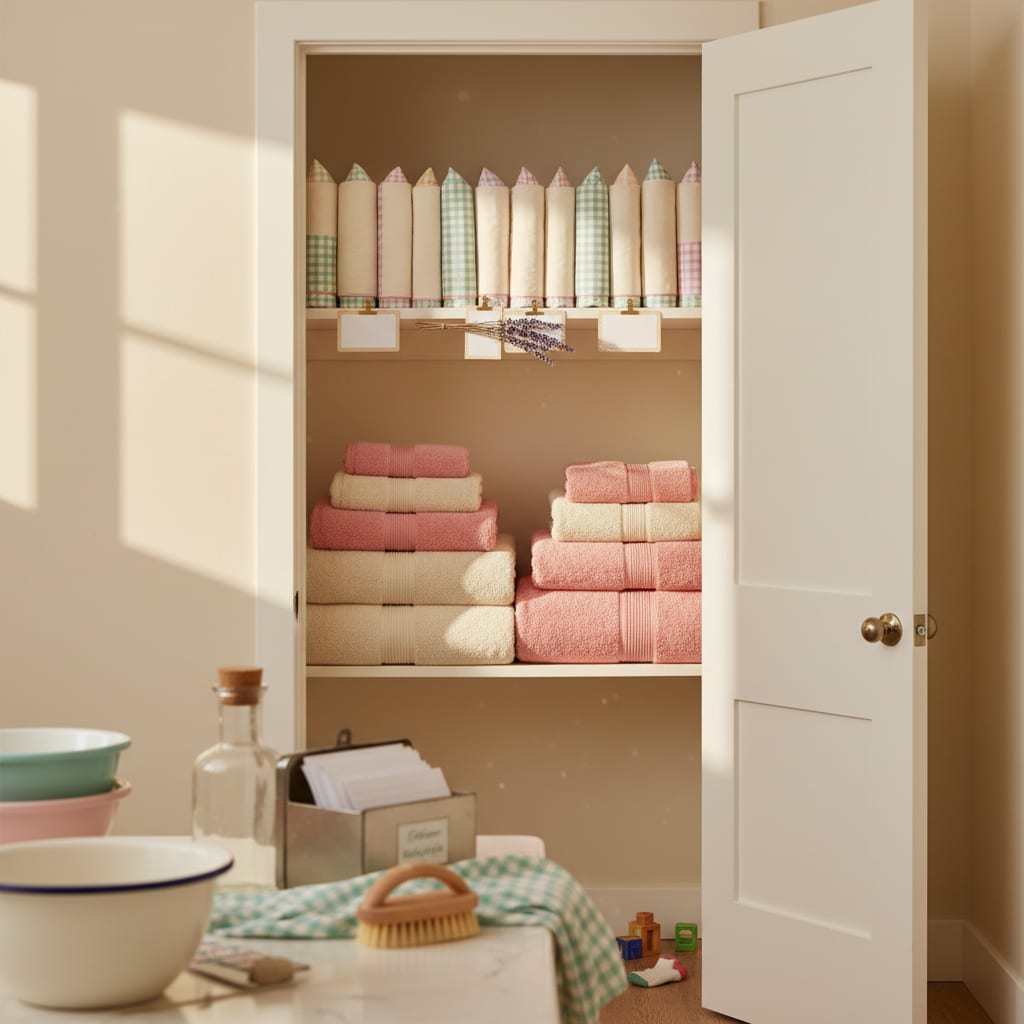
The whole secret of linen closet organization is the folded-sets trick: fold each sheet set and slide it inside one of its own pillowcases, making a tidy bundle that contains fitted sheet, flat sheet and spare case in a single grab. One bed change equals one bundle — no excavating for the fitted sheet’s mate, no strata of orphaned linens. Add a simple shelf order (eye level for daily, high for seasonal, low for bulky), a hard cap on towel count, and a shelf-edge label system, and the closet stays organized through actual family use — which is the only test that matters.
First: empty it and thin it
A linen closet organizes easily once it stops storing your linen history. Pull everything out and be honest: towels gone crunchy or fringed, sheet sets whose fitted sheet died years ago, the comforter for a bed size you no longer own, the mystery table linens. Ragged towels go to the rag bin or the animal shelter; orphaned flat sheets become drop cloths, picnic blankets or the fort-building supply. This is one stop on the whole-house declutter checklist, and it’s among the most satisfying — few closets hold so much pure archaeology per cubic foot. What survives should be only what the current house, with its current beds, actually uses.
The folded-sets trick, properly
Fold the fitted sheet first (the flat-ish rectangle version is fine; the goal is compact, not televised), fold the flat sheet to match, stack them with one pillowcase folded on top, then slide the stack into the second pillowcase, folding its open end loosely over like an envelope. The bundle stands on the shelf like a book. Two refinements from the tin card file: store bundles spine out so you can count sets at a glance, and keep exactly two bundles per bed — one on, one in the closet. The third set the catalog wants to sell you is how linen closets die; two sets cycle forever through a normal laundry schedule, where the stripped bed feeds wash day and the spare bundle goes straight on.
Her linen cards specify ironed sheets, lavender sachets, and sets wrapped in their pillowcases — partly for order, partly because a guest could be handed one bundle and a towel and be fully equipped, no rummaging, no fuss.
The pillowcase bundle survives untouched — it's perfect. The ironing is retired without apology, the sachet is optional, and the guest logic still holds: one bundle, one towel set, handed over in ten seconds flat.
Shelf order: the closet’s traffic plan
Organize by reach frequency, not by category prettiness:
- Eye level: everyday sheet bundles and bath towels — the shelves a tired person hits daily.
- One shelf down: kids’ bedding (low enough that they can fetch their own bundle — yes, really; my five-year-old restocks her bed like a tiny hotel housekeeper) and the everyday spare blankets.
- Top shelf: seasonal and rare — guest bedding, the winter duvet in a zip bag, beach towels off-season.
- Floor level: bulky items in labeled bins or baskets — heating pads, the humidifier, the sleeping bags.
- Door or side wall: a small caddy for the odd linens — mattress protectors, crib sheets (which cycle constantly; the nursery runs on its own two-bundle logic), and the picnic blanket.
Towel cap, stated plainly: per person, around two bath towels in rotation plus a modest guest allowance. Towels expand to fill all shelving offered; the cap, like the toy bin, is the container-is-the-limit rule wearing terrycloth.
Labels and the maintenance minute
Label shelf edges, not containers — “QUEEN,” “KIDS,” “GUEST,” “SEASONAL” on simple clip or tape labels — so the system survives every family member who puts laundry away, including the ones who are five. Then the maintenance is genuinely one minute: on wash day, returning bundles go behind the remaining ones (a lazy first-in-first-out that evens out wear), and once a season, a thirty-second squint for strata forming on the kids’ shelf. A linen closet organized by frequency, capped by count, and labeled for the whole household doesn’t drift back — there’s simply nowhere for chaos to accumulate.
Storing tablecloths and table linens
Tablecloths and napkins are the linens that come out twice a year and go back wrong, then turn up in November with yellow patches and a crease that won’t iron out. The University of Georgia Extension’s guide to textile heirlooms is written for the good lace, but its rules suit the everyday holiday cloth too:
- Store them clean and fully dry. UGA warns that soiled textiles invite insects, mold and mildew. A cloth with a wax drip or a gravy mark goes through the candle wax method and the wash before it goes on the shelf.
- Skip the starch before storing. UGA says starch “will discolor and cause the textile to appear yellow” and attracts insects. Starch it when it comes out, not when it goes away.
- Roll the long ones. Rolled storage avoids creases altogether. Roll the cloth smoothly on a flat table around a mailing tube or fabric-bolt tube covered first in washed muslin or an old pillowcase. UGA says to roll without creasing and not too tightly.
- If you fold, pad and shift the folds. UGA notes that “textiles tend to split where consistent creases and pressure are placed,” so use as few folds as possible, cushion them with white tissue, and refold along different lines a few times a year. Acid-free tissue is the conservator’s choice; plain white tissue is fine if it is fresh and replaced yearly. Never colored paper.
- No plastic and no bare wood. UGA’s reasons: plastic traps moisture and gives off chemicals, and wood, newspaper and ordinary boxes make cloth acidic. Line a wooden shelf with washed muslin or an old sheet. Cedar chests are wrong for cotton and linen.
- Keep them in the house proper. Attics and basements are too hot, cold or damp.
The tablecloths get their own labeled shelf edge, “TABLE,” on the high shelf with the seasonal bedding.
FAQ: linen closet organization
How do you fold sheets so they stay organized?
Fold each set compactly and store it inside one of its own pillowcases — the bundle keeps fitted, flat and cases together and stands on the shelf like a book. Perfection of fold matters far less than completeness of set.
How many sheet sets and towels should you keep?
Two sets per bed (one on, one shelved) and roughly two bath towels per person in rotation, plus a small guest reserve. More than that is storage debt, not preparedness.
What should not be stored in a linen closet?
Anything that isn’t cloth or closely allied: medicines and toiletries overflow (bathroom’s job), paper goods (pantry’s job), and memory-box textiles, which deserve a real archive bin elsewhere. A linen closet that stores everything organizes nothing.
How do you store tablecloths without creases or yellowing?
Wash and dry them fully, skip the starch, and roll long cloths around a tube covered in clean cotton. If you must fold, pad the folds with white tissue and refold them along new lines a few times a year.
How do you organize a small or shallow linen closet?
Bundles stored vertically like books, shelf-edge labels, and the two-set cap enforced ruthlessly — small closets thrive on inventory limits. Bulky duvets move to under-bed zip bags to free the shelf space linens actually need.