How to Organize Toys So They Get Played With
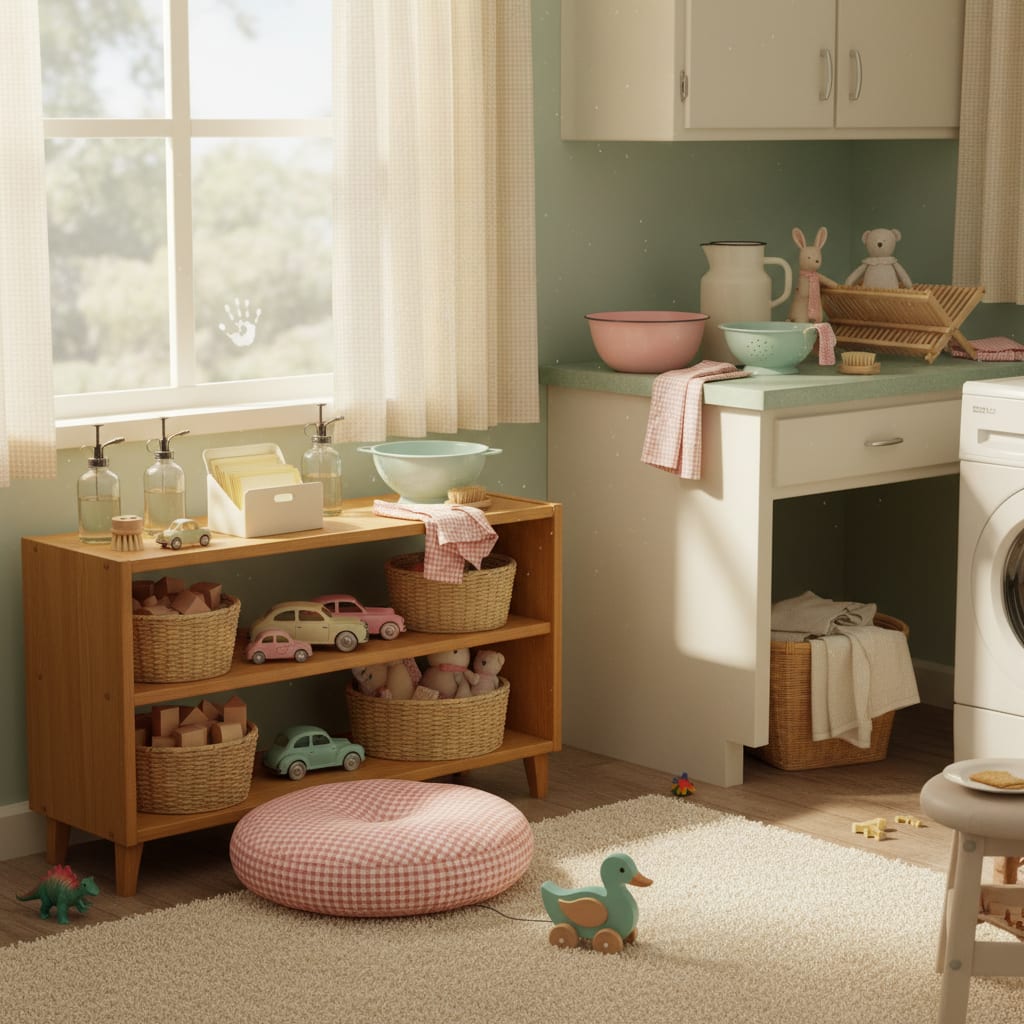
The way to organize toys so they actually get played with is to store fewer of them, in open bins, sorted by broad category, at child height — and to accept that the container is the limit: when a bin overflows, toys leave rather than bins multiplying. Kids play more, and better, when they can see everything available in about four seconds. Deep toy boxes, high shelves and lidded systems all fail the same way — they make toys invisible, and invisible toys don’t exist to a four-year-old. This is a storage post, not a play-philosophy post; the system below is what survives in a 1950s ranch house with a five-year-old, a two-year-old, and no playroom.
The four rules
- Open bins, no lids. A lid is a wall. My grandmother’s card file keeps toys in baskets and one shallow drawer per child — shallow being the operative word; nothing can be buried in a shallow container.
- Broad categories, not fine ones. Blocks, vehicles, animals, dolls-and-their-luggage, art. A bin per category. Sorting finer than a toddler can maintain means you are the sorting system, forever.
- Kid height or it doesn’t count. Storage above their reach is your storage, not theirs — fine for the rotation shelf, useless for daily play.
- The container is the limit. The bin defines how many blocks live here. Overflow triggers an edit, not a shopping trip for a bigger bin.
Set it up in one nap time
Dump everything in the middle of the room — genuinely everything; the under-couch archaeology too. Make four piles: broken (trash, no ceremony), outgrown (a labeled bin to the garage for the next kid or donation), duplicates and never-played (donate box), keepers. Be ruthless with the never-played pile; a toy that hasn’t been touched since winter is dead weight with a face on it. Then give each keeper category a bin (soft fabric cubes work well), each bin a home on a low shelf, and — if your kids are pre-readers — tape a photo label on the bin, which is the difference between “kids can clean up” and “mom re-sorts nightly.” The full room-by-room version of this purge lives in the declutter checklist; toys are just its loudest chapter.
Keep some toys off-stage
Whatever survives the edit still shouldn’t all be out. Keep roughly half the toys in a closet or garage bin and swap sets every few weeks — old toys return with new-toy energy, and the floor stays survivable between swaps. That swap habit is a storage trick; the deeper play-science version — running rotation as an intentional play system, with stages and observation — is its own discipline, and One Mom’s Guide covers that side of the house well. Here, the point is simpler: fewer toys visible means more play and less floor.
The cleanup system is the storage system
A toy system you can’t reset in ten minutes isn’t a system; it’s a diorama. Ours resets nightly inside the ten-minute pickup from the daily cleaning routine: timer on, everyone returns things to bins, bins to shelves, done when the timer sings. Because the categories are broad and the bins are open, a two-year-old can genuinely do it — “blocks go in the block bin” is toddler-executable in a way “sort by set” never will be. If cleanup routinely runs past ten minutes, that’s not a discipline problem, it’s an inventory problem: too many toys are out. Swap more off-stage.
Special cases, honestly handled
The tiny-pieces problem (magnet tiles, tiny bricks, beads): one zippered pouch or shallow latching box per set, stored on the rotation shelf, brought down as a table activity, returned complete. Open-bin rules don’t apply to five hundred pieces of anything — that’s not organizing, that’s confetti management. The stuffed-animal population: they compound like mess does; one open basket is the container, the basket is the limit, and the overflow conversation happens with the child, who will surprise you. Gifts and grandparents: the inflow will always exceed the outflow unless the outgrown bin runs monthly. Run it monthly. And in the baby’s room, toys stay minimal on principle — that room has one job, and the nursery organization post explains why almost everything with batteries sleeps elsewhere.
FAQ: organizing toys
How do you organize toys in a small house with no playroom?
Low open shelving in the room where play actually happens, broad-category bins, and half the collection stored off-stage in closets or the garage. Small houses run best on a smaller visible inventory, swapped often.
How many toys should be out at once?
Fewer than feels natural — a good starting rule is what fits on one low shelf unit with every bin visibly containing one category. If nightly cleanup exceeds ten minutes, too many are out.
Should toys be stored in the child’s bedroom?
Books and a few quiet toys, yes; the main collection, ideally no — bedrooms organized around sleep work better, especially for toddlers. Store the loud inventory in shared spaces and rotate it.
How do I get my kids to put toys away?
Make the system toddler-executable: open bins, photo labels, broad categories, kid height — then run cleanup as a timed nightly game. Kids maintain systems they can operate without an adult’s sorting brain.