Nursery Humidifier: Dry Air, Stuffy Noses, Safe Setup
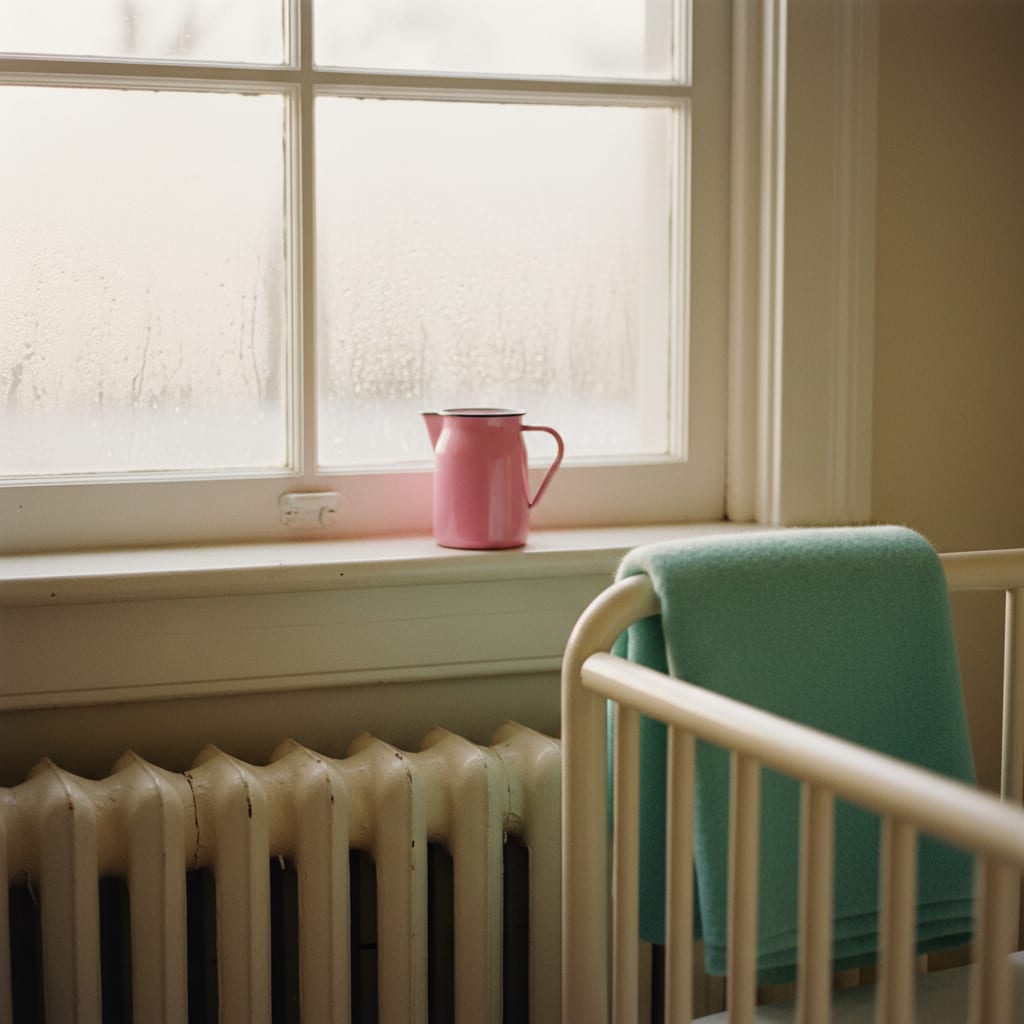
A nursery humidifier helps with winter’s dry air, but only as household equipment that gets looked after. Pick a cool-mist model, never a hot-steam one. Put it near the cot but out of reach, empty and refill it daily, clean it every third day, and keep the room under 50 percent humidity. The stuffy nose itself usually comes from a cold rather than the air, so the humidifier eases it rather than cures it — and the baby still sleeps flat on their back.
Where the dry air comes from
Heating dries a house, and a bedroom with the door shut and the radiator on all night gets the worst of it. The house usually tells you before the children do. The U.S. Environmental Protection Agency’s page on the use and care of home humidifiers lists the “common nuisances brought on by winter heating, such as static electricity, peeling wallpaper, and cracks in paint and furniture” alongside the “dry nose, throat, lips, and skin” people buy humidifiers for.
The children feel it in their noses. The American Academy of Pediatrics’ cough and cold survival kit puts it plainly: “Winter’s cold, dry air can make nasal mucus thicker.”
Where the stuffy nose actually comes from
Dry air thickens what is already there; it is rarely what put it there. The AAP’s page on helping a baby with a stuffy nose sleep safely explains that “stuffy noses happen when the blood vessels and tissues inside your baby’s nose fill up with too much fluid”, and it frames the relief around recovering from “a cold, the flu, or any other virus that causes congestion.”
So a humidifier makes a cold more comfortable to sleep through; it will not end one. Betteroo’s explainer on where baby congestion comes from and when to worry sorts the ordinary snuffles from the ones that need a doctor.
Measure the room before you buy anything
Buy the gauge before the humidifier. A small digital hygrometer such as the TP50 from ThermoPro, now sold as TempPro, shows temperature and humidity together, which also tells you whether the room runs cold overnight — its own audit in the 4am cold-room post.
The number you are working to has a ceiling rather than a target. EPA says: “Do not humidify to indoor relative humidity levels exceeding 50 percent”, because “higher humidity levels may encourage the growth of biological organisms in the home”, naming dust mites and molds. Its no-gauge test: if water condenses on windows or walls, move the humidifier, turn it down or run it less.
Cool mist, never hot steam, in a child’s room
The AAP survival kit says: “Cool-mist humidifiers generally are considered safer for young children than warm-mist humidifiers or steam vaporizers. That’s because there’s no risk of burns.” EPA agrees: “Keep steam vaporizer humidifiers out of the reach of children.”
“Cool mist” covers more than one machine, though, and EPA separates them by what they put into the air:
| Type | How it works | What EPA says it disperses |
|---|---|---|
| Ultrasonic | Vibration makes a visible mist | Among the greatest dispersal of microorganisms and minerals |
| Impeller | A spinning disk throws a mist | Among the greatest dispersal of microorganisms and minerals |
| Evaporative | A fan blows air through a wet wick | Less, if any; not expected to disperse much mineral |
| Steam / warm mist | Heats water to steam | Less, if any; burn risk in a child’s room |
So the nursery pick is an evaporative cool-moisture unit, which is cool and low-dispersal at once. The Honeywell HCM-350 is a well-known example: Honeywell’s own product page (loaded 2026-09-27) describes a wicking filter and a fan, and says: there is no “mist” emitted. If you already own an ultrasonic, EPA’s advice is to fill it with bottled water labelled “distilled”, which cuts the scale and the white dust that settles on furniture.
Where it goes in the room
The AAP’s placement rule is precise: close enough “that the mist reaches your baby while they’re sleeping, but out of your child’s reach.” In practice: a dresser top or sturdy shelf across from the cot, cord behind the furniture.
EPA’s other rules are about the room. “Do not permit the area around the humidifier to become damp or wet”, and do not let absorbent things — “carpeting, drapes, or tablecloths” — get damp. Keep it off the rug, away from the curtains and off the radiator shelf, on a tray if the surface is wood. The full layout of the room, with the cot placed first, is in nursery organization.

The cleaning card
A humidifier is a tank of standing water in a warm room, which is why it needs a schedule. EPA warns that ultrasonic and impeller models “can disperse materials, such as microorganisms and minerals, from their water tanks into indoor air”, and the AAP adds that “running an unclean humidifier can release these germs and deposits into the air.” Written as a card:
- Every day: empty the tank, wipe all surfaces dry and refill, per EPA.
- Every third day: clean it, per EPA — scrub off the scale, film and deposits inside the tank and wipe everything dry.
- Disinfecting: follow the manufacturer. If the manual says nothing, EPA’s fallback is a 3% solution of hydrogen peroxide on every surface that touches water, then rinse “with several changes of tap water” so no cleaner goes into the air. Use one product at a time; never mix cleaners, and never vinegar with bleach.
- Filters and wicks: replace on the manufacturer’s schedule.
- End of season: clean it, let every part dry, throw away used filters or cartridges, and store it somewhere dry. EPA says to clean it again when it comes back out. A bin on the bottom shelf of the linen closet is where ours spends the summer.
EPA also says to stop using a humidifier and contact your doctor if you have breathing symptoms you believe are linked to it, even when you are following the cleaning directions.
The January card has a pan of water near the radiator and "wipe the window sills" underneath it. Nobody measured anything; the house told her with condensation, and she read it.
Same instinct, with a gauge and a ceiling: a hygrometer on the shelf, a cool machine on a daily and three-day schedule, and the sill still checked every morning.
The bed stays flat
The instinct with a snuffly baby is to prop the head of the mattress. The AAP’s answer is no: “It may seem harmless to prop up your baby on towels or pillows or incline their mattress, but it is NOT safe”, because a propped head bends the airway. It notes that the Consumer Product Safety Commission has banned inclined sleepers, “any product in which the baby’s head is more than 10 degrees above a flat surface.” Betteroo’s guide on why a congested baby still sleeps on their back goes through the reasoning.
What the AAP does suggest before sleep: plain saline drops and gentle suction, a steamy bathroom with the shower run for a few minutes, and plenty to drink. The rest of the bed setup is in the baby sleep environment post. The same page says to call 911 if a baby is struggling for each breath, can barely make sounds, or has bluish lips or face.
FAQ: nursery humidifiers
Is a cool-mist or warm-mist humidifier better for a baby’s room?
Cool mist. The AAP says cool-mist models are generally considered safer for young children because there is no risk of burns.
What humidity should a nursery be?
Under 50 percent relative humidity, per EPA; higher levels encourage dust mites and mold.
How often should you clean a baby’s humidifier?
Empty, wipe dry and refill it daily, and clean it every third day, per EPA.
Should I use distilled water in a humidifier?
In an ultrasonic or impeller model, yes: EPA recommends bottled water labelled “distilled” to cut scale and white mineral dust.
Can a humidifier help a baby with a stuffy nose sleep?
It can ease mucus thickened by heated winter air, and the AAP lists one among safe comforts. It does not treat the cold, and the baby still sleeps flat.
Next cards in the file
Nursery Organization: Set Up for the 2am You
July 17, 2026
The Sunday Reset: A 90-Minute Family Version
July 17, 2026
How to Get Red Wine Out of Carpet (Fresh or Dried)
October 7, 2026