Baby Waking Later on Dark Mornings? The Winter Routine
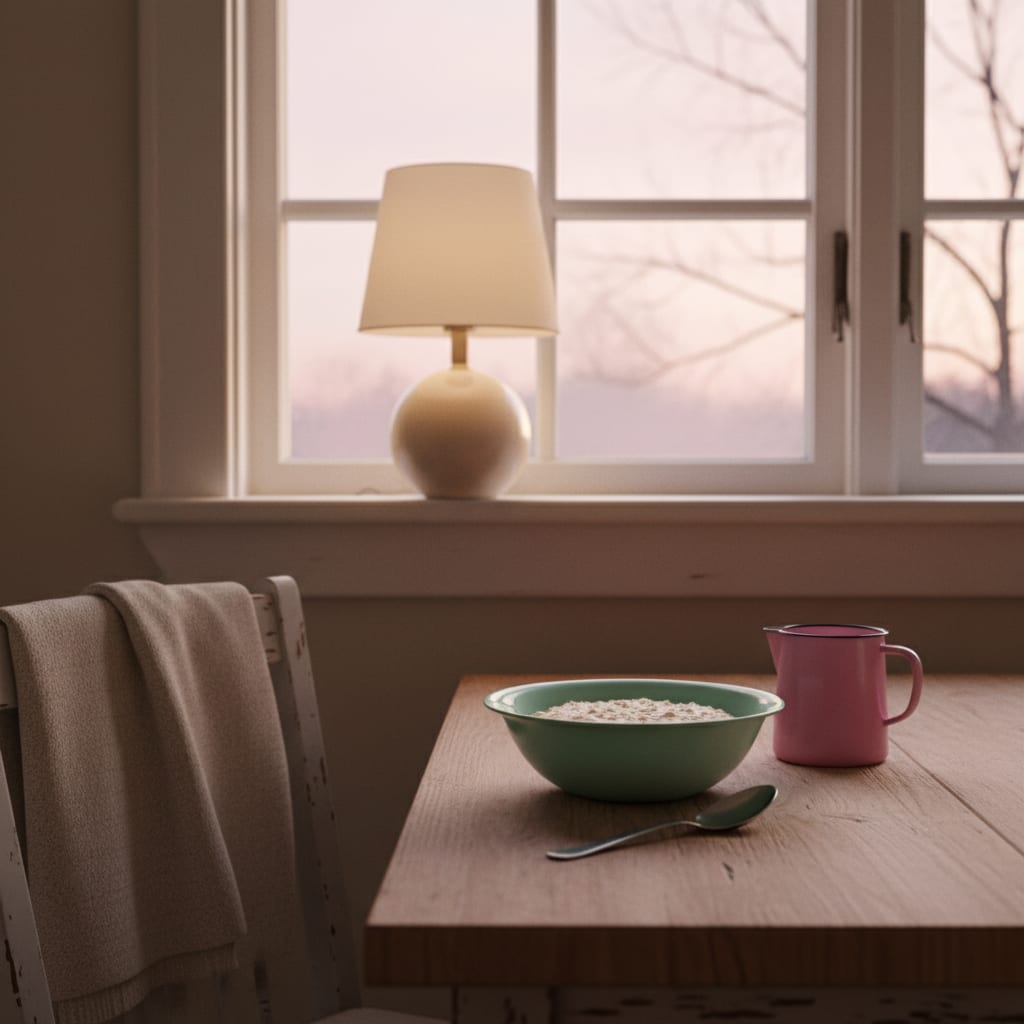
When the mornings darken in autumn, a baby’s wake-up can drift later, because the strongest signal their body clock gets, morning light, now arrives after the wake time instead of before it. Let the later wake-up stand if naps, bedtime and the household’s mornings still fit around it. If they don’t, hold the old wake time and supply the light yourself: curtains open and lamps on at the wake time, breakfast by the brightest window, and a walk outside before mid-morning. Then dim the house earlier in the evening so bedtime keeps pace.
Why the wake-up drifts once the mornings go dark
The National Institute of General Medical Sciences’ fact sheet on circadian rhythms puts it plainly: “Light and dark have the biggest influence on circadian rhythms, but food intake, stress, physical activity, social environment, and temperature also affect them.” The brain’s master clock “controls production of the hormone melatonin based on the amount of light the eyes receive.”
The same page compares the clock’s feedback loop to a thermostat: “a home’s furnace will turn off when the house reaches the set temperature.” That is a useful way to see the season. In June the sun is up before the household. By November the household is up before the sun, and a blacked-out nursery at a dark seven o’clock gives the same reading as five o’clock.
Temperature is on that list too. A heating setback that restarts after the wake means getting up into the coldest, darkest hour of the house; the thermostat side is in the 4am cold-room post.
An honest note on the evidence for babies. A 2024 scoping review in the European Journal of Pediatrics, on light exposure and infant circadian rhythms, found that “light exposure during daytime promoted efficient sleep at night and daytime waking”, but also that “the benefits of cycled light had weak supporting evidence due to limitations in study design.” So treat morning light as a sensible house habit with a plausible mechanism, not a proven cure. For a newborn it matters less: Betteroo’s guide to how sleep pressure works alongside the body clock notes that circadian rhythms develop around two to three months of age.
Let it stand, or hold the old wake time?
A later wake-up is not automatically a problem. Run it past three questions first:
| Question | If yes | If no |
|---|---|---|
| Has the whole day moved with it, naps and bedtime included, with the same total sleep? | It is a shift, not a loss | Look at the naps first |
| Does the household’s morning have room for it (drop-off, school run, work)? | Let it stand | Hold the old time |
| Has it settled at one new time for a week or more? | Fine | Still drifting; hold now, while it’s small |
If you hold, hold it every day, weekends included: wake at the chosen time, curtains open, lights on, breakfast started. A wake time that moves on Saturdays is not a wake time.
One date to plan around: clocks go back at 2 a.m. on Sunday, November 1, 2026, per NIST’s daylight saving time page. A baby waking at 7:30 by the October clock will, by their own body, wake at around 6:30 on the new one. Betteroo’s walk-through of the fall-back weekend with a baby puts it simply: “Fall back often causes earlier wake-ups.” So a family fighting a late drift all October may find the clock change does the job for them, while a family that has held 6:30 may be looking at 5:30. Decide which you are before that weekend. The mornings keep darkening afterwards, so the habits below still apply.
Bring the light in: the morning card
Write the light into the morning like any other job.
- The nursery: dark at night, open at the wake time. Blackout shades stay; they do their job overnight, as set out in the baby sleep environment post. What changes is that they open at the chosen wake time every day, not whenever someone gets to it.
- The first room: lit before anyone walks in. Put the kitchen lamp on a plug-in timer set a few minutes before the wake time. A mechanical one such as the BN-LINK 24-hour plug-in timer needs no app: you push down a pin for each quarter-hour you want the lamp on. Keep that lamp and its cord in the shared rooms, away from the cot, and put the overhead lights on too.
- Breakfast at the brightest window. Move the high chair to whichever side of the house gets the dawn first. Food is on the NIGMS list of cues as well, so the meal and the light work together.
- Outside before mid-morning. The lamp is a stand-in; daylight is what it imitates. A walk to the mailbox counts. In November that means coats, hats and boots, which is where most morning walks die, so set the door up for a two-minute exit, as in entryway organization.
The NHS guide to helping your baby sleep says the same from the start: “During the day, open curtains, play games and do not worry too much about everyday noises when they sleep,” and at night “keep the lights down low.”
The ripple into naps and bedtime
A wake-up is the first domino. Wake 40 minutes later and the first nap comes later, the last nap ends later, and bedtime arrives before the child has been awake long enough to be ready. Betteroo’s sleep-pressure guide describes the result: “A too-long or too-late nap drains pressure that was supposed to carry bedtime, so bedtime takes an hour.”
Pick one plan and run it consistently:
- Letting it stand: move everything by the same amount, so the gaps between wake, naps and bedtime stay as they were.
- Holding the wake time: time naps from the held wake, and cap a late afternoon nap rather than letting it run into the evening.
Then there is the evening, which winter makes worse: the lamps come on at five and stay on, bright, until bedtime. In a small study published in Physiological Reports in 2018, ten healthy preschool children averaging about four years old had an hour of bright light (around 1,000 lux) before bedtime. Melatonin was suppressed by 87.6% on average and “remained attenuated for 50-min after termination of the light stimulus.” Ten children under a lab lamp is not your living room, but the direction is clear enough to act on: overheads off after supper, the last hour on low lamps. If the wind-down itself has grown long, trimming a 90-minute bedtime routine works through it.

The November card: kitchen light on first, porridge at the window, everyone in coats for the walk to the gate. Supper early, lamps low, bed. She called it keeping the house to its hours.
Same rhythm, with a plug-in timer doing the first job, a wake time written on the card and kept on Saturdays, and the overheads off after supper.
When it isn’t the mornings
The NHS notes that “growth spurts, teething and illnesses can all affect how your baby sleeps”, and a cold or new teeth in October can look exactly like a seasonal drift. If a child is unusually hard to wake, sleepy through the day or seems unwell, talk to your doctor rather than adjusting the lamps.
FAQ: dark mornings and a later wake-up
Why does my baby wake up later in winter?
Morning light is the body clock’s strongest cue, and in autumn and winter it arrives after the usual wake time. In a dark nursery nothing signals morning, so the wake-up can drift.
Should I wake my baby at the same time every morning?
If the later wake-up throws out naps, bedtime or the household’s morning, yes, every day including weekends. If the whole day has shifted cleanly, you can let it stand.
Will the November clock change fix a late wake-up?
It can. When clocks go back on November 1, 2026, a baby waking at 7:30 by the old clock will tend to wake around 6:30 on the new one.
Is a lamp as good as daylight for a baby’s body clock?
Nobody can say with confidence; a 2024 review calls the evidence for cycled light in infants weak. A walk outside is the better bet for the light itself.
Next cards in the file
Nursery Organization: Set Up for the 2am You
July 17, 2026
Deep Cleaning Checklist, Room by Room (Printable)
August 3, 2026
Downsized? Bedtime When Their Room Is the Smallest
September 23, 2026