The Nap-Time Reset: What to Clean in One Nap
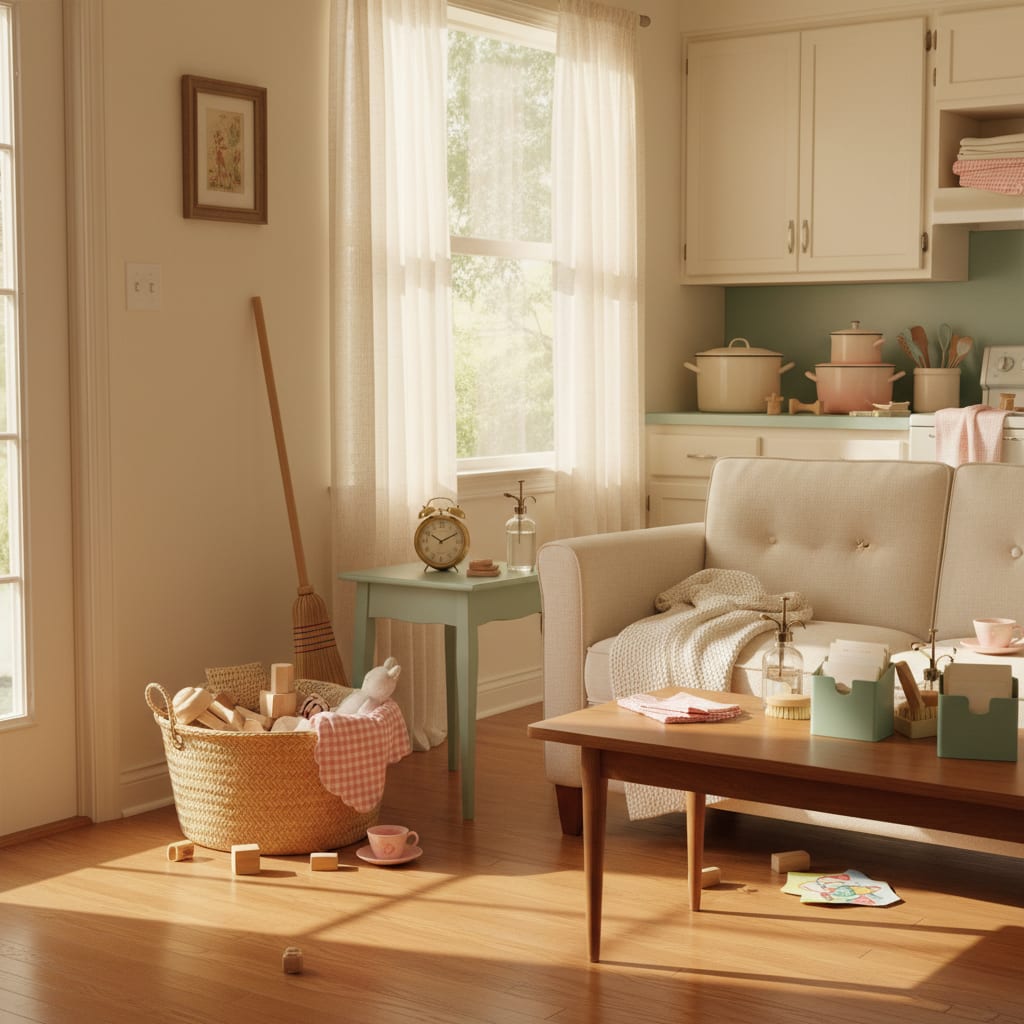
A nap is not a cleaning window. It’s a bounded window of unknown length, and that changes what you can put in it. The routine that works is: pick one room, do three passes in a fixed order — clear, wipe, reset — and choose the room by how long that child’s naps actually run. Forty minutes buys you one room’s surfaces. Ninety buys a room plus one deep task. Nothing buys you a project you can’t abandon mid-sentence. The rule that makes the whole thing work is that every job in the nap has to be safely stoppable at any second, because the nap ends when it ends and not when you’re finished.
First, find out how long the nap really is
Most nap-time cleaning advice skips the only input that matters. You cannot plan a routine around “nap time” any more than you can plan a wash day around “some laundry.” Watch the clock for a week and write down the actual number.
Once you have it, one of three things is true. If naps are consistently long, you have a genuine block and should treat it like one. If naps are consistently short — the classic thirty-to-forty-five-minute cat nap — you have a surface window, and trying to force a deep clean into it will only make you resent it. And if naps are wildly variable, the schedule is the thing to fix before the cleaning routine is, because the cause is usually timing rather than temperament. Betteroo’s rundown of what’s actually behind short naps covers the usual suspects — an overlong wake window, a room that isn’t dark enough, a nap that starts past the tired point.
My grandmother’s card file has a line for this and it’s the whole philosophy: know how long you’ve got before you start.
Match the job to the window
Three tiers. Pick the one that matches your real number, not the one you wish you had.
The 30–45 minute nap: one surface, one room. Kitchen counters or the living room floor or the bathroom. One. You clear it, wipe it, and reset it, and then you sit down. This is the tier most people underestimate, and doing one room properly beats starting four and finishing none by a distance that isn’t close.
The 60–75 minute nap: one room, full reset. Surfaces plus floor plus the put-away pass — the same shape as the ten-minute tidy in the daily cleaning routine, extended to a whole room and done properly instead of at a run.
The 90+ minute nap: one room plus one deep task. The room reset, then a single item off the rotating list — wipe the fridge shelves, the bathroom mirror and fixtures, the front of the kitchen cabinets. One deep task, chosen before you start, from the rotation in the weekly cleaning schedule.
Whatever tier you’re in, decide the room before the baby goes down. Deciding while standing in the hallway with twenty-eight minutes left is how naps get spent on deciding.
The three passes, in order
Order matters more than speed, and this order is the reason a nap-cleaned room stays clean.
Pass one: clear. Take one basket around the room and put everything that doesn’t live there into it. Don’t deliver anything yet; deliveries take you into other rooms and other rooms are where naps go to die. Clear surfaces first, then the floor.
Pass two: wipe. Top down, left to right, one cloth. Counters, table, sills, then the floor last so the crumbs you knock down get picked up rather than walked in.
Pass three: reset. Now the basket gets emptied, and the room gets put into its evening posture — cushions straight, chairs in, one thing put where the next person will need it. Reset is the pass everyone skips, and it’s the one that makes the room look done rather than merely clean.
If the nap ends during pass one, you’ve made a mess of a room. If it ends during pass three, you have a clean room and a basket to empty later. That’s why the passes are in that order.
The quiet rule
Anything loud goes in the awake half of the day. Vacuum, blender, coffee grinder, the dishwasher’s drain cycle, the door of the room next to theirs — all of it. Trading a full nap for a vacuumed rug is a bad trade, and it teaches you to resent both.
What’s actually quiet: wiping, folding, sorting, dishwashing by hand, sweeping with a soft broom, decanting, tidying. That’s a large fraction of household work, and it’s more than enough to fill any nap. Save the noisy jobs for when the baby is up and in the room with you — a toddler is a perfectly good vacuuming companion, and a baby on the floor with a wooden spoon is unbothered by machinery she can see.
The one place noise is worth managing rather than avoiding is the nursery itself: a steady sound machine like the Yogasleep Dohm masks the household better than tiptoeing does, which is one of the arguments for the layout in nursery organization.
The afternoon rest was a fixed institution — everyone lay down, the house went quiet, and the woman running it used the hour for the jobs that needed both hands and no interruptions. Mending, ironing, the accounts.
Same hour, less certainty. So we size the job to the window, keep every task abandonable, and protect a piece of the nap for sitting down — because an hour spent entirely on the house is an hour the house took twice.
Keep part of it
This is the part I’d argue hardest for. If the nap is your only reliably quiet stretch, the whole thing should not go to the house. Take the first ten minutes for coffee and the last ten for nothing at all, and give the middle to one room. A room a day for five days is a clean house by Friday, and you will still be a person on Friday.
The tell that you’ve got the balance wrong is dread. If you hear the monitor go quiet and feel a checklist rather than relief, the routine is too big for the window and it needs cutting down a tier.
When the naps themselves change
The routine that fits perfectly in September stops fitting in January, because naps consolidate as children grow — three naps become two, then two become one long afternoon block, then eventually none. Each of those shifts scrambles your window for a few weeks. If your reliable hour has suddenly gone ragged, the cause may be developmental rather than anything you did; Betteroo’s guide to how nap counts change with age lays out the usual timing so you can tell a transition from a bad week.
When you’re mid-transition, drop a tier. Go back to one surface, one room, and rebuild once the new pattern settles.

FAQ: cleaning during nap time
How much can you actually clean during one nap?
One room, done in three passes, is a realistic ceiling for a 45-to-75-minute nap. Longer naps add exactly one deep task. Attempting a whole-house sweep in a nap reliably produces four half-cleaned rooms.
Should I vacuum while the baby naps?
Generally no — trading the rest of a nap for a vacuumed floor rarely pays. Do the loud jobs while the baby is awake and with you; a running sound machine helps, but it isn’t a licence for a vacuum outside the door.
What if the nap ends halfway through?
That’s what the pass order is for. Clear, wipe, reset means every stopping point leaves the room better than it was — and the put-away basket can wait until the evening tidy without anyone tripping over it.
Is it better to clean during nap time or after bedtime?
Split them by noise. Nap time takes the quiet jobs and the room resets; after bedtime takes the vacuum, the dishwasher and anything that needs a door left open. Doing all of it after bedtime is how the evening disappears.
Next cards in the file
Nursery Organization: Set Up for the 2am You
July 17, 2026
Why Homemade Laundry Soap Can Wreck Your Wash
August 11, 2026
Furnace Replacement Week: How to Protect Bedtime
September 7, 2026