Does Laundry Detergent Expire? What Actually Changes
Yes — slowly, and not into anything hazardous. Liquid detergent holds full strength for roughly nine months to a year unopened and about six months once the cap comes off. Single-dose pods keep around fifteen months sealed, and P&G’s own guidance is to use them within six months of buying. Powder is the survivor: kept genuinely dry, it stays useful more or less indefinitely. What you lose is cleaning power and fragrance, not safety. Enzymes wind down, the mixture separates, and powder cakes into a lump.
What actually degrades in the bottle
Liquid detergent is not one substance. It is surfactants, enzymes, brighteners, fragrance and water held in a suspension that wants to come apart, and the parts age at different rates.
The enzymes go first. They are proteins, sensitive to heat and time, and they lose potency long before the bottle looks any different — which is why an old bottle still makes suds and still smells faintly of something but stops shifting the grass stains it used to. Fragrance oils evaporate next. The surfactants themselves are stable for years; separation is what beats them, and once a bottle has split into a thin layer and a thick one, a hard shake buys back most but not all of the performance.
Powder ages differently, because its enemy is moisture rather than time. Dry powder is chemically patient; powder that has spent a summer in a humid laundry room absorbs enough water to cake, and caked powder doesn’t dissolve properly in a cold or short cycle — it comes out sitting in the fabric.
Pods are the least patient of the three. The film that dissolves in the drum also responds to humidity in the tub, which is why a fused block of pods is the most common “expired detergent” anyone actually sees.
Shelf life, by type
| Product | Sealed | After opening | What goes wrong |
|---|---|---|---|
| Liquid detergent | About 9–12 months at full strength | Around 6 months | Enzymes fade, layers separate |
| Powder detergent | Effectively indefinite if dry | Indefinite if kept airtight | Clumping from humidity |
| Single-dose pods | About 15 months | Use within about 6 months of purchase | Films soften, pods fuse |
| Oxygen bleach powder | Long, if dry | Months, once opened | Loses its oxygen punch quietly |
| Homemade grated soap mix | No preservatives at all | Weeks to months | Softens, clumps, goes rancid if it holds any oil |
Most bottles carry no printed expiry date, because manufacturers don’t consider one necessary. Some carry a small open-jar symbol with a number — the “period after opening” in months, and the closest thing to a real date on the shelf.
How to tell yours is past it
Five honest signals, in the order they show up:
- It separated. A watery layer over a thick layer. Shake it hard; if it re-mixes and stays mixed, keep using it.
- It thickened or went gluey. Liquid that pours like syrup won’t dilute properly in a short cold cycle and will streak dark fabrics.
- It smells of nothing, or slightly sour. Fragrance loss alone is cosmetic. A genuinely sour or fermented smell means it’s done.
- The powder is one solid brick. Break it up and it may still work, but if it won’t crumble to loose grains, it won’t dissolve.
- The pods have fused or leaked. Never try to prise apart a fused block. Wet film plus concentrated detergent is an eye and skin irritant, and this is the one failure mode with a genuine safety edge to it.
Soap flakes in a tin on a high shelf, bought in a box and decanted the day it came home. Nothing in that laundry cupboard had a date on it, and nothing needed one — the whole shelf was dry powders and bar soap, which keep for years by their nature.
Same shelf logic, different products. Buy the size you'll finish in six months, decant powder into something airtight, and stop treating the warehouse-club drum of liquid as a bargain. It isn't, if the last third of it washes worse than the first.
Storage beats the date
Where a bottle lives determines almost everything about how long it lasts, and the average laundry room is the worst room in the house for it: warm, damp, and often with the machines throwing heat and steam all day.
Cool, dark and dry, in that order. A closet shelf on the north side of the house beats a shelf above the dryer by a wide margin, and direct sun through a laundry-room window is the fastest way to cook a bottle.
Never on a concrete floor. Concrete wicks moisture, and a cardboard box of powder standing on a basement slab draws damp up through its base. Get it onto a shelf or a board.
Lids fully closed, every time. The half-turned cap is what puts the six-month clock on liquid.
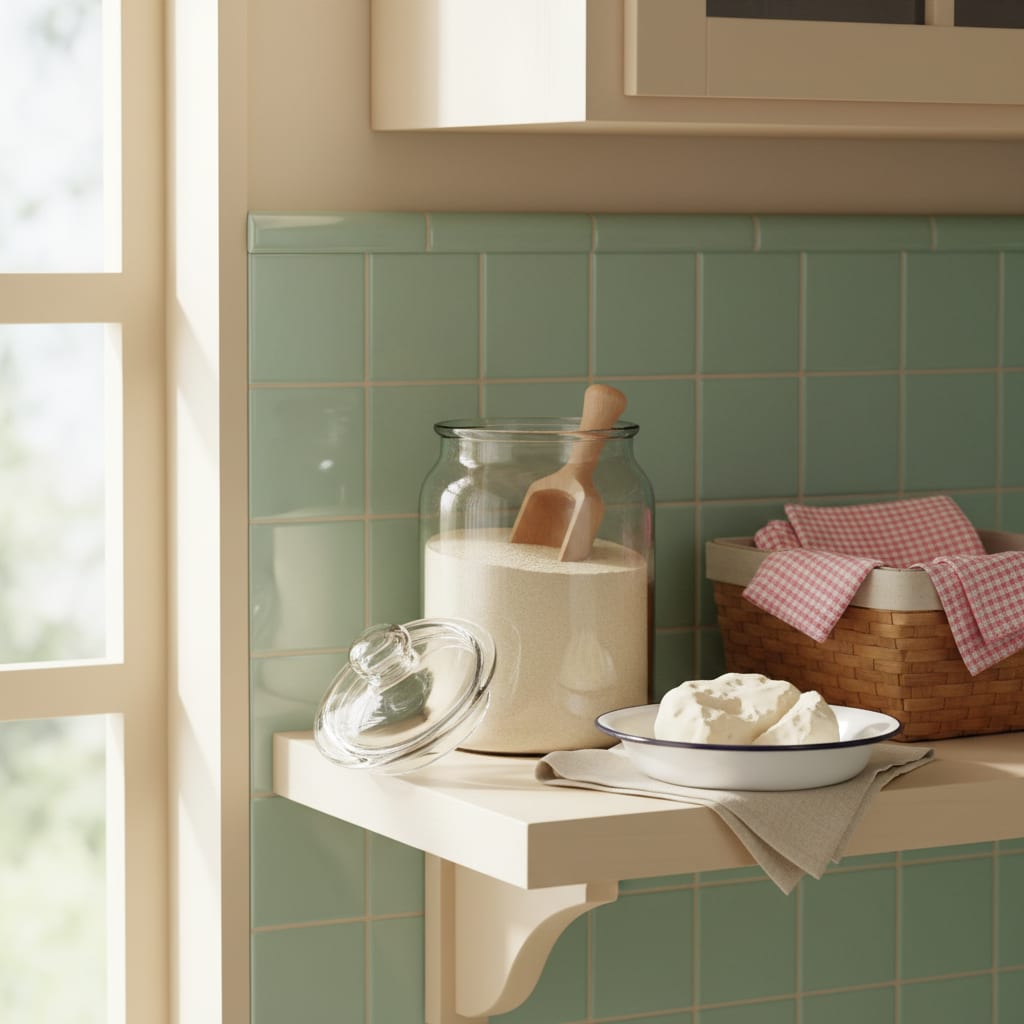
Decant the powder. This is the one genuinely worthwhile purchase in the whole subject: a wide airtight canister with a real seal, such as an OXO POP container, holds a standard box of powder and ends the clumping question permanently. A scoop lives inside it and the box goes in the recycling.
Pods in their own tub, latched, out of reach. The child-resistant tub is not optional storage — it’s what makes pods safe to keep in a house with children, and decanting them into a pretty jar defeats both the safety catch and the humidity seal.
What to do with a bottle that’s gone weak
Don’t compensate by doubling the dose. Faded detergent that’s overdosed still doesn’t clean better, and now it also leaves residue — the same trap set out in how much laundry detergent to use, where too much is a far more common fault in this house than too little.
Instead, retire it downward. Weak liquid still works as a pre-treat for collars and cuffs, where it sits on a stain rather than diluting into thirty gallons of water; it works in a bucket for rags and cleaning cloths, and in the mop water on a hard floor. Caked powder that still crumbles can be dissolved in hot water and poured into the drum as liquid, which sidesteps the problem entirely.
If the bottle is genuinely sour, pour it out. Detergent goes down a household drain with running water, and the empty container is usually recyclable once it’s rinsed.
The homemade exception
Anything mixed at home has no preservative system, which shortens the calendar. A grated-soap powder made in a batch big enough to last a year will be softening and clumping by month three, and any recipe including a liquid oil can go rancid. Mix small, store airtight, and read the honest version of the homemade recipe before committing to a five-gallon bucket.
The related failure is worth separating out: homemade soap that leaves fabric stiff and grey is not expired, it’s behaving exactly as soap behaves in hard water, and that’s a different problem with a different fix — set out in why homemade laundry soap can wreck your wash.
FAQ: detergent shelf life
Is it safe to use expired laundry detergent?
Yes. Detergent doesn’t become hazardous with age — it becomes weaker. The only real caution is a block of fused pods, which should go in the trash rather than be pulled apart by hand.
How long does laundry detergent last once opened?
Liquid: about six months at full strength. Powder: indefinitely, provided it stays dry and airtight. Pods: use them within about six months of buying, and keep the tub latched.
Does powdered laundry detergent go bad?
Not really, as long as no moisture reaches it. Clumped powder is damp powder — break it up, dissolve it in hot water before adding it to the drum, and store what’s left in an airtight canister.
Why does my detergent look separated?
Liquid detergent is a suspension, and suspensions settle. Shake the bottle hard and check whether it stays mixed. If it re-separates within a day or pours like syrup, it’s past its useful life.
Where should laundry detergent be stored?
Cool, dark, dry and off the floor — a hall closet shelf beats the shelf over the dryer. Heat, sunlight and laundry-room humidity all shorten its life faster than the calendar does.