Homemade Laundry Detergent: The Recipe, Honestly
The classic homemade laundry detergent is one grated bar of laundry soap, one cup of washing soda and one cup of borax, mixed dry and used at roughly one to two tablespoons a load. That’s the whole recipe, and it has been passed around kitchens since long before it was passed around the internet. It genuinely cleans lightly soiled clothes, it costs less per load than most name brands, and it is also — honestly — soap rather than detergent, which is the source of every complaint people have about it. Here’s how to make it properly, and exactly where it stops working.
What’s actually in the recipe
Three ingredients, doing three different jobs.
- Grated bar soap is the cleaning agent. Traditional choices are a laundry bar like Fels-Naptha or Zote, or a pure castile bar if you want it plainer; castile has a whole house’s worth of other uses too.
- Washing soda (sodium carbonate) is the builder. It raises the water’s pH and softens the water so the soap can work instead of reacting with minerals. Arm & Hammer’s Super Washing Soda is the box in every grocery aisle. It is not the same thing as baking soda, and swapping one for the other is the most common reason a batch underperforms.
- Borax (sodium tetraborate) is a second builder and a mild whitener and deodorizer. A single box of 20 Mule Team lasts most households a long time.
Some versions add oxygen bleach for whites, or a cup of baking soda for smell. Neither is essential and both change the dose, so make the plain version first.
Making it, step by step
Give it twenty minutes and do it somewhere ventilated — grated soap throws a fine dust that catches the back of the throat.
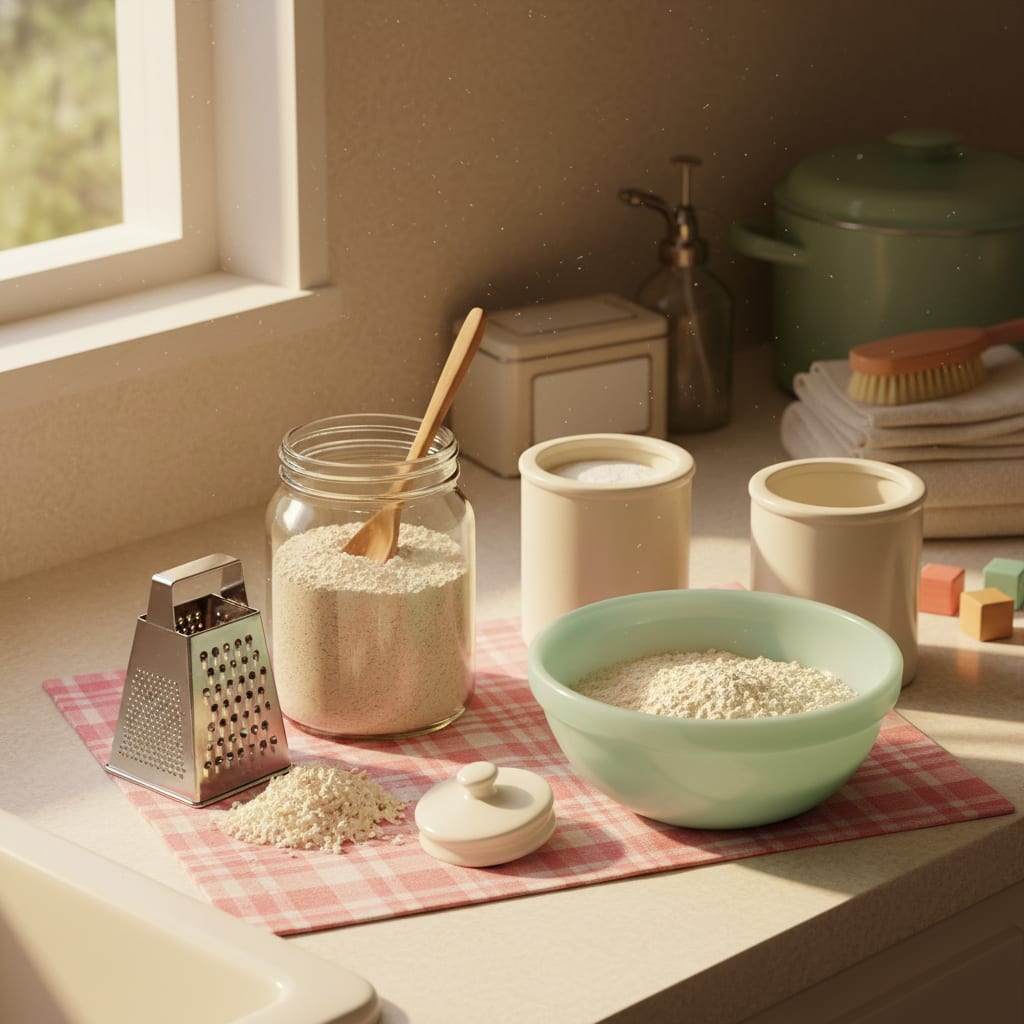
- Grate one bar of soap on the fine side of a box grater, or in a food processor kept for household jobs. Finer is better: coarse shreds don’t dissolve in a cold wash and end up as specks on dark clothes.
- Dry the shreds for a day on a tray if the bar was soft. A slightly stale, dried-out bar grates and stores far better than a fresh one — the old trick was to leave a bar unwrapped in the cupboard for a few weeks before using it.
- Mix in one cup of washing soda and one cup of borax in a large bowl, stirring until the color is even.
- Store it in a lidded jar with a tablespoon measure inside. Laundry rooms are humid, and an open container clumps within a month.
Wear gloves if your hands are sensitive — washing soda is alkaline and borax is an irritant. Both carry standard household-product label directions: keep them out of reach of children, and wash your hands after handling. Follow the box, and treat the mixture as you would any other cleaning product rather than as something food-safe because it looks like it.
How much to use, and how to use it
One to two tablespoons a load. It looks absurdly little next to a detergent cap, and that’s the point: builders and soap in a soft-water wash do not need volume, and overdosing this mixture leaves residue faster than any commercial product will.
Dissolve it first. Powdered soap needs help in anything below warm, so put the tablespoon in the empty drum and start the water before the clothes go in, or stir it into a mug of hot water and pour that in. In a front-loader it goes into the drum, never the drawer — it will cake there.
Add half a cup of white vinegar to the rinse and the difference is noticeable, because the acid neutralizes leftover alkalinity and helps rinse the soap out. The dose and the caveats live in how much vinegar to add to laundry.
Soap, washing soda and a wringer washer full of hot rainwater — which is soft, free and exactly what soap wants. The recipe wasn't thrift so much as chemistry that suited the water coming out of the sky.
Same three ingredients, harder water and a cold-wash machine that rinses on a budget. So we make it, use it on the light loads, and keep a bottle of ordinary detergent for towels and the truly filthy. The card file gets an asterisk, not a rewrite.
Where it works and where it doesn’t
Be clear about what you’ve made: this is soap plus water softeners, not detergent. Detergent is built from synthetic surfactants that stay dissolved and rinse out of fabric even in hard, cold water. Soap doesn’t. When soap meets the calcium and magnesium in hard water it forms an insoluble curd — the same grey ring a bathtub gets — and that curd lands in the fibres.
So the recipe performs well when the conditions suit it: soft or softened water, warm or hot washes, lightly soiled everyday clothes, and a machine that uses plenty of water. It performs badly in hard water, in cold-only washes, on greasy or body-oil-heavy loads like gym clothes, and in high-efficiency machines that rinse with very little water.
That’s not a small footnote, and the failure mode is cumulative rather than immediate — clothes come out fine for two months and then start to feel stiff and smell faintly off when they get damp. The full account of that problem, including what manufacturers say about their machines, is in why homemade laundry soap can wreck your wash. Read it before you commit the whole household.
The middle path most people land on
If your water is hard or your machine is a high-efficiency front-loader, there’s a compromise that keeps most of the savings and none of the residue: skip the soap, keep the builders. A tablespoon of washing soda added to a normal dose of ordinary detergent softens the water, boosts cleaning noticeably in hard-water areas, and lets you use less detergent overall. Borax does similar work on whites and smells.
Then keep the homemade jar for the loads it’s good at — everyday shirts, kids’ clothes without much grease, pillowcases, cotton napkins — and let the bottle handle towels, bedding and sports kit. That split is honest, it’s cheap, and it’s how the recipe survives in a modern house instead of quietly ruining the towels. It’s the same principle behind the homemade all-purpose cleaner: make the thing that’s genuinely better made at home, buy the thing that isn’t.
FAQ: homemade laundry detergent
What is the basic homemade laundry detergent recipe?
One grated bar of laundry soap, one cup of washing soda and one cup of borax, mixed dry. Use one to two tablespoons per load, dissolved in the drum rather than added to a dispenser drawer.
Can I use homemade laundry detergent in an HE washer?
Cautiously, and many manufacturers advise against anything that isn’t HE detergent. Homemade soap suds more and rinses less well in the small amount of water an HE machine uses, so residue builds faster. Check your manual first.
Can I use baking soda instead of washing soda?
No. They’re different compounds — washing soda is far more alkaline and does the water-softening work. Baking soda is a mild deodorizer and a gentle abrasive, not a substitute builder.
How long does homemade laundry detergent keep?
Indefinitely if it stays dry, which in a humid laundry room means a lidded jar rather than a bucket. If it has clumped hard, break it up and it still works — the ingredients don’t spoil.