How Much Vinegar to Add to Laundry (and When Not To)
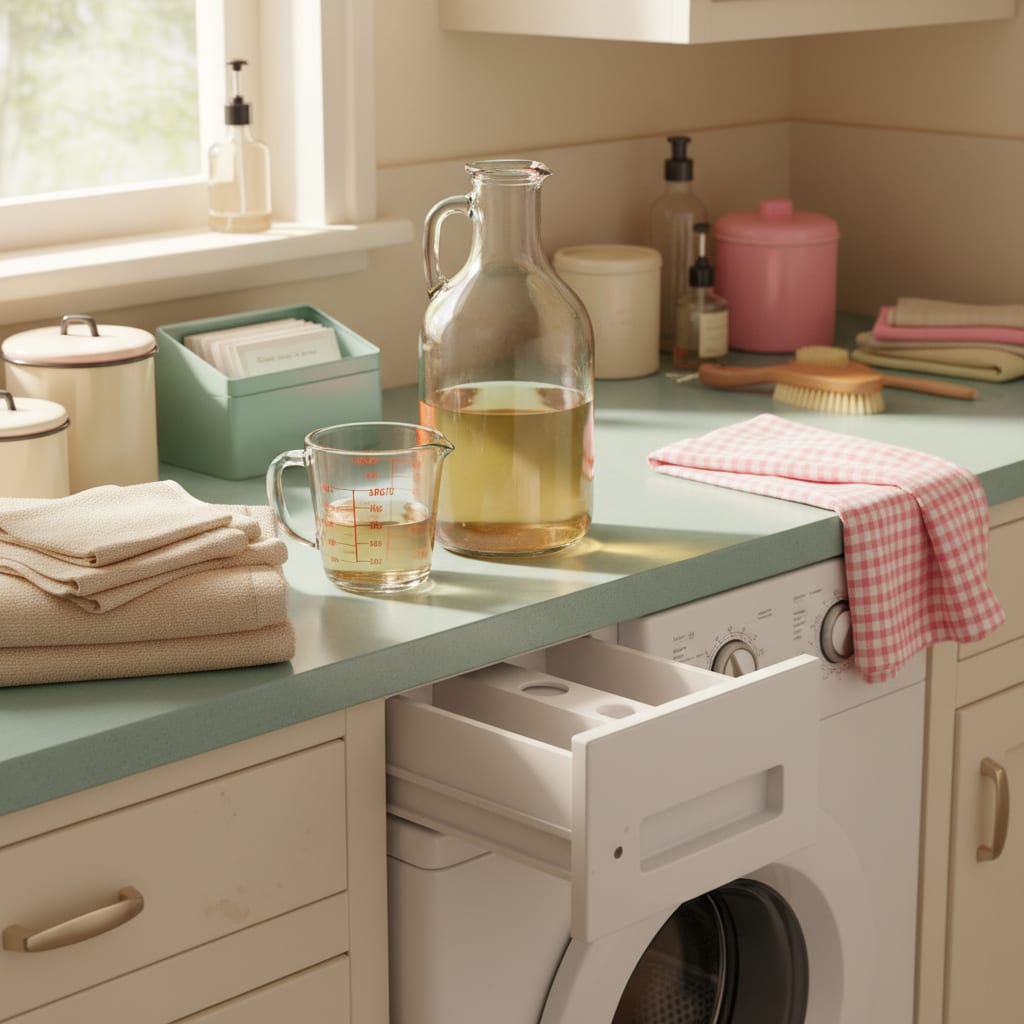
Half a cup of plain white vinegar in the rinse handles a normal load. Use a full cup for towels, bedding or anything that has gone sour, and a cup or two in a tub soak for laundry that needs rescuing. It goes in the fabric-softener compartment or into the drum at the start of the rinse — never in with the detergent, where the acid and the alkali cancel each other out and you get the benefit of neither. And it never, under any circumstances, shares a machine or a cycle with chlorine bleach.
The dose, by job
| Load | Vinegar | Where |
|---|---|---|
| Everyday clothes | ½ cup | Softener compartment |
| Towels, bedding, sports kit | 1 cup | Softener compartment |
| Musty or sour laundry | 1 cup, plus a second rinse | Softener compartment |
| Tub or bucket soak | 1–2 cups in warm water | Straight into the water |
| Stiff, over-detergented towels | 1 cup, no detergent at all | Softener compartment |
More is not better. Past about a cup you’re mostly rinsing money down the drain, and regular heavy doses are harder on the rubber parts of the machine than the job justifies.
Where it goes, and why the timing matters
The fabric-softener compartment is the right home for it, because that compartment is designed to hold its contents back until the rinse. That’s exactly when you want an acid: after the alkaline detergent has done its work, to neutralize what’s left and help it rinse clear.
Put vinegar in with the detergent and the two neutralize on contact. Detergents are formulated alkaline on purpose; drop the pH at the start of the wash and you’ve quietly reduced the cleaning power you paid for. If your machine has no softener compartment, wait for the rinse to start and pour it into the drum by hand — awkward but effective.
What vinegar actually does in a wash
Three things, reliably:
- It removes detergent residue. This is the big one. Most fabric that feels stiff or scratchy is carrying leftover detergent and softener, and an acid rinse strips it. Towels that have stopped absorbing often come back after two or three vinegar rinses with no detergent at all.
- It softens without coating. Commercial softener works by depositing a waxy film on the fibres, which is why it eventually ruins towel absorbency and gums up machines. Vinegar softens by removing residue instead of adding any.
- It cuts musty smells. Damp-forgotten loads and gym clothes respond to a full cup and a longer soak. It’s not a disinfectant — for laundry that genuinely needs sanitizing, use hot water and a laundry sanitizer per its label.
Two things it does not do, despite the folklore: it will not set dye in modern fabrics in any dependable way, and it will not whiten. Greying whites are a residue-and-redeposition problem, and vinegar helps only inasmuch as it clears residue.
A splash of vinegar in the rinse water, every wash day, no measuring. Cheap, on the shelf already, and doing real work in an era when soap left plenty behind to rinse out.
Measured, and not every load. Half a cup in the towel rinse and the sports-kit rinse, skipped on ordinary clothes washed with a sensible dose of detergent — because if there's no residue, there's nothing for the vinegar to do.
When to leave it in the cupboard
Never with bleach. Mixing vinegar with chlorine bleach releases chlorine gas. This is a genuine hazard, not a cautious internet warning, and it applies to sequential loads too — don’t run a bleach cycle and a vinegar cycle back to back without a plain rinse between them.
Not as a detergent substitute. Vinegar doesn’t lift soil. A load washed in vinegar alone comes out wet and no cleaner.
Not every wash, if your manual says so. Some manufacturers advise against routine vinegar because repeated acid exposure over years is hard on rubber seals and hoses; others are relaxed about it. Check the care section of your own manual, and if it warns you off, use it in a bucket soak rather than in the machine. The same caution and the full surface list are in cleaning with vinegar, which is worth reading before you let it loose on the rest of the house.
Not on wool or silk without care. A very dilute acid rinse suits protein fibres, but full-strength vinegar poured onto a wool sweater is not a gentle treatment. Dilute it in the water first.
Not with hydrogen peroxide in the same bottle. Used one after another with a rinse between, they’re fine. Combined and stored, they make an irritant.
White vinegar or cleaning vinegar?
Plain distilled white vinegar is what the laundry jobs want. Cleaning vinegar is modestly more acidic, which buys you a little more on scale and nothing meaningful in a rinse. Apple cider vinegar is a poor choice for laundry — it’s darker, and on pale fabrics it can tint.
Buy it by the gallon in the grocery aisle rather than the cleaning aisle. It’s the same liquid at a better price.
Where it fits in the rest of the laundry
Vinegar is a rinse aid, not a system. It earns its place in two fixed slots here: the towel load, and any load that came out of a machine or a hamper smelling wrong. If you’re finding you need it every single wash, the real problem is upstream — usually too much detergent, sometimes a machine that needs a hot empty cycle and a filter clean, and occasionally soap residue from a homemade mixture, which is a slower and more stubborn problem than plain over-dosing. That distinction matters, and it’s laid out in why homemade laundry soap can wreck your wash.
Vinegar also earns a permanent role alongside a from-scratch wash: if you use the homemade laundry recipe, the vinegar rinse isn’t optional, it’s the step that keeps the soap from staying in the fabric.
FAQ: vinegar in laundry
How much vinegar do you put in a load of laundry?
Half a cup of plain white vinegar in the rinse for an ordinary load, a full cup for towels, bedding or sour-smelling laundry. Add it to the fabric-softener compartment, not the detergent drawer.
Can you put vinegar and laundry detergent in together?
No — they neutralize each other. Detergent works in the wash, vinegar works in the rinse. Adding both at the start weakens the wash and wastes the vinegar.
Will vinegar make my laundry smell like vinegar?
No. The smell is noticeable while the machine runs and gone once the fabric dries. If clothes still smell of vinegar when dry, the dose was too high or the rinse was too short.
Is vinegar safe for front-loading washing machines?
Occasional use is generally fine; heavy weekly use is what raises concerns about rubber seals and hoses. Check your manual, and if it advises against vinegar, do the soaking in a bucket instead.
Next cards in the file

Nursery Organization: Set Up for the 2am You
July 17, 2026

How to Sleep in a Heatwave With No Air Conditioning
August 15, 2026

Bedtime Routine Too Long? Trim a 90-Minute Wind-Down
August 7, 2026