Why Homemade Laundry Soap Can Wreck Your Wash
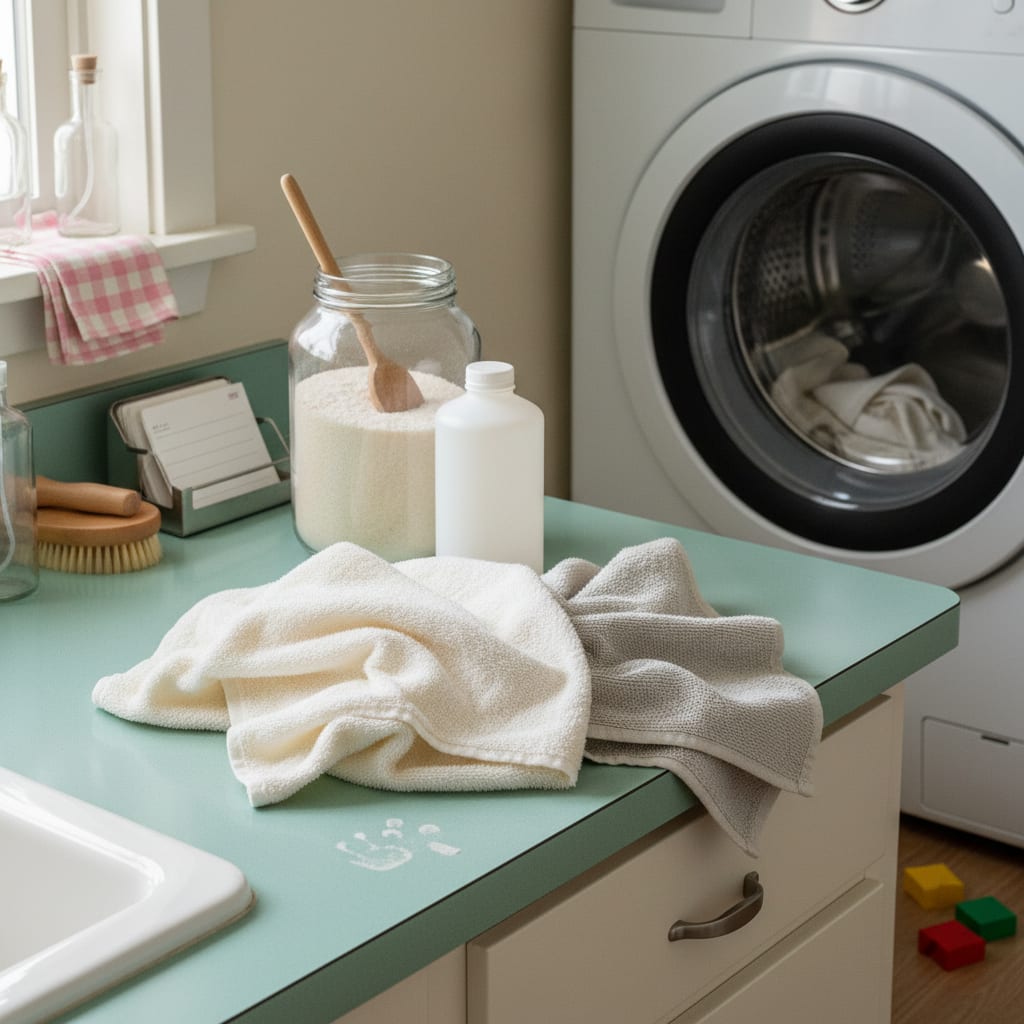
Homemade laundry soap causes trouble for one reason: it is soap, and soap reacts with the minerals in hard water to form an insoluble curd that stays in fabric and in the machine. Detergent doesn’t do that, which is why it replaced soap in the first place. The damage is slow — towels stiffen, whites go grey, clothes smell fine dry and sour when damp, and the machine starts to smell — so most people don’t connect the effect to the cause for months. This is the honest version, written by someone whose card file is otherwise full of old methods.
Soap and detergent are not the same product
Soap is made by combining fat with an alkali. Detergent is built from synthetic surfactants. Both lift dirt, but they behave completely differently in the presence of the calcium and magnesium that make water “hard.”
Soap reacts with those minerals and produces an insoluble compound — the grey ring around a bathtub is exactly this. Once formed, it isn’t dissolved by more water, and in a washing machine there’s nowhere for it to go except into the fabric and onto the drum. Detergent surfactants are far less bothered by hardness, which is precisely the problem they were invented to solve, and they keep loosened soil suspended in the water so it drains away rather than redepositing.
Most homemade “detergent” recipes are grated bar soap plus washing soda and borax. The washing soda and borax are builders — they soften the water and raise the pH, which helps, and in soft water it helps enough that the recipe works. What they can’t do is turn soap into a surfactant.
What the residue does to your laundry
The complaints are consistent enough that you can almost diagnose the cause from the list.
- Towels stop absorbing. A film of soap curd is water-repellent. Towels feel stiff, then feel like they’re pushing water around instead of soaking it up.
- Whites and light colors go dull grey. Redeposited soil bound in curd doesn’t rinse; it accumulates evenly across everything.
- Clothes smell musty when damp. They pass the sniff test out of the dryer and smell distinctly off in a warm car or after a workout, because the residue holds onto body oils that never rinsed away.
- Fabric feels waxy or stiff, especially on synthetics and anything technical. Sportswear is the first casualty; its whole design assumes soil gets carried off in the rinse.
- Colors dull faster. Repeated high-pH washing is hard on some dyes and on wool and silk in particular, which is why those fibres want a neutral or acidic wash.
None of this happens in week one. It compounds, which is why the recipe reviews so well in its first month and so badly in its sixth.
What it does to the machine
The same curd films the drum, the door gasket, the dispenser and the drain pump filter. That’s the layer bacteria live in, and it’s the usual answer to “why does my washer smell when I clean it constantly.”
There’s a second issue in high-efficiency machines. HE cycles use a small amount of water and rely on detergent that suds very little, so the rinse actually rinses. Soap-based mixtures suds more, and excess suds cushion the clothes away from the mechanical action, extend the cycle while the machine tries to rinse them out, and leave more behind each time.
Soap worked because the water suited it — rainwater from the barrel, softened with washing soda, heated to properly hot, in a machine that used as much water as it liked and rinsed twice.
Municipal hard water, cold cycles and a machine designed around a rinse budget. The method didn't get worse; the conditions it depended on disappeared. That's worth saying plainly rather than pretending the old card still applies.
What the manufacturers say
This part isn’t folklore, and it’s worth reading before you commit. Whirlpool’s own guidance on HE detergent use in a washer states that using non-HE detergent, or more than the recommended amount, can lengthen the wash cycle, affect cleaning performance, and produce excess suds that lead to leaking, draining problems and poor rinsing. Most major manufacturers publish some version of the same instruction, and homemade soap mixtures are not HE-formulated by any definition.
The warranty question comes up a lot and deserves a careful answer rather than a scary one: manuals generally exclude damage caused by improper use or by products the manual tells you not to use, so a residue-related fault is a plausible thing for a service technician to attribute to what you’ve been washing with. Read your own manual’s care section — it’s a five-minute job and it settles the question for your specific machine.
When homemade soap is genuinely fine
This isn’t a blanket prohibition, and the site’s whole premise is testing old methods rather than dismissing them. Homemade soap holds up when the conditions it was designed for still exist:
- Soft water, naturally soft or from a whole-house softener.
- Warm or hot washes rather than cold-only.
- An older top-loader that fills generously and rinses in plenty of water.
- Lightly soiled cotton — everyday clothes, napkins, pillowcases — rather than towels, sportswear or work clothes.
- A vinegar rinse every time, which neutralizes alkalinity and helps carry soap out of the fabric.
If that describes your house, the homemade recipe and the correct dose are worth having. If it doesn’t, use the builders without the soap: a spoonful of washing soda alongside a normal detergent gets you most of the benefit and none of the curd.
How to undo it
If you’ve been using it a while, fix the fabric and the machine in that order, because a clean machine will just re-coat clothes that are still full of residue.
Strip the laundry. A long hot soak with washing soda, borax and a little detergent pulls out accumulated residue, and towels are the load to start with — the method and its honest limits are in laundry stripping. Expect grey water and expect to be slightly appalled.
Then clean the machine. A hot empty cycle plus the gasket, the dispenser and the drain pump filter, as in cleaning a washing machine. For a machine with real buildup, a slow-dissolving tablet cleaner such as Affresh run twice in a row does more than a vinegar cycle alone.
Then change what goes in. Ordinary detergent at a modest dose, one hot load a week, and a vinegar rinse where it helps — the dose is in how much vinegar to add to laundry. Give it three or four washes before you judge the towels; they recover, but not instantly.
FAQ: homemade laundry soap
Is homemade laundry soap actually bad for clothes?
In hard water or cold washes, yes — soap combines with minerals into a residue that stays in the fabric, stiffens towels, dulls whites and traps odor. In soft water with warm washes it performs reasonably well.
Does homemade laundry detergent ruin washing machines?
It doesn’t destroy them, but it films the drum, gasket and pump filter, which causes smells and drainage complaints, and it works against the low-suds rinse an HE machine depends on.
How do I know if soap residue is the problem?
Three signs together: towels that have stopped absorbing, clothes that smell musty only when damp, and a machine that smells within days of being cleaned. A strip wash that turns the water grey confirms it.
Is borax or washing soda the problem?
Neither. Both are builders that soften water and help cleaning; the grated bar soap is the ingredient that reacts with hard water. Keeping the builders and dropping the soap is the simplest fix.
Next cards in the file
Nursery Organization: Set Up for the 2am You
July 17, 2026
How to Wash Pillows (Down, Fiber and Foam)
October 11, 2026
How to Get Candle Wax Out of Fabric and Tablecloths
October 11, 2026