Line Drying Clothes: How to Hang, Dry and Save
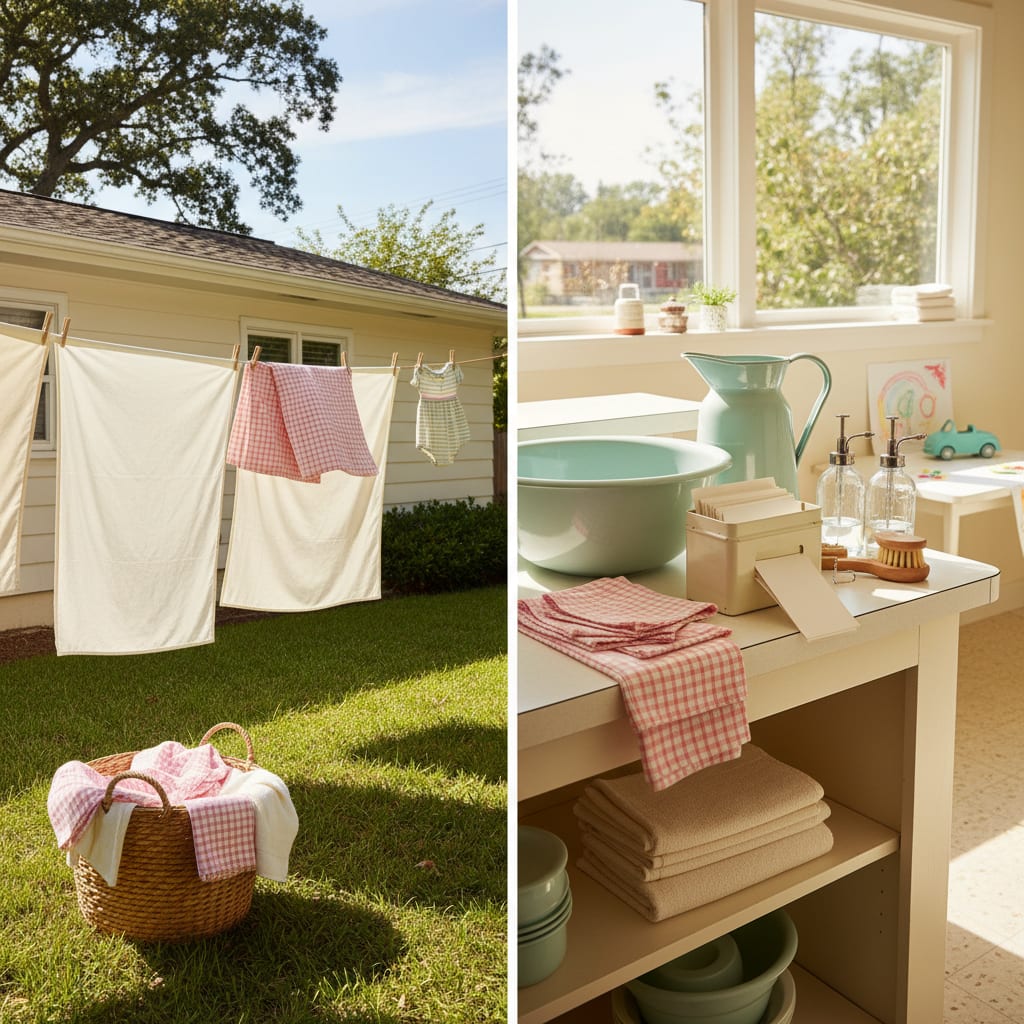
Line drying clothes means hanging a washed load on an outdoor line, a rotary airer or an indoor rack and letting moving air do the work a dryer does with heat. Budget ten to fifteen minutes of hanging per load and two hours to a full day of drying, depending more on wind than temperature. The method is what separates a good result from a stiff one: hang each item by the part that can carry its own wet weight, leave a hand’s width between pieces so air moves, and finish towels with a short tumble. Everything below is that method, garment by garment.
What line drying saves
Two things, one bigger than people expect.
Energy. A tumble dryer runs a heating element for the better part of an hour, several times a week, which puts it alongside the water heater and the fridge rather than down among the small appliances. Hang half your loads and the saving is genuine, though the figure depends on your rates and your machine.
Clothing life. The lint trap fills with fiber that used to be your towels and shirts — that is what tumbling does. Heat also cooks elastic, so waistbands and swim fabric fail earlier in a dryer. Air drying is the cheapest garment care there is.
Two smaller gains: sunlight bleaches organic stains on whites for free — the rescue for a faintly yellow bib — and hung clothes carry fewer set wrinkles than a load that cooled in the dryer.
How to hang each thing
Shake every item out before it goes up — one sharp snap opens the weave and removes most of the wrinkles you would otherwise iron. Then hang by weight-bearing seams.
| Item | How to hang it | Rough drying time |
|---|---|---|
| Sheets and duvet covers | Over the line doubled, hem to hem, so a long U hangs down both sides | 2–4 hours in wind |
| T-shirts and tops | On a hanger by the shoulders, or pegged at the hem so pegs don’t dimple the shoulder line | 2–3 hours |
| Jeans and heavy cotton | By the waistband, pockets pulled out, legs apart | 4 hours to all day |
| Socks and small items | Pegged in pairs along the line’s end, or on a rack — smallest things where the wind hits hardest | 1–2 hours |
| Knitwear and anything stretchy | Flat on a rack, never hanging, or a sleeve gains two inches | Overnight |
| Dark clothes | Inside out, in shade — the UV that bleaches stains also fades dye | 2–3 hours |
| Baby clothes, muslins, cloth diapers | Full sun, right side out, hung open rather than folded over | 2–3 hours |
The spacing rule does more than any of it: garments that touch dry at the speed of the slowest one, and a crowded rack takes days and smells musty. If the line is short, hang half a load and swap — two fast rounds beat one slow one.
Better in the dryer: towels without the finishing tumble below, anything needed within the hour, and filthy kid laundry in winter.
What it actually costs
Time. Ten to fifteen minutes per load, hanging and taking down. On a wash day where four loads relay through, that is an hour outside — pleasant in June, a different proposition in February.
Scheduling. Line drying doesn’t relay. The dryer takes a load an hour; a line holds a load until it’s dry, which might be all day. That is a real constraint on a one-day wash, and an honest argument for the load-a-day rhythm compared in laundry schedule.
Weather and pollen. Rain is the obvious one. The less obvious one: line-dried bedding collects pollen in spring, which is why plenty of allergic households hang indoors from March.
The crunchy-towel fix
Towels go stiff on the line because there’s no tumbling to break the fibers apart as the water leaves, and hard-water minerals make it worse. Three fixes, in order of effectiveness:
- Tumble for ten minutes at the end. Line dry until nearly dry, then give the load a short low-heat tumble. You keep almost all the saving and get soft towels — the single best answer, and almost nobody does it.
- Snap each towel hard before hanging. A sharp shake separates the loops. It genuinely helps and costs nothing.
- Half a cup of white vinegar in the rinse. It cuts the detergent residue that is a large part of stiffness — the logic behind the deep soak in laundry stripping. Never in the same load as chlorine bleach.
Towels that feel waxy rather than stiff are a buildup problem, not a line problem, and no drying method fixes that.
The line was not a choice. Wash day ended with a yard full of sheets, pegs held in an apron pocket, and a permanent weather eye — the whole day's schedule bent around whether it would hold dry until four o'clock.
The line is a choice now, so we use it where it pays: sheets, jeans, anything with elastic, anything white and stained. Towels and Tuesday emergencies go in the dryer without guilt, and a rack in the laundry room covers February.
Indoor and winter drying, without the damp
Indoor drying is where line drying goes wrong. A full load releases a couple of liters of water into the house, and if it has nowhere to go it lands on cold walls and windows — which is how airing clothes indoors builds a mold problem in an unventilated room.
The rules are simple: one room, door shut, window cracked or an extractor fan or dehumidifier running. Never drape laundry over radiators — it blocks the heat, raises humidity fastest and is the classic route to damp.
Winter outdoors still works, and it is the part people give up on too early. A cold dry breezy day beats a warm still one, because wind carries moisture away and stillness does not. Below freezing, washing goes stiff as a board and then finishes by sublimation — slow, but it happens, and it comes in smelling extraordinary. The honest winter answer in most houses is a hybrid: outside until the load stops dripping, inside on a rack to finish.
A plain accordion rack does the job — the Household Essentials wooden folding rack is the standard version and folds flat behind a door, which matters more than capacity if you’re short on floor. A retractable line strung across a laundry room or over a bath works even better in a small house, because it disappears when it’s not in use.
The verdict, load by load
Run it as a rule rather than an ideology: bedding and jeans on the line when the weather allows, anything with elastic on the line always, stained whites out in the sun, towels through the dryer or finished with a short tumble — and the whole system suspended without guilt in a week when nobody has time to stand in a yard. Everything that comes off the line still goes away the same day, bundled by set with the folded-sets trick; a line-dried sheet left in a basket wrinkles exactly like a tumble-dried one.
FAQ: line drying clothes
How do you line dry clothes properly?
Shake each item out, hang it by a weight-bearing edge — shoulders or hem for tops, waistband for trousers, doubled over the line for sheets — and leave roughly a hand’s width between pieces so air can move. Small items go where the wind is strongest, knitwear goes flat on a rack.
Does line drying really save money?
Yes, though how much depends on your electricity rate and how many loads you shift. The dryer is among the bigger electricity users in a typical home, so moving even half your loads to a line is a noticeable, ongoing saving.
Why are my line-dried towels stiff?
Because nothing tumbles the fibers apart as the water evaporates, and detergent or mineral residue stiffens them further. Snap each towel before hanging, cut back on detergent, and finish the load with a ten-minute low-heat tumble.
Is it bad to dry clothes indoors?
Only if the moisture has nowhere to go. Dry in one ventilated room with the door closed, use an extractor fan or dehumidifier, space the garments, and never drape wet laundry over radiators.
How long does it take clothes to dry on a line?
About two hours on a warm breezy day, a full day in still weather. Wind matters more than temperature, and jeans and towels always take longest.
Next cards in the file
Nursery Organization: Set Up for the 2am You
July 17, 2026
The Seasonal Cleaning Checklist (Four Small Lists)
August 3, 2026

Child Snores and Keeps Their Sibling Awake? Room Fixes
September 3, 2026