Bring Back Wash Day: One-Day Laundry for Modern Machines
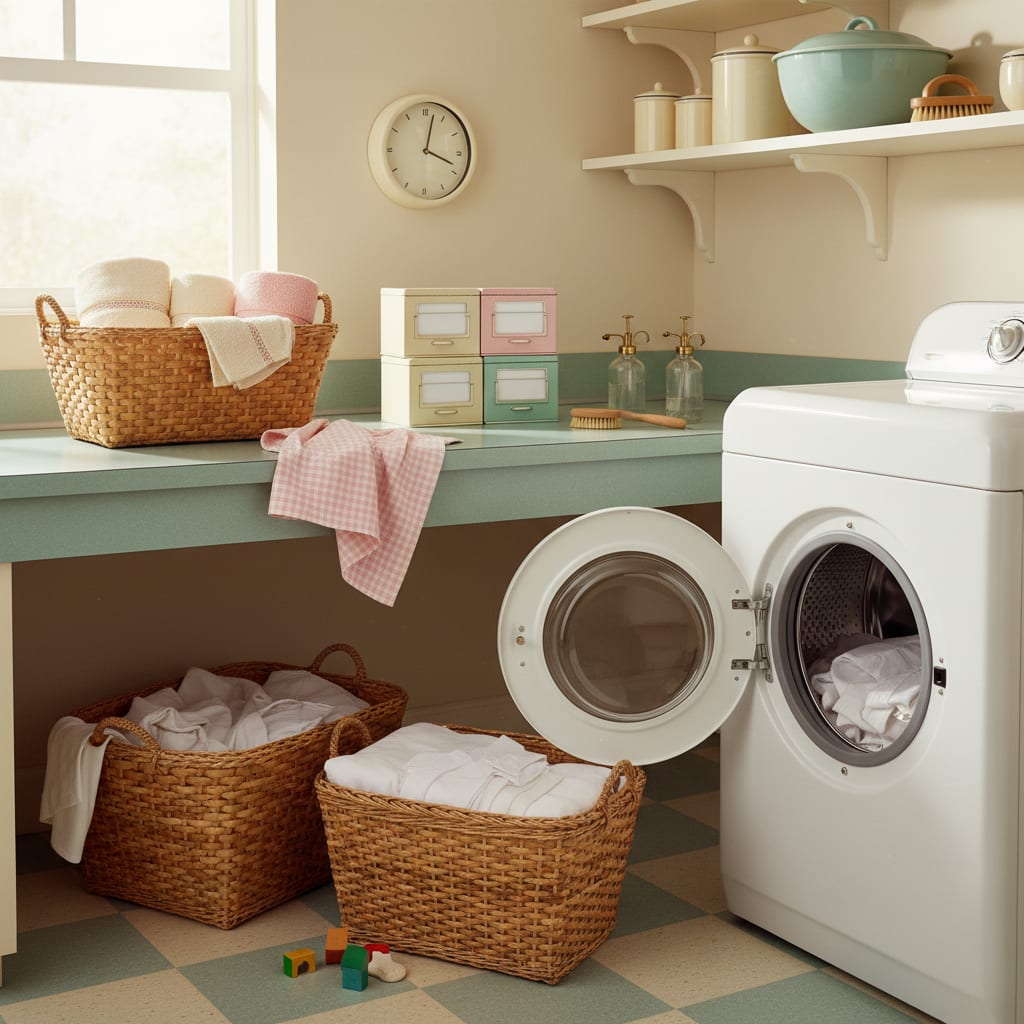
A wash day is all the household laundry — washed, dried, folded and put away — inside one day, and it still works on modern machines as long as you do the arithmetic first. Count your weekly loads, multiply by your machine’s real cycle time, and see whether the day holds. Four or five loads relay comfortably between breakfast and dinner. Eight do not. This post is the execution guide: the sort that happens the night before, the relay that keeps both machines fed, the fold-warm rule that deletes the ironing day, and the honest list of households where the one-day rhythm is the wrong choice. If you’re still deciding between wash day and a load a day, the laundry schedule post compares the two systems first.
Why it was Monday, and why that part doesn’t matter
Wash day was Monday because laundry was a production run. Water had to be hauled and heated, clothes boiled, wrung, rinsed, wrung again, hung. Nobody did that twice a week if they could help it, so it was batched — and batched at the start of the week, when Sunday’s linens had just come off the beds.
Every one of those reasons is gone. What survived is the benefit of batching, which was never really about the water: laundry occupies one day and releases the other six. There is no hamper guilt on Thursday. There is no half-finished load souring in the drum on a Saturday. My grandmother’s card for Monday is four words long, and the fourth word is the whole system — wash, dry, fold, away.
The arithmetic: does your week fit in a day?
Do this before you commit to anything. Three numbers:
- Your real weekly load count. Not your estimate — count for one week. Most families of four land somewhere around five to eight loads including towels and bedding; a baby, a potty-trainer or a sports kid pushes it up.
- Your machine’s actual cycle time. Read the display, not the manual. Modern high-efficiency washers are slow by design — a normal cycle often runs well over an hour, and heavy or sanitize cycles longer.
- Your dryer’s real cycle time. Usually longer than the wash, especially for towels.
Then: the dryer is your bottleneck, not the washer. Your day’s capacity is roughly hours available ÷ dryer cycle time. Nine hours and a 70-minute dryer gives you about seven loads — on paper. In a house with children, halve nothing but assume two interruptions per load, and plan for five.
If your week doesn’t fit, you have three moves: shift towels and bedding to their own mid-week mini-day, add a drying rack to take the delicates and shirts out of the dryer queue, or go to a load a day and keep reading anyway, because the rules below apply to both.
The night before: the sort is the setup
Wash day fails in the morning if the sorting happens in the morning. The night before takes ten minutes:
- Sort into finished loads, not piles. Ours: darks, lights, towels-and-linens, and kid-grade filthy. A three-bag sorter does this passively all week — the Household Essentials sorter with the woodgrain top is the workhorse version, and any laundry-room hamper split into three bags does the same job. The point isn’t the furniture; it’s that Tuesday’s shirt lands in its load on Tuesday.
- Pre-treat now, not at the machine. A collar or a knee treated the night before has hours to work. Thirty seconds of spray at the drum does almost nothing.
- Strip the beds last thing. Sheets go into the towels-and-linens load, so wash day starts with the bed already bare — the single best trick for making yourself finish, because the bed can’t be made until the load is done.
- Empty every pocket and put the first load in the machine. Not running. Just loaded, door open, so the morning has no decisions in it.
The day, in relay
Wash day is not a day of laundry. It’s a day of transitions — roughly ninety seconds of work, six or seven times, at moments you can predict.
- Breakfast: start load one. You’re in the kitchen anyway.
- Every changeover, set a timer. Not “I’ll remember.” The entire system dies in the forgotten-wet-load gap, and a rewashed load costs you an hour of capacity you already spent.
- Fold each load warm, out of the dryer. Five minutes on a warm load beats twenty on a cold one, because wrinkles set as fabric cools. This is why Tuesday was ironing day and why we don’t need one. If you can’t fold immediately, run the dryer’s wrinkle-guard tumble rather than letting the load sit.
- Away as you go, never at the end. Each folded stack walks to its room before the next load comes out. A finished-but-stacked wash day is how you end the evening with four baskets in the hall and no wash day at all.
- Everything away before dinner. Kids carry their own stacks — my two-year-old delivers washcloths with the solemnity of a coronation, and delivers them to roughly the right room.
One long day of physical labor: boiling, wringing, hanging, and a Tuesday reserved for ironing everything the process had crumpled. The batching was forced on her by the equipment.
One ordinary day punctuated by six ninety-second transitions. The machines do the labor; we kept the containment, the night-before sort, and the rule that a load isn't done until it's away. The ironing day got deleted by folding warm.
Three rules that decide whether it holds
One: no load starts after the last-start time. Work backwards from dinner by one wash plus one dry, and mark that clock hour as the cutoff. A load started past it becomes tomorrow’s problem in a system that isn’t supposed to have a tomorrow.
Two: the machine gets its own maintenance slot. A filmy, sour washer quietly ruins every load you put through it, so a monthly clean-out belongs in the rhythm — the vinegar routine in how to clean a washing machine takes about an hour of unattended time and is best run on a non-wash day.
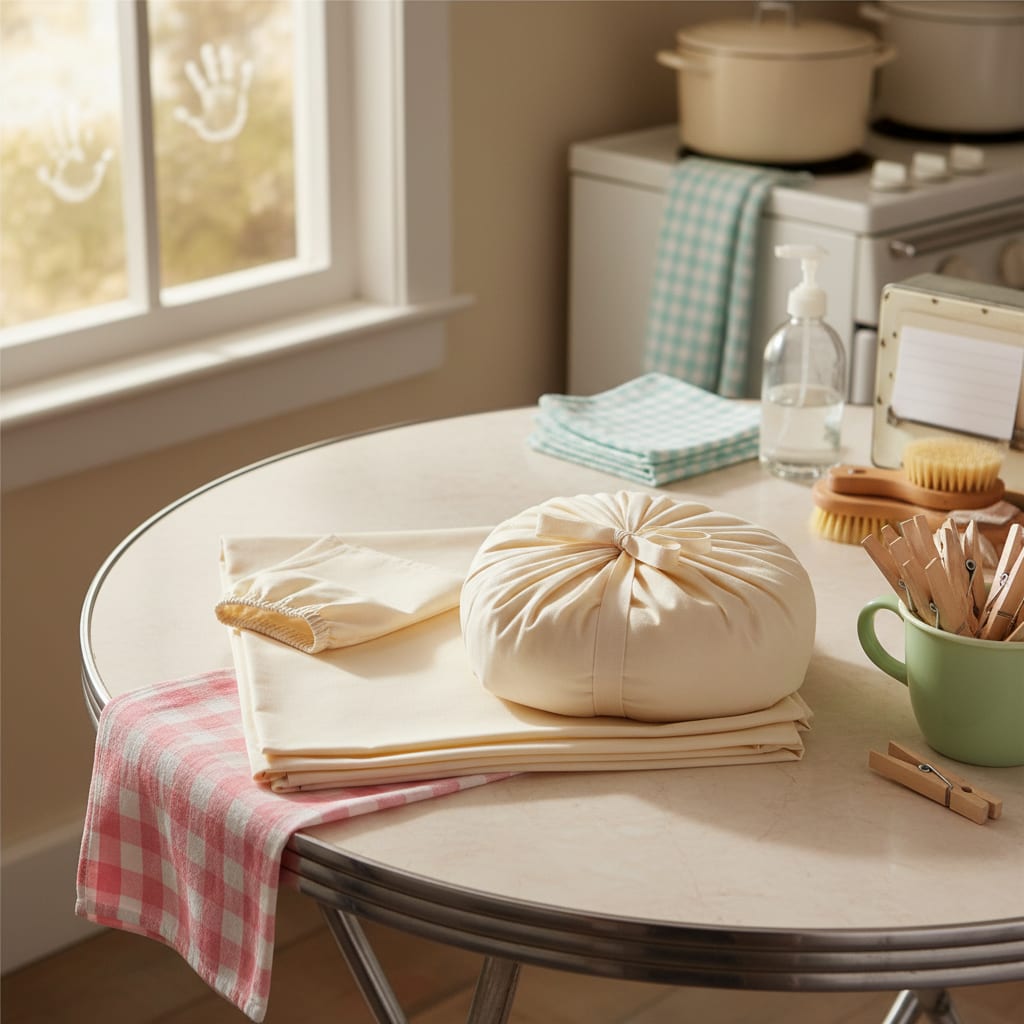
Three: the closet has to be able to receive. Wash day ends at a linen closet, and a closet you have to excavate turns the last twenty minutes into a fight. The folded-sets trick — each sheet set bundled inside its own pillowcase — is the receiving end of the whole system.
Who shouldn’t run a wash day
Honest list. Wash day suits homes with one broadly predictable day, machine capacity that matches the week, and somewhere to stage folding. It suits it badly if you work rotating shifts, if your week runs past about eight loads, if you share a laundry room or use a laundromat by the hour, or if the only free day is also the only day anyone leaves the house. In all of those, a load a day is the stronger system and there’s no nostalgia penalty for choosing it.
And a few times a year, whichever rhythm you run, towels and bedding need more than a cycle — the periodic deep soak in laundry stripping resets the buildup that even a good wash day accumulates.
FAQ: running a wash day
How many loads can you realistically do in one day?
Your dryer sets the limit. Divide your available hours by the dryer’s real cycle time, then subtract one for interruptions. For most families that’s four to six loads between breakfast and dinner.
What day is best for wash day?
Whichever day you’re most reliably home, though Monday still has a practical argument: weekend bedding feeds straight into it and the week starts fully stocked. The consistency matters far more than the label.
Is it better to do laundry all in one day or a little each day?
Neither is better in the abstract. One day wins on containment and suits predictable weeks; a load a day wins on flexibility and suits high volume or shift work. The failure mode is doing laundry “whenever,” which is how the weekend mountain forms.
How do I stop forgetting the wet load in the washer?
Set a timer at the moment you start each cycle, and never start a load whose dry-fold-away window you can’t actually see on the clock. If you can’t finish it today, it belongs in tomorrow’s plan, not in the drum.