How Much Laundry Detergent to Use (Most Use Too Much)
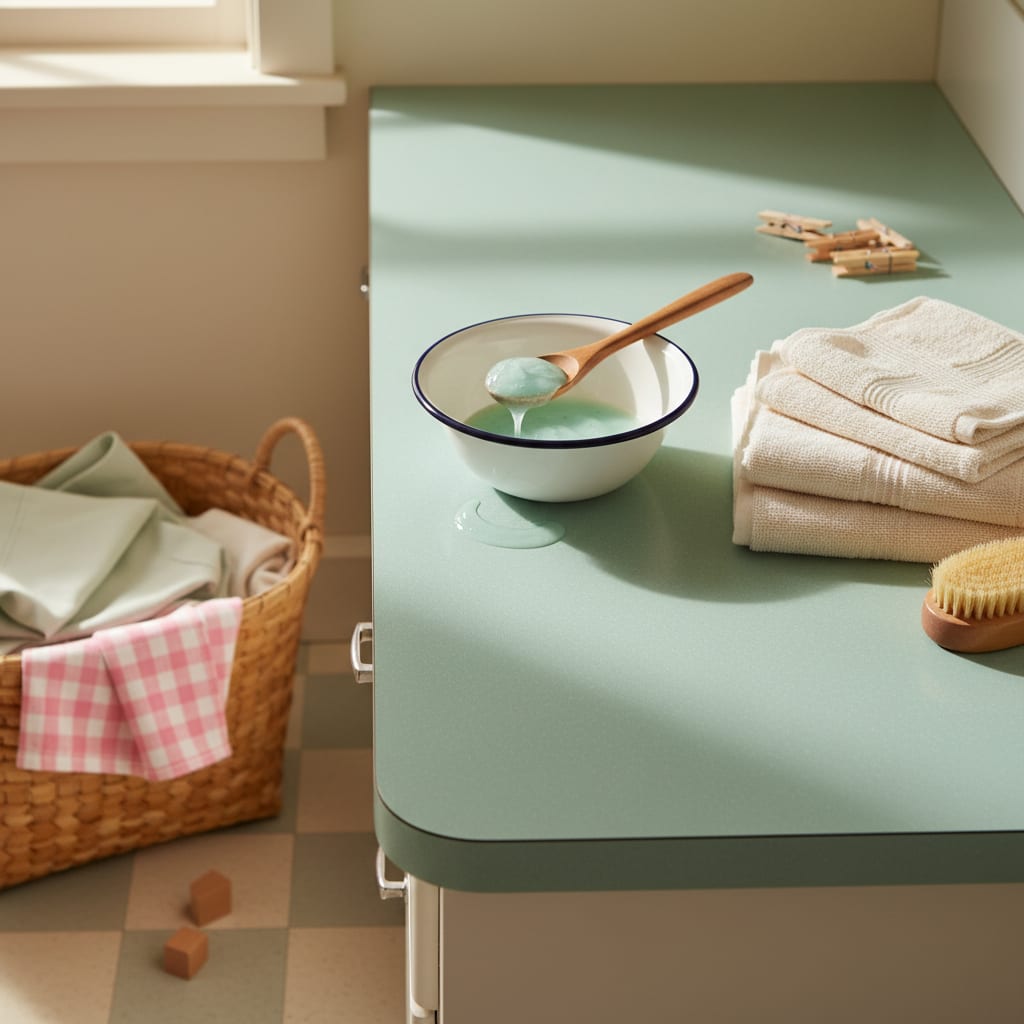
For an average, ordinary-soil load in a modern high-efficiency machine, the dose is around two tablespoons of concentrated liquid — nowhere near a full cap. One pod, never two. For powder, the lower line on the scoop. The cap’s brim is sized for a heavily soiled, full-to-the-top load in hard water, which is not the load most of us are washing on a Tuesday. Start by reading your own bottle’s fill line 1, then treat that as the ceiling rather than the target, and adjust for how full, how dirty and how hard.
Why the cap misleads you
The cap is a measuring device with a marketing problem. Most bottles mould three fill lines into it, and line 1 — the small one, often barely a third of the way up — is the medium-load dose. The lines are faint, they’re printed inside a translucent plastic cup, and they disappear entirely the first time detergent dries in the cap. So people fill it, and a filled cap on many concentrated formulas is two to three times a medium dose.
Then there’s the arithmetic underneath. Detergents have been concentrated repeatedly over the last twenty years while the caps stayed a familiar size, and machines have moved the other way: a high-efficiency washer uses a fraction of the water an old top-loader did. Less water and stronger detergent, dosed out of a cup that was designed around neither, is how a whole country ended up over-dosing at once.
The dose, by machine and load
| Situation | Concentrated liquid | Powder | Pods |
|---|---|---|---|
| HE machine, average load, normal soil | About 2 tbsp (fill line 1) | Lower scoop line | 1 |
| HE machine, full and genuinely dirty | Fill line 2 | Full scoop line | 1 |
| Standard (non-HE) top-loader, average load | Roughly double the HE dose | Full scoop line | 1 |
| Small or half load | Halve it | Half scoop | 1 — never split a pod; run a fuller load instead |
| Hard water | Add a booster rather than more detergent | Full line plus a booster | 1 plus a booster |
| Very soft water | Cut it by a quarter | Below the lower line | 1 |
Your own bottle wins any argument with this table. Concentrations differ enough between brands and between “ultra” and standard formulas that the printed fill line on the product in your hand is the only authoritative number — this is a shape to check yours against, not a replacement for it.
What too much detergent actually does
Excess detergent does not dissolve into nothing. There is only so much soil in a load to attach to, and the surplus has to go somewhere.
It stays in the fabric. Fibres hold what the rinse can’t clear, and it builds cycle over cycle. Towels stop absorbing, sheets go faintly stiff, and dark clothes pick up a chalky cast that reads as fading.
It holds smell rather than removing it. Residue is soft and slightly tacky, which gives odor-causing bacteria a foothold. The load that smells musty an hour after it dries is nearly always an over-dosed load, not an under-dosed one — which is why more detergent is the wrong instinct at exactly the moment it feels most obvious.
It lives in the machine. The American Cleaning Institute is direct about this: in HE machines, excess suds can lengthen cycles, cause the pump to work against foam, and leave a residue film that goes on smelling. In a front-loader it collects in the door gasket and the detergent drawer.
It cushions the wash. Suds make the load slide instead of tumble, and mechanical action is a real part of how clothes get clean. A foaming machine is washing less effectively, not more.
A scoop of flakes into a tub of hot water, judged by eye against how grey the water went and how much suds sat on top. Nobody measured, because the soap was weak, the water was plentiful, and the feedback was immediate.
Measured, because our detergent is strong, our machines use very little water, and the feedback is delayed by a month. The card file's rule is short: fill line 1, or the tablespoon, and only go up when something is genuinely filthy.
The halving test, one week
If you suspect you’ve been heavy-handed, don’t reason about it — run the test.
- Cut the dose in half for one week, every load, no exceptions. Two tablespoons becomes one.
- Change nothing else. Same cycle, same temperature, same machine, no vinegar, no boosters. One variable.
- Judge on the towels. They’re the honest witness — they’ll feel softer and dry you faster within about three washes, because the old residue is finally coming out.
- Check the collars. If anything genuinely came out less clean, that’s your signal to go back up a notch. In practice it almost never does on ordinary household laundry.
- Settle at the lowest dose that still works for your water and your family’s dirt, and write it on the card taped inside the cupboard door.
Most households end the week somewhere below where they started and stay there. If yours doesn’t, hard water is the likeliest reason — see the next section before adding more detergent.
Hard water changes the math
In hard water, part of every dose is consumed neutralizing dissolved minerals before any of it reaches the laundry. That’s a genuine reason a standard dose underperforms, and it’s the one situation where “use more” has some logic behind it.
More detergent is still the expensive way to solve it. A water-softening booster does the same job at a fraction of the cost — half a cup of washing soda or borax alongside a normal detergent dose handles the minerals so the detergent can handle the dirt. If your soap scums, your kettle scales and your glasses come out cloudy, you have hard water, and boosting is the cheaper answer.
Clearing the backlog you already have
Correcting the dose stops the problem growing; it doesn’t undo years of it. Two things clear the existing buildup.
For the fabric: a rinse with no detergent at all and a cup of white vinegar, repeated two or three times on the worst towels. The dose table for that job lives in how much vinegar to add to laundry. For badly built-up towels and sheets, the full tub soak in laundry stripping is the demolition option — seasonal, not routine.
For the machine: a hot empty cycle with the drawer and gasket wiped out, and a cleaning tablet such as an Affresh tablet if there’s visible film. The full method, including the filter nobody knows they have, is in how to clean a washing machine. A machine still carrying residue will re-deposit it on the next load however carefully you dose.
One more thing worth ruling out while you’re at it: detergent that has sat open for a year cleans measurably less well than fresh, and dosing up to compensate is the exact wrong move — what actually changes as detergent ages covers when a bottle has genuinely lost its potency.
FAQ: detergent dosing
How much liquid detergent for a normal load?
Roughly two tablespoons of a concentrated liquid in a high-efficiency machine, which usually corresponds to fill line 1 on the cap. A standard non-HE top-loader uses about double that, because it washes in far more water.
Is one pod enough for a large load?
For an ordinary large load, yes. Pods are dosed for a full standard load, and adding a second is the fastest route to residue. If a load is so big that one pod looks inadequate, it’s too big to wash properly anyway — split it.
How do I know if I’m using too much laundry detergent?
Stiff towels that have stopped absorbing, laundry that smells musty soon after drying, suds still visible in the rinse, and a film or smell in the machine. Any two of those together mean the dose is too high.
Does using less detergent get clothes less clean?
Below a certain point, yes — but almost nobody is near that point. Under-dosing shows up as visible soil left behind, which is rare. Over-dosing shows up as residue, which is common.
Should I use more detergent in hard water?
Add a booster instead. Half a cup of washing soda or borax neutralizes the minerals so a normal detergent dose can do its actual job, and it costs a fraction of the extra detergent.