Rewiring or Replumbing? Bedtime Around the Works
Book the works as one block, then solve three things in this order: the sockets beside the bed, the dust, and where everyone is sleeping. A rewire or a replumb takes the small machinery of a bedroom off the wall — lamp, sound machine, monitor, tap, flushing toilet — and puts boards up in rooms you use at night. None of that is a sleep problem on its own. It becomes one when the running order changes shape at the same time as the address. Keep the order identical; move it to a finished room.
Walk the house before the first board comes up
Trades answer questions precisely and volunteer nothing. Walk the house before day one and write down four answers.
- Which circuits are dead, on which days? A rewire rarely kills the whole house at once, and knowing the upstairs lighting is off Tuesday is the difference between planning and improvising at 6:45pm.
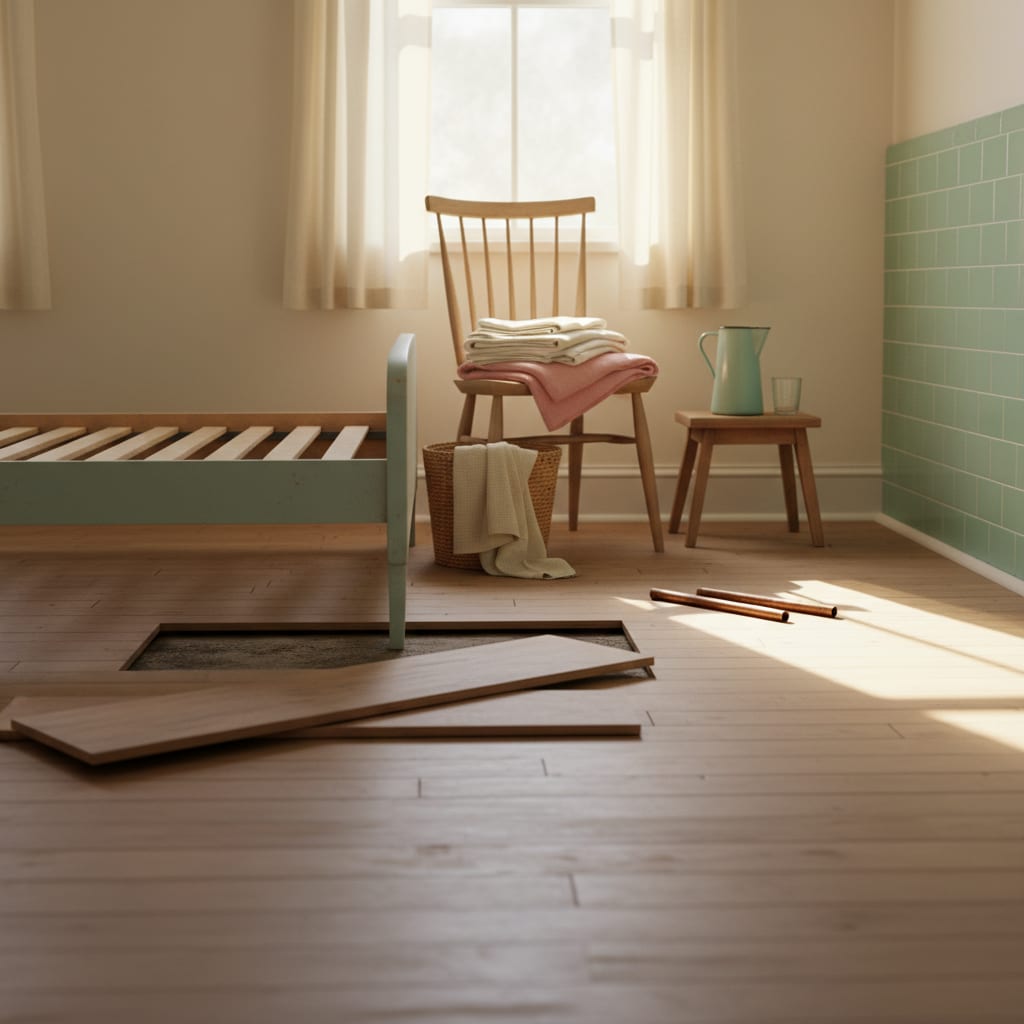
- Which rooms need boards up, and do they go back down that day? An open floor void is not a room anyone sleeps in, and “we’ll get to that tomorrow” is an answer you need in advance.
- Is the bathroom out overnight, or only in working hours? On a replumb those are different weeks — one is an inconvenience, the other needs a plan for a 2am nappy change.
- Which rooms are you in on which day? The question that buys most and gets asked least: trades can often sequence bedrooms, and a child’s room done first is back in use while the rest is chaos.
Batch anything else that wants doing while the floor is open — same logic as batching a repaint into one weekend block: the room is lost once, not three times.
The bedside sockets are the first problem, not the last
Everything that makes a bedroom work at night is plugged in, and on a rewire the socket boxes come out of the wall. Solve it with batteries rather than cable. A rechargeable sound machine — something like the Yogasleep Rohm, which runs off its own battery — holds the room’s sound floor steady while the circuit is dead, and a battery lantern handles the landing. Candles do not: an unfamiliar dark house with boards up is the worst place for an open flame.
Run the extension leads the way the U.S. Fire Administration asks. Its appliance and electrical fire safety page reports an estimated 24,200 residential building electrical fires in 2021, causing an estimated 295 deaths, 900 injuries and over $1.2 billion in property loss. Two lines worth taping to the fridge: “do not overload power strips,” and “avoid putting cords where they can be damaged or pinched, like under a carpet or rug.”
Take the free upgrade while the faceplates are off. The same list says to “install tamper-resistant electrical outlets if you have young children,” and the week an electrician is at every socket is the cheapest that will ever be.
Chasing walls is loud in a way a closed door does not fix
Drilling and chasing put energy into the framing, so the sound arrives through the structure rather than the air — which is why shutting the bedroom door does nothing, the mechanism worked through in re-timing the wash so the spin cycle stops waking the baby.
So do not try to nap through first fix. Ask which days are the loud ones and take the nap out of the house on those. Second fix is comparatively quiet, and two days of outsourced naps costs far less than four days of failed ones.
The dust is the part people underestimate
Chasing plaster and masonry throws a fine grey dust that stays airborne for hours and keeps settling for days after the noise stops. It gets into bedding, which is the one thing a child has their face in for eleven hours.
Strip the beds and get the bedding out before work starts, not after — sheets, pillows, the soft toys that matter, sealed in bags behind a closed door. Washing grit out of a duvet is a wash day you did not plan.
A pre-1978 house needs more care here. EPA’s Lead Renovation, Repair and Painting Program page states that “approximately three-quarters of the homes in the United States built before 1978 still contain some lead-based paint,” and that “any renovation, repair or painting project in a pre-1978 home or building that has lead-based paint can easily create dangerous lead dust.” Chasing a cable through a painted wall is exactly that, and the RRP Rule requires anyone paid to disturb painted surfaces in such a home to be certified in lead-safe work practices. Ask before you book.
Before the bed goes back in, wipe rather than sweep — dry sweeping relaunches everything you are trying to remove. Damp cloths, top down, and the walls last.
Where everyone sleeps while the boards are up
Pick the room the trades are finished with, or will not touch at all; second choice is the one they do last. What you are avoiding is moving twice.
Move the sleeping kit as one unit and keep it complete: the child’s own pillowcase, their own sleeping bag, the two books, the same toy, in the same order. Smell and sequence carry more than furniture does. If a child has never slept anywhere but their own cot, expect the first night to be the hard one rather than the fourth; Betteroo’s guide to what to do when the bed itself is being refused covers the same behaviour in its ordinary version.
One honest warning: a floor mattress beside a sibling beats moving a child into the adults’ bed — not for any moral reason, but because it is far easier to undo. Same call as a heating replacement week.

The nights with no water
A replumb reaches bedtime hardest, because two of the evening’s fixed points run on it.
Fill containers before the stopcock goes off. A bucket in the bath flushes a toilet; a stockpot and two jugs cover teeth, bottles and washing-up.
Keep the bath’s slot even when there is no bath. It is the body step of the evening, not the quiet one, so cutting it leaves the wind-down without its hinge. Two minutes of warm flannel at a live basin holds the shape.
Then be careful about the water coming back. Refilled pipes bang and run brown for a day — startling at 11pm, and harmless. What is not cosmetic is what has been standing in the pipework. EPA’s reduce the risk of lead exposure at home page notes that “the more time water has been sitting in pipes, the more lead it may contain,” says to flush before drinking by running the tap, a shower or a load of laundry, names lead solder and brass fittings as ordinary sources in older houses, and says to “use only cold water for drinking, cooking and making baby formula” — hot water pulls more lead from pipes, and boiling does not remove it.
The night the works end is the one to plan
Move back on a morning, never at bedtime — a child handed a re-plastered room at 6:50pm has to process a changed environment in the twenty minutes they are least able to. Give the room a day first: windows open, surfaces wiped, bed made up with its own bedding, furniture back where it was rather than where it now looks better. Save rearranging for a fortnight later.
Expect the first two nights back to be worse than the works were; that is not the plan failing. What you hold steady is the running order, not the room — Betteroo’s rundown of the steps most evenings settle into is worth measuring your own against once the dust is down.
FAQ: sleeping in a house being rewired or replumbed
Can a child sleep in a room that was rewired that day? Once the boards are down, the dust is wiped rather than swept and the bedding has come from somewhere sealed, yes. If the floor is still open or the plaster is wet, sleep elsewhere and move back in daylight.
Should we just move out for the week? If the bathroom is out overnight, or the works run past four or five days, a few nights elsewhere is often cheaper than a fortnight of recovery. Take the pillowcase, the sleeping bag and the running order — that is what the child is attached to.