How to Make Towels Soft Again (Find the Cause First)
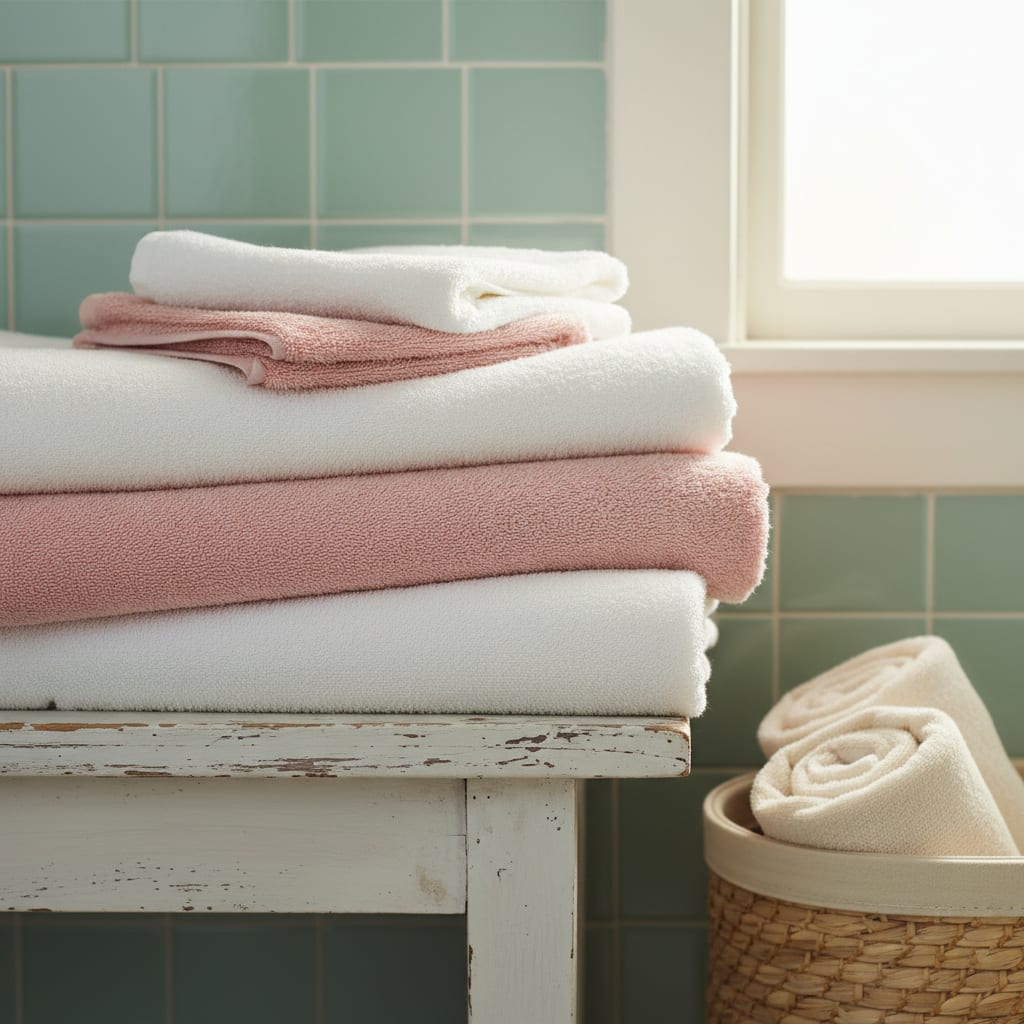
Towels go hard for a handful of reasons, and each has its own fix. The usual suspects are too much detergent left in the fibers, fabric softener coating them, hard-water minerals, body soil building up, a crowded washer or dryer, and line drying with nothing to fluff the loops. Find your cause with the checks below and fix that one. Most towels come back within a few washes. A towel that has worn thin won’t, and no laundry trick changes that. Guessing is how people end up adding more product to a towel whose problem is too much product.
Find your cause: the quick diagnosis
Feel the towel, smell it damp, and look at your taps. Then match it here.
| What you notice | Likely cause | First fix |
|---|---|---|
| Slick or waxy, water beads instead of soaking in | Fabric softener | Stop using it on towels; rinse it out |
| Stiff, smells sour or “wet dog” when damp | Detergent and body soil build-up | Measure detergent; wash towels more often |
| Stiff and dull, white crust on taps and drains | Hard water | Soften the wash water |
| Stiff and flat out of a packed dryer | Crowding | Smaller loads, room at the top of the drum |
| Crunchy only after the clothesline | No tumbling | A short tumble at the end |
| Thin, bald patches, loops pulling out | Age | Retire it to the rag bag |
More than one can apply. A slick, sour towel in a hard-water house has three problems. Work through them in the order below, because that’s the order they’re cheapest to fix.
Cause 1: too much detergent
This is the most common cause and the easiest to miss, because more detergent feels like more clean. Downy’s towel care page says overdosing, “especially in high-efficiency (HE) washers,” can cause buildup that doesn’t fully rinse away, leaving towels “stiff and dull.” The American Cleaning Institute’s laundry basics goes further: “too much detergent or too little can leave your clothes less clean” than the right amount.
The fix: read the dose on the label and measure it, rather than filling the cap. The full method, including a one-week test that shows the difference on towels first, is in how much laundry detergent to use.
Cause 2: fabric softener
Softener makes towels feel soft by coating them, and the coating gets in the way of drying you off. CHOICE, the Australian consumer group, tests softeners for absorbency for that reason. It explains that “fabric softeners tend to reduce the water absorbency of towels as a side effect of the softness,” and that is what it measures in the lab. CHOICE and ACI both add a second reason to keep softener away from children’s things: it may reduce the flame retardancy of fabrics such as children’s sleepwear.
To be fair to the other side, Downy, which makes softener, says its product used as directed keeps towels soft while they still absorb water. The house rule here sides with the absorbency testing: no softener on towels. A rinse of white vinegar does the softening job by removing residue rather than adding a layer. Doses by load are in how much vinegar to add to laundry, along with the one rule that matters: never in the same load as bleach.
Cause 3: hard water
ACI explains the chemistry plainly. Hard water carries minerals, “mostly calcium and magnesium,” which react with soap to form a curd. That curd can show up as white powder on clothes, make fabrics “feel stiff,” and coat the inside of the machine. ACI gives two ways to tell: white residue around taps and drains, or fabrics that “feel stiff, not fluffy.” Your water company or local Cooperative Extension office can tell you for sure.
Here the detergent advice flips. In hard water, ACI says to add “slightly more detergent than the product label directions recommend,” so the extra softens the water, or to add a water softener or detergent booster. It’s the one case where more detergent is the fix. That’s why diagnosis comes first: the same stiff towel needs opposite treatment in a soft-water house and a hard-water one.
Cause 4: body soil and everything else towels soak up
Towels are built to hold whatever they touch. Downy lists what collects in the fibers: “body soils (sweat, sebum, skin cells), detergent, hard water minerals, and personal care products.” Together, those make towels “feel scratchy, stiff, and even smell musty.” A towel that smells sour the moment it gets wet is the giveaway.
The fix is frequency and heat. ACI says towels “should be hung to dry between uses and washed after 3-5 normal uses.” Use the Normal/Cotton setting, which ACI describes as warm or hot water and a vigorous wash. If the towels have years of build-up, a regular wash won’t catch up, and the long hot soak in laundry stripping is the reset. Do it once, then keep up the regular washing so it doesn’t happen again.
The card for towels is two lines long: "Hot water, plenty of rinse, out in the wind. Never wash a towel with anything that sheds or anything that shines."
Towels get their own load on the hot cotton cycle, a measured dose and no softener, plus a vinegar rinse when they start to smell. Then a dryer with room to spare. When a towel still won't soften after that, it's the towel, not the wash.
Cause 5: a crowded washer or dryer
Loops need room to move to be rinsed clean and fluffed dry. ACI’s rule for the washer is short: “Don’t overload the washer—clothes need room to move.” Downy gives a measure for the dryer: leave “at least 6 inches of space at the top of the drum” so towels tumble freely. A full load of bath towels is heavier and bulkier than it looks, so split it if it fills the drum.
Cause 6: the clothesline
Towels dried on a line have nothing breaking the loops apart as the water leaves, so they dry stiff even when they’re perfectly clean. That one has its own fix: a sharp snap before hanging and a short tumble at the end. It’s covered in the crunchy-towel section of line drying clothes, so it isn’t repeated here.
When it’s the towel, not the wash
This part is house judgment rather than a source. Towels wear out. Thinning, bald patches where the loops have worn flat, and loops pulling loose at the hems are signs of age, and no wash routine reverses them. Retire them to cleaning rags, which is the most useful thing a stiff old towel can be.
The reset, in order
For a cupboard of towels with more than one cause, run this sequence once:
- One wash, towels only, on hot (if the labels allow) with a measured dose of detergent and no softener.
- Add a vinegar rinse through the softener compartment.
- Dry with room in the drum, leaving space at the top for them to tumble.
- Repeat on the next two washes before you judge. Build-up comes out over several cycles, not one.
- Strip only if that fails. If they’re still stiff and slick, the build-up is deeper, and that’s what stripping is for.
FAQ: soft towels
Why are my towels stiff after washing?
Usually because something is left in them: too much detergent, fabric softener or hard-water minerals. A crowded machine, or line drying with no tumble, can also do it. Use the table above to match your symptom to the cause before changing anything.
Should I use fabric softener on towels?
Consumer testing by CHOICE found softeners tend to reduce how much water towels absorb. Downy, a softener maker, says its product used as directed keeps them absorbent. The house rule here is no softener on towels, with a vinegar rinse instead.
Does vinegar make towels soft again?
It helps when the stiffness comes from detergent or softener residue, because it rinses that out. It won’t help a worn-out towel. Never add vinegar to a load that contains bleach.
How often should towels be washed?
ACI says towels should be hung to dry between uses and washed after 3 to 5 normal uses. Downy says every 3 to 4 uses. Washing them more often keeps body soil from building up and stiffening them.
Next cards in the file
Nursery Organization: Set Up for the 2am You
July 17, 2026
How to Clean Grout Without Wrecking It
September 23, 2026
How Often Should You Wash Your Sheets? A Real Schedule
October 7, 2026