Entryway Organization Ideas: Coats, Boots, Backpacks
The entryway organization that survives children is built in the order people actually come through the door: a place for wet boots right at the threshold, hooks at the children’s own height, one basket or cubby per person for the small things, a fixed spot for backpacks, and a route for the paper inside them. Keep only this season’s gear there. An entryway usually fails not for lack of storage but because the storage is in the wrong order, at the wrong height, and full of things nobody wore this month.
Walk the route before you buy anything
Stand outside with the door closed, then come in the way the family does on a school afternoon, and notice what happens in what order. Usually: boots off, bag dropped, coat off, hat and gloves shed, papers pulled out, and then everyone heads for the kitchen.
That sequence is the layout. Whatever gets dropped first needs the spot nearest the door; whatever gets dropped last can sit furthest in. An entry that puts the coat hooks by the door and the boot tray three steps inside is asking wet boots to walk across the floor to reach it — and they will not.
The floor: boots stop at the threshold
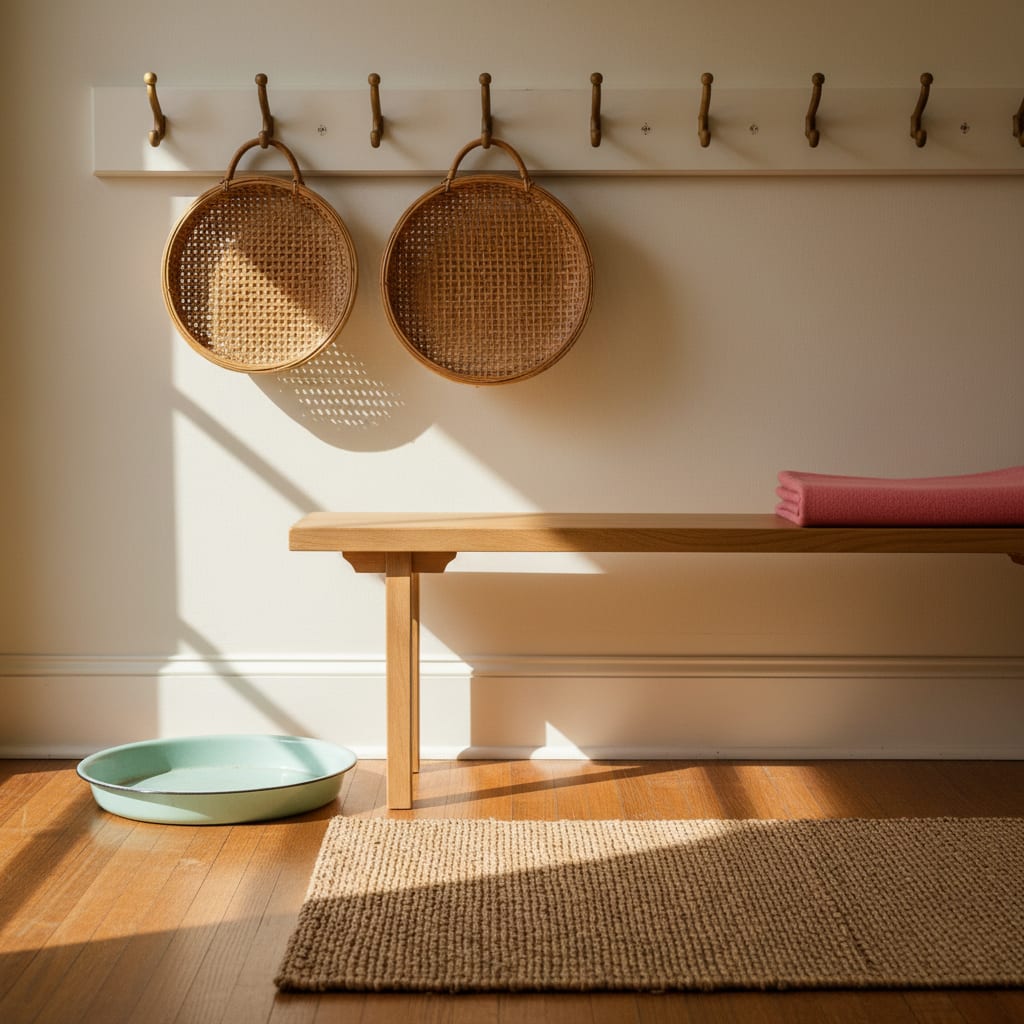
A boot tray or a washable mat sits right inside the door, before anyone takes a second step. Its job is to hold water and grit, so choose something with a lip that can be carried out and rinsed.
Give each person a shoe limit. One or two pairs each in the entry — the ones worn this week. Everything else lives in the bedroom closets. A shoe pile is almost always the out-of-season pairs nobody put away, not the ones in daily use.
Leave a clear strip of floor. A landing zone needs somewhere to stand while unzipping a toddler. If every inch is storage, the stand-and-strip happens on the living room rug instead.
The wall: hooks at their height, not yours
Hooks beat hangers in an entry, because a child can hang a coat on a hook in one movement and cannot hang it on a hanger at all.
Put a row of hooks at a height the youngest can reach without climbing, and a second row higher up for adults. One hook per child per item — coat on one, bag on another — so nothing is buried under anything else. Hooks with a spare one each are better than hooks that exactly fit, because there is always a scarf or a wet sweater nobody planned for.
If the wall will carry a shelf above the hooks, it is a good home for the things that come out seasonally, like sun hats in summer and spare gloves in winter, in a closed basket so the shelf does not become a second counter.
One basket or cubby per person
Hats, gloves, sunglasses, the swimming bag, the library book: small things are what turn an entry into a heap. Give each person one container and let everything small that belongs to them go into it, unsorted.
A cube unit handles this well — an open cube organizer like ClosetMaid’s Cubeicals, with a fabric bin per child on the row they can reach, shoes in the open cubes, and the top as a landing spot for keys and the day’s post. A narrow bench with baskets underneath does the same job in a hallway too slim for a cube unit.
Anchor anything tall. A cube unit, a shoe cabinet or a hall stand is exactly the kind of furniture a child climbs to reach a hook. The CPSC’s Anchor It campaign puts it simply: “Anchoring all furniture with drawers, doors, and shelves to the wall prevents tip-over injuries and deaths.” Many units come with a wall strap in the box; fit it the day the unit goes in.
The backpack handoff
The backpack is where the entry meets the rest of the house. Give each child’s bag its own hook or cubby, and make emptying it part of arriving: lunchbox to the kitchen, papers out, bag back on its hook, ready for morning.
The papers are the part that goes wrong. They need one landing spot and one weekly sort, and they should not live in the entry at all — the whole keep-toss-treasure system is in school papers organization. The entry’s only job is to get the papers out of the bag and onto the path to that spot.
The back porch was the mudroom: galoshes on newspaper by the door, coats on a row of pegs, and nobody set foot in her kitchen in outdoor shoes. The card says "pegs low for the children" and nothing else, as though the rest was obvious.
Most modern houses have no back porch, so the mudroom shrinks to a strip of wall by the front door. The rules came with it intact: the wet things stop at the door, the pegs are low, and every child has a place that is theirs.
Keep only this season at the door
An entry fills up because it becomes storage for the whole year’s outerwear. Swap it twice a year: in fall the winter coats and boots come forward and the sandals and sun hats go back to the bedrooms or the bin under the stairs; in spring the reverse. The same seasonal swap for clothes, sized so hand-me-downs stay findable, is in kids’ closet organization — the entry is simply its front edge.
When there is no entryway at all
Plenty of houses open straight into the living room. The landing zone still exists; it just has to be built from furniture rather than architecture.
- Mark the zone with a rug or mat that is clearly “the door’s”, so boots stop on it.
- Use the back of the door for an over-door hook rail if the wall beside it is taken.
- Borrow the nearest closet. A coat closet with the door removed or left open, a low rod or hooks inside, and a basket on the floor becomes a mudroom in miniature.
- Garage or side-door entries work the same way: the boot spot, then hooks, then baskets, in the order people come in, whatever door that is.
Keeping it clear
An entry stays organised when it is reset daily, briefly, as part of the evening. Hats back in baskets, boots back on the tray, anything that does not belong in the entry carried to where it does. It fits naturally into the evening reset, before the kitchen is closed down for the night. If the reset keeps overrunning, too much is living at the door — go back to the shoe limit and the season rule.
FAQ: entryway organization
How do you organize an entryway with kids?
Build it in the order they come in: boot tray at the door, low hooks they can reach, one basket or cubby per child for small things, and a fixed hook for each backpack. Keep only this season’s gear there and reset it briefly each evening.
What do you need in a small entryway?
A boot tray or washable mat, a row of hooks at two heights, and one small container per person. A narrow bench with baskets underneath covers most needs if the space is tight.
Where should backpacks go?
On their own hook or in their own cubby by the door, emptied on arrival so lunchboxes and papers go where they belong and the bag is ready for the morning.
How do you keep shoes from piling up at the front door?
Set a limit of one or two pairs per person at the door and send the rest back to bedroom closets. Most piles are out-of-season or rarely worn shoes, not the daily pairs.