The School-Paper System: Keep, Toss, Treasure
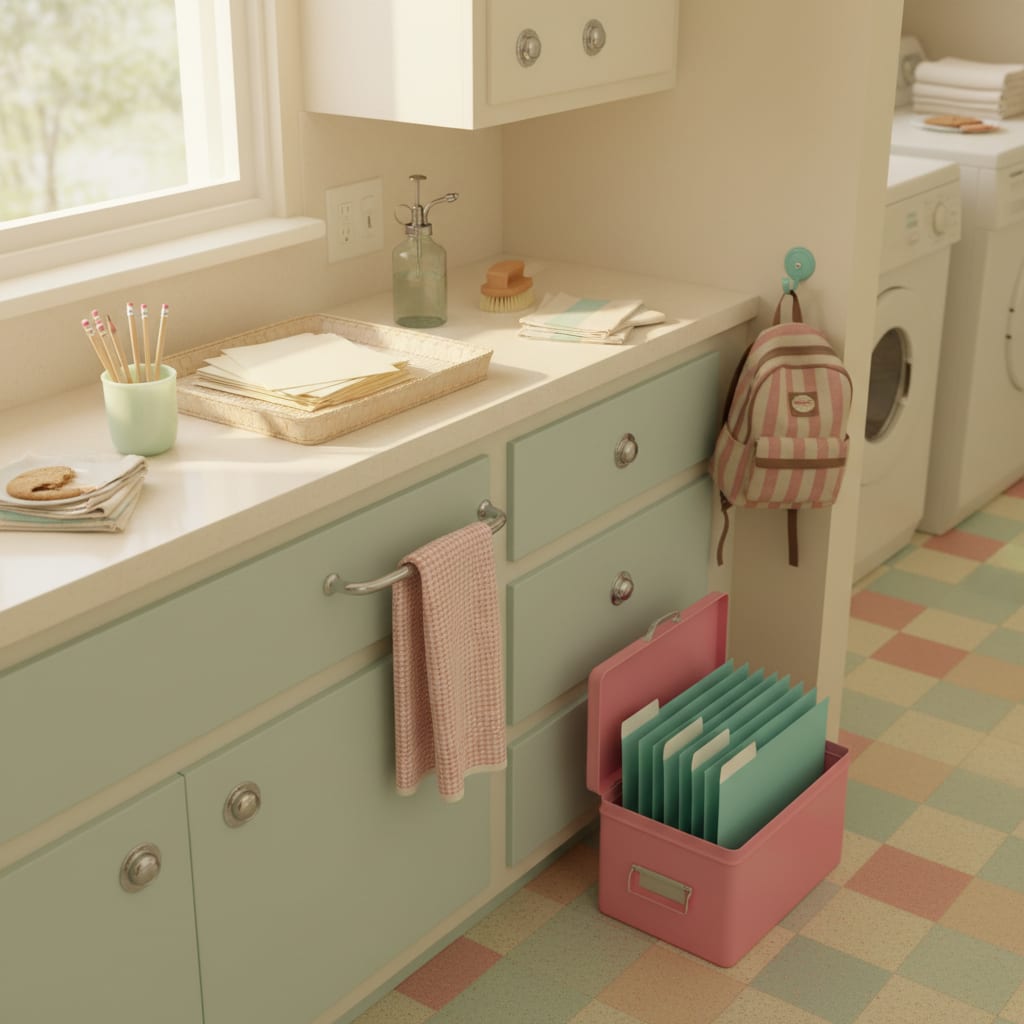
The school-paper system that works has exactly three destinations and one weekly appointment. Everything that comes home lands in one tray by the door. Once a week you sort that tray into keep (anything with a date or an action — permission slips, calendars, forms), toss (worksheets, flyers, duplicates, the ninth reading log) and treasure (the small handful worth an archive). Keep goes on the calendar and into a slim action file. Toss goes in the recycling that day. Treasure goes in one file box per child, one folder per school year. Five minutes a week, and the counter pile never forms.
Why paper beats every other kind of clutter
Paper arrives daily, is individually trivial, and carries a faint guilt charge — this might matter, she made this, that might be a deadline — so it never gets thrown out and never gets filed. It just migrates: backpack to counter to basket to drawer to the box in the closet you’ll deal with in summer.
The fix isn’t a better filing cabinet. It’s a decision rule fast enough to apply while standing up. Keep, toss, treasure, in that order, out loud if it helps.
Step one: one landing zone, and only one
Pick the spot the backpacks already stop at — the kitchen counter end, a hook by the door, the top of the shoe bench — and put one shallow tray or basket there. That is the only sanctioned place paper is allowed to be. Not the fridge, not the stairs, not the pile behind the fruit bowl.
Shallow is doing real work in that sentence. A deep basket lets three months accumulate invisibly; a shallow tray physically overflows in about a week, which is the reminder. Teach the kids one rule and only one: papers come out of the backpack and go in the tray. Nothing else is their job.
Step two: the weekly five-minute sort
Pick a fixed slot — Friday after school and Sunday evening are the two that stick — and run the tray standing up, with the recycling bin open at your feet.
Toss, first and fastest. Completed worksheets, flyers for events that have passed, newsletters you’ve read, catalogs, third copies of the same field-trip notice. This is eighty per cent of the tray and it should take ninety seconds. Never re-read a worksheet; if it’s graded and finished, its job is done.
Keep — anything with a date or an action. Permission slips, order forms, medical paperwork, the term calendar, the class contact list. Do the two-minute version now: sign the slip, put the date on the family calendar, and put the paper itself in a slim action file or a labeled clip on the fridge side. Then, crucially, the paper still leaves once the date has passed — a calendar entry outlives its paperwork.
Treasure — the small handful. Everything left. Be a ruthless curator: one or two pieces a month per child, not one or two per week. What earns a place is the thing that shows the child, not the assignment — the self-portrait, the story with the misspellings, the first written name, the thing they were visibly proud of. Twelve pieces a year is a beautiful archive; two hundred is a box nobody opens.
That whole sequence is a weekly rhythm, and it belongs to the same family of habits as the Sunday reset — a small, fixed, recurring appointment that stops a category of chaos from compounding. Paper is the quietest of them and the fastest to run.
Step three: one file box per child
The archive is a single box per child that lives on a closet shelf, not a drawer that fills up in September. A plastic file box with hanging rails works well because the hanging folders stay upright as the box empties and fills, and the lid keeps out dust and toddlers. One hanging folder per school year, labeled by year, preschool through twelfth grade. That’s it — the whole system fits in about fourteen folders.
The retro version of this is the accordion file, and it still holds up: my grandmother’s household papers lived in one, with the tabs relabeled in pencil so they could change jobs. If you already own one, use it — the principle is the same. One container per child, one divider per year, and a hard edge that says the archive is this big and no bigger.
Two rules keep the box honest. When a year’s folder is too fat to close comfortably, edit it down before adding more — you’ll find half of it was ordinary. And date each piece as it goes in, on the back, in pencil, with the child’s age. Undated childhood art is charming and unidentifiable within four years.
Photograph the rest
The pieces that are too big, too three-dimensional, or too numerous get photographed and released. Lay the artwork on a plain floor in daylight, shoot straight down, and put the photo in a per-child album on your phone. A painting on an easel, a cereal-box castle, the six-foot dinosaur mural — all of these live better as photos than as objects, and the child almost never asks after them.
One practical caution: a photo is only an archive if it’s backed up. Whatever your backup already is, make sure the album is inside it.
Where the papers you own go
School paper is two categories wearing one coat: the child’s work, which is sentiment, and the household’s admin, which is logistics. Report cards, immunization records, IEP paperwork, test results, enrollment forms — these belong with the family’s important documents, not in the treasure box, because you’ll need to find them under time pressure. One labeled folder per child in the household files, checked once a year at enrollment time.
Getting the backlog down
If you’re starting with a decade of accumulation rather than a clean tray, don’t try to do it all. Run it at one box a session, on the same one-box-a-day pace as the declutter checklist, and go newest-first — recent papers are easier to judge, and by the time you reach the ancient strata you’ll be fast and unsentimental. Anything that stalls you goes to the maybe pile and gets one more look at the end. Most people find their real keepers fit in one folder per year, exactly as the system predicts, which is oddly reassuring.
While you’re in there, the school backpack and the outgrown school clothes usually need the same treatment; the seasonal swap in kids’ closet organization is a natural companion job for the same afternoon.
FAQ: organizing school papers
What school papers should you actually keep?
Anything with an upcoming date or a required action, official records (report cards, immunizations, IEPs, enrollment forms), and a small curated handful of work per child per year. Completed worksheets, flyers and newsletters can go the day they arrive.
How do you organize kids’ schoolwork and art long term?
One file box per child with a hanging folder per school year, curated to roughly one or two pieces a month. Date each item on the back with the child’s age, and photograph anything oversized instead of storing it.
How often should you sort school papers?
Weekly, in a fixed five-minute slot — Friday afternoon or Sunday evening. Weekly is short enough to stay easy; monthly turns into a project, and a project gets postponed.
How do you keep the counter pile from coming back?
One shallow tray as the only legal landing spot, a weekly sort with the recycling bin open, and the rule that keep-papers leave once their date has passed. The pile is a symptom of having no decision rule, not of having too little storage.