How to Wash a Comforter at Home Without Wrecking It
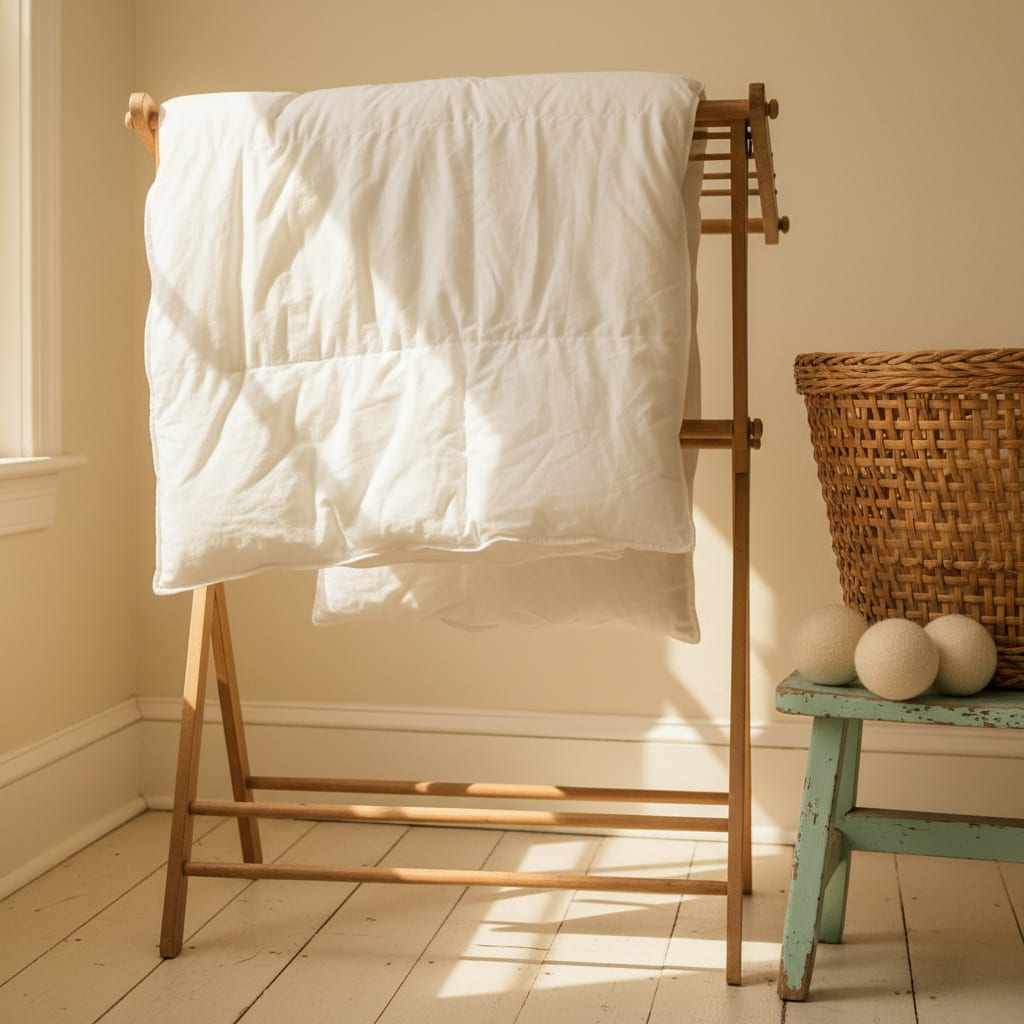
To wash a comforter at home, read the care label first, then check that it fits your washer loosely enough to move. Wash it on its own, on a gentle or bedding cycle, with a small amount of mild detergent and an extra rinse. Use warm water for down and cool water for cotton or polyester, never bleach, and no fabric softener on down. Dry it on low heat with dryer balls, pulling it out every half hour to shake it, and keep going until the middle is dry, not just the outside. If it won’t fit your machine, take it to a laundromat’s large-capacity washer.
First: will it fit, and what’s inside?
Two questions decide the whole job, and both are answered before anything gets wet.
What does the label say? Samsung’s bedding care page puts it plainly: “if your item has a care tag, always read and follow the instructions on the tag.” Some comforters are dry-clean only, some machine-wash, some hand-wash. The label also tells you the fill.
Does it fit? This is the step most guides skip. The Sleep Foundation’s down comforter guide says a home front-loader is fine “as long as it’s large enough to allow the comforter to move freely.” Stuff a queen comforter into a small drum and the middle never gets properly wet or properly rinsed, and the machine may not balance. The same guide warns that in a top-loader with an agitator, a comforter “can wrap around the agitators” and “wash unevenly or stretch and tear.”
A quick test: put the dry comforter in the drum loosely. If you have to push to close the door, or the drum is packed to the top, it’s a laundromat job.
When it’s a laundromat job
Washing a comforter at home is cheaper and easier only if your machine is big enough. The Sleep Foundation’s advice when it isn’t: “find a laundromat with a large-capacity washing machine.” The big washers there are front-loaders built for exactly this. So are the big dryers, and the dryer matters as much, because a queen down comforter can take hours to dry.
Take your own mild detergent, measured out at home, and a few dryer balls. Plan for the time the drying will take, or plan to finish the drying at home.
How to wash it, step by step
- Spot-treat first. For a stain, the Sleep Foundation suggests lifting the fabric “away from the fill to avoid getting it wet”, applying a little detergent, rubbing gently and letting it sit 10 to 20 minutes.
- Load it alone, loosely. Samsung says to wash a comforter “separately regardless of size.” Spread it evenly around the drum, “not folded, twisted, or bunched,” as the Sleep Foundation puts it.
- Choose the cycle. Bedding, gentle or delicate.
- Choose the temperature by fill. Samsung gives warm water for down, and “cool or cold water (warm or hot water may shrink and damage your bedding)” for cotton. For polyester it gives the same cool-or-cold advice.
- Use less detergent than you think. A small amount of mild detergent. Too much leaves residue in the fill. The Sleep Foundation warns it can “clump the down,” and the measuring that applies to every load is in how much laundry detergent to use.
- Add an extra rinse. Samsung notes “you may have to rinse it more than once to remove any excess laundry detergent.”
- Leave out bleach and softener. Samsung says never bleach. The Sleep Foundation adds that softener coats down fibers and “can cause them to clump together and flatten.”
Drying: the part that decides whether it lasts
A comforter that is dry on the outside and damp in the middle is the one that comes out of the cupboard smelling musty in spring. The Sleep Foundation’s warning: “If the down stays damp, it can clump together, develop a musty odor, or even grow mildew over time.”
- Low heat, big dryer. Choose the lowest heat setting. The Sleep Foundation says to “expect the process to take 2 to 4 hours, depending on the size of your comforter,” and that “high heat can damage the delicate down clusters.” For polyester, Samsung goes further and suggests a cool or no-heat cycle.
- Dryer balls. A few wool dryer balls break up clumps of fill as it tumbles. Skip dryer sheets on down, which the Sleep Foundation says coat it with softener.
- Stop and shake it. The Sleep Foundation says every 30 minutes; Samsung says every 15 or so. Either way, take it out, shake it hard, and put it back the other way round.
How to tell it’s dry all the way through. Squeeze the thickest part, the middle of the comforter, between your hands, and feel for any cool or heavy patch. Hold a handful of the fill and sniff it; the Sleep Foundation names “the telltale smell of wet down” as the sign it isn’t finished. When it’s light, evenly lofted and smells of nothing, it’s ready. Samsung suggests “airing it out on a comforter rack for a day or two after the drying cycle” to be sure.
Line drying works on a warm, dry, breezy day, but it takes most of the day and plenty of shaking. Many people finish in the dryer and air it on the line afterward, or the other way round. The line itself is set out in line drying clothes.
The feather tick went out on the line twice a year, beaten with a cane carpet beater and turned every hour. It was washed only when it had to be, and then on the hottest, windiest day she could find.
A cover on it so it rarely needs washing, a laundromat front-loader when it does, low heat with dryer balls, and a squeeze test in the middle before it goes back on the bed.
Down, synthetic and cotton: the differences
| Down | Polyester (down alternative) | Cotton-filled | |
|---|---|---|---|
| Water | Warm (Samsung), cold or warm (Sleep Foundation) | Cool or cold | Cool or cold |
| Dryer | Lowest heat, 2 to 4 hours | Cool or no heat | Low heat |
| Softener | No | Follow the label | Follow the label |
| Watch for | Clumped fill, musty smell | Fill not dry in the middle | Shrinking; Samsung says take it out slightly damp |
Sources disagree about dry cleaning down. Samsung suggests you “may want to consider having your comforter or duvet dry cleaned” if the material is too delicate for your washer. The Sleep Foundation says “traditional dry cleaning isn’t recommended” for down and points instead to services offering water-based “wet cleaning” for down products. The label decides, and when in doubt, ask the cleaner which method they use.
How often, and how to store it between washes
With a duvet cover or a top sheet under it, the Sleep Foundation says a down comforter “likely only needs to be washed once or twice a year.” Samsung says 2 to 3 times a year. The full bed schedule, sheets included, is in how often to wash sheets, and the fall bedding swap is part of the fall cleaning checklist.
The two sources also disagree on storage. Samsung suggests a vacuum storage bag; the Sleep Foundation advises “a breathable cotton or linen bag” and says to “avoid vacuum-sealed or plastic containers, as these can trap moisture.” Whichever you choose, the comforter has to be completely dry before it goes in.
FAQ: washing a comforter
Can you wash a comforter in a regular washing machine?
Yes, if it fits loosely and the label allows it. A drum packed tight, or a top-loader with an agitator, risks an uneven wash and torn fabric. Use a laundromat’s large-capacity front-loader instead.
How long does a comforter take to dry?
The Sleep Foundation says 2 to 4 hours on the lowest heat for a down comforter, depending on size. Air it for a day afterward if you’re unsure.
Why does my comforter smell musty after washing?
The fill wasn’t dry in the middle. Put it back in the dryer on low with dryer balls, shaking it often, until it smells of nothing.
Should you use fabric softener on a comforter?
Not on down. The Sleep Foundation says softener coats down fibers and makes them clump and flatten.
Next cards in the file

Nursery Organization: Set Up for the 2am You
July 17, 2026
Deep Cleaning Checklist, Room by Room (Printable)
August 3, 2026
How Much Laundry Detergent to Use (Most Use Too Much)
August 15, 2026