Downsized? Bedtime When Their Room Is the Smallest
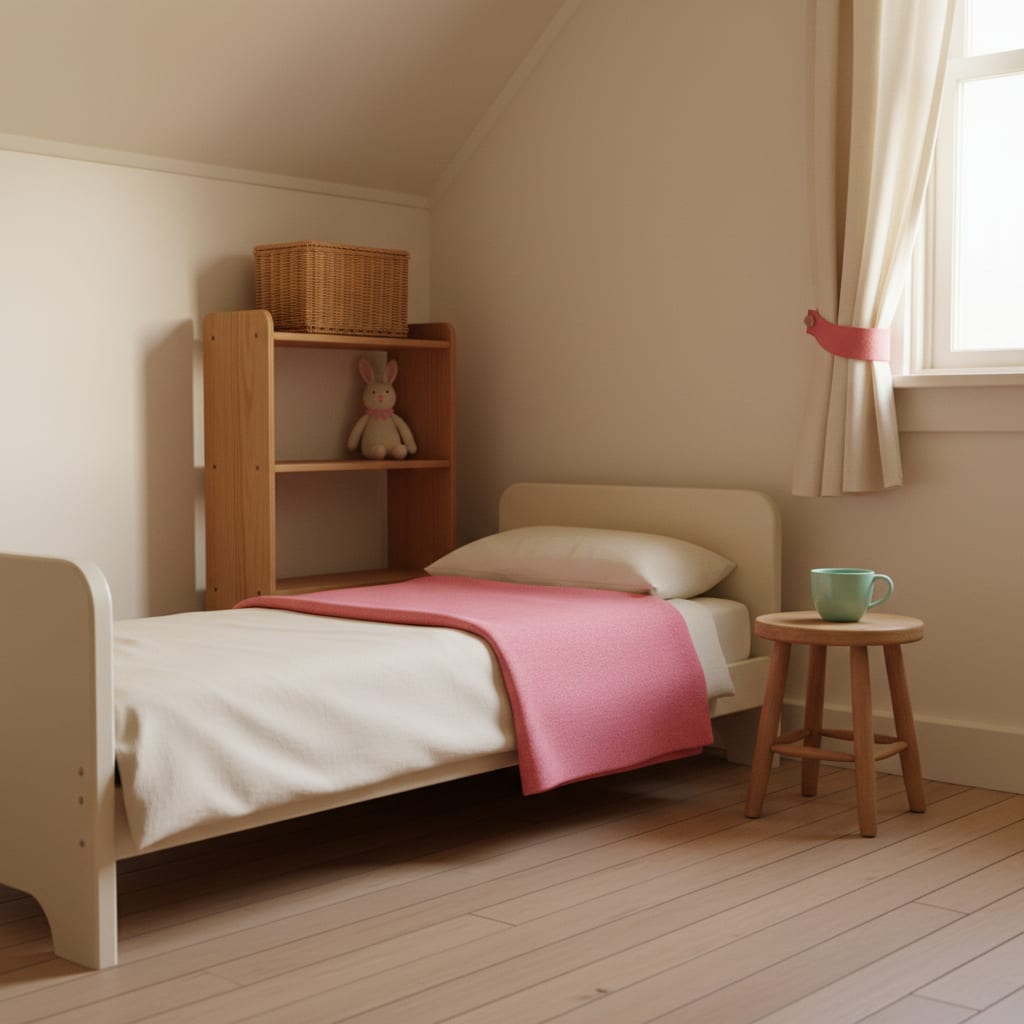
A small bedroom can sleep a child perfectly well; what usually goes wrong after a downsize is layout and storage, not size. Put the bed in the corner furthest from the door, away from the window and its cords and clear of the radiator. Take the toys out so the room only has to do sleeping and dressing. Send storage up the wall, and anchor it. Then set the room up completely before the first night and keep the bedtime running order exactly as it was — the address changed, the evening doesn’t have to.
A smaller room is a layout problem first
After a downsize, the child’s room is often the one left over: the box room, the old study, the bedroom with the sloped ceiling. It is tempting to treat that as a sleep problem and start adjusting bedtimes. Resist it: lay the room out for sleeping first, rather than for everything the old room used to hold.
The mistake is moving the old room in wholesale. Furniture that fitted around the edges of a big room fills a small one, and a room with no floor is hard to settle in and impossible to reset.
Place the bed before anything else
With only one or two walls long enough for a bed, the choice is usually made for you. Check it against three things:
Away from the window and its cords. The U.S. Consumer Product Safety Commission’s Go Cordless page asks parents to “move all cribs, beds, furniture and toys away from windows and window covering cords, preferably to another wall”, and says that “cordless window coverings are the only option to eliminate the strangulation hazard.” In a small room the bed often ends up under the window because it is the only free wall. If that is the case, the window covering needs to be cordless.
Clear of the heat. The U.S. Fire Administration’s heating fire safety page says to “keep anything that can burn at least 3 feet from all heat sources including fireplaces, wood stoves, radiators, space heaters or candles.” In a small room that rules out the radiator wall for the bed, the bedding and the curtains that hang next to it.
In a corner, along the wall, as far from the door as it will go. A bed tucked into a corner feels enclosed, is out of the path of the door, and keeps the rest of the floor in one usable piece.
Move the toys out
A small bedroom cannot also be a playroom, and trying to make it one is where many downsized-room problems start. Decide that the room does two jobs — sleeping and getting dressed — and give the toys a home somewhere else: a corner of the living room, a cupboard in the hall, a shelf on the landing.
Keep a few things that belong in a bedroom: the books for bedtime, the comfort toy, one small basket of the child’s own treasures. Everything else goes. A room with nothing to play with at bedtime is also a room with nothing to negotiate about at bedtime.
Storage goes up, and gets anchored
With the floor kept clear, storage climbs. Taller, narrower furniture fits a small room better than wide, low pieces, and the closet can do more than hang clothes: a second, lower rod lets a child reach their own clothes, and bins on the closet floor hold what the dresser used to. The height-split closet and the size-by-size bin system are in kids’ closet organization.
Tall furniture in a child’s room has one non-negotiable. The CPSC’s Anchor It campaign says it plainly: “Anchoring all furniture with drawers, doors, and shelves to the wall prevents tip-over injuries and deaths.” Strap the dresser, the bookshelf and anything else with drawers or shelves on the day it goes in.
The bunk or loft temptation
A bunk or loft bed looks like the obvious answer to a small room — the bed goes up and the floor comes back. It can work, but only at the right age. The American Academy of Pediatrics’ bunk bed safety page says: “Do not allow a child younger than 6 years to sleep in the top bunk. A child younger than 6 years does not have the coordination to climb safely or to keep from falling out.” It also advises placing bunk beds “in a corner, with walls on 2 sides”, a guardrail on the top bunk, and a night-light so the child can see the ladder.
For a toddler or preschooler in a small room, that usually means a low bed now and the height later. If siblings are sharing the smaller space, Betteroo’s guide on choosing a bunk bed for a room with a toddler in it covers what to check, and the furniture-and-noise side of two children in one room is in organizing a shared kids’ room.

Air, warmth and light in a small room
A small room tends to follow whatever is heating or cooling it, and a shut door holds whatever it gets. Check the room’s temperature at the hour the child is actually asleep in it, not only at bedtime, with a simple room thermometer like the TempPro TP50. If it runs cold overnight, the heating schedule is the likely culprit, and the full audit is in the 4am cold-room post.
Light matters more in a small room too, because everything is closer to the bed. A night-light that seemed dim across a big room can be bright from right beside the bed. Keep it low, and keep it warm-toned: Betteroo’s explainer on why warm red and amber light sits best at night covers the reasoning. A combined sound machine and adjustable night-light like the Hatch Baby does both jobs from one spot on a shelf.
Her children slept two to a room under the eaves, with a chest at the foot of the bed and hooks on the back of the door, and nothing else. The card calls the bedroom "for sleeping", as though that settled the matter.
More things than she ever owned, so the rule does more work now, not less: the bedroom is for sleeping and dressing, the toys live elsewhere, and whatever is tall is strapped to the wall.
Setting up the room, and the first nights
Set the room up completely during the day before the first night: bed made with the child’s own bedding, the comfort toy on the pillow, the bedtime books on their shelf, the night-light and sound where they will stay. A child put to bed among boxes is being asked to settle into a room that is still changing.
Then keep the running order identical — the same bath, the same books, the same words at the door. Expect a few unsettled nights anyway; a move is a change, and a child may notice the new shadows and sounds before they notice the smaller floor. If there is decorating to do, do it before the child moves in rather than around them; the order for that is in painting a kid’s room without wrecking bedtime.
FAQ: bedtime in a smaller room
Can a small bedroom affect a child’s sleep?
Size is rarely the problem on its own. The usual culprits are a crowded room, a bed by a draughty window or a hot radiator, too much light close to the bed, or a room that also has to be a playroom. Lay the room out for sleeping first.
Where should the bed go in a small child’s room?
In a corner, along a wall, as far from the door as possible, away from the window and any window-covering cords, and at least three feet from radiators or other heat sources.
Is a bunk bed a good idea for a small room?
For an older child, it can be. The AAP advises that no child under 6 sleep in the top bunk, so for toddlers and preschoolers a low bed is the safer choice until they are older.
How do you help a child adjust to a smaller room after a move?
Set the room up fully before the first night, keep their own bedding and comfort items, move the toys to another room, and keep the bedtime routine exactly as it was. Expect a few unsettled nights while they get used to the new room.