Speed Cleaning: The 30-Minute Company's-Coming List
Speed cleaning is thirty minutes run as one lap of the house in a fixed order — haul, kitchen, bathroom, sitting room, floors, entry. You are not cleaning the house. You are cleaning the parts a guest will walk through, sit on and use, in roughly the order they will meet them. The list below is the one taped inside my broom-closet door, and it assumes company is half an hour out and the house sits at its ordinary Tuesday level of chaos rather than its worst. Set a timer before you touch anything.
Decide what the guest actually sees
Before the timer starts, spend ten seconds on triage. Walk to your own front door, turn around, and look at the house the way somebody arriving will: entry, the room they’ll sit in, the bathroom they’ll ask for, and whatever slice of kitchen is visible from the sitting room. That is the whole job. Everything else — bedrooms, the office, the laundry room, the inside of any cupboard — is behind a door, and doors are a legitimate cleaning tool.
This is the same triage the three-day guest-ready plan makes over a weekend, compressed to the span of one phone call. The order below never changes, which is the point: at minute nineteen you should not be deciding anything.
The thirty-minute lap, in order
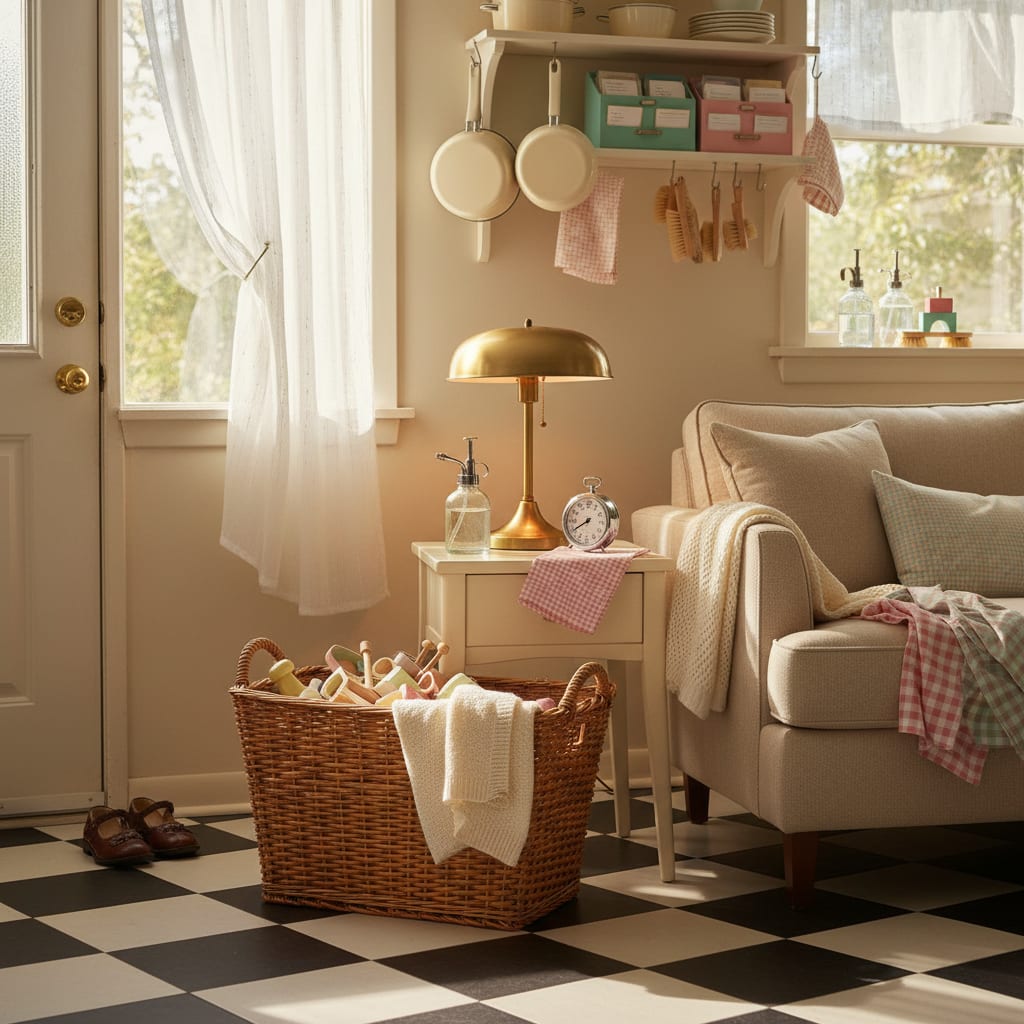
0–5: the haul lap. One laundry basket, one direction around the public rooms. Everything that doesn’t live in the room goes in the basket — shoes, cups, library books, the small plastic things. Do not deliver anything yet; delivering takes you into bedrooms and bedrooms eat the clock. At minute five the basket goes into a room with a door that shuts. This is a defer, not a solution, and it gets emptied tonight.
5–10: kitchen counters and sink. Dishes into the dishwasher or, if it’s full and running, into a dishpan under the sink. Counters cleared, then wiped left to right with one cloth. Sink rinsed and the faucet dried — a dry, shining faucet reads as “clean kitchen” out of all proportion to the four seconds it costs. Trash out if it’s near full, because a guest will notice a bin before they notice a floor.
10–16: the bathroom they’ll use. In order: clear the counter, wipe the counter and sink, wipe the faucet and the mirror, swish the toilet bowl, then wipe the seat, lid and — this is the one everyone skips — the flush handle and the door handle. Fresh hand towel, full paper roll, floor around the base wiped with the cloth you’re about to retire. Six minutes is genuinely enough if you don’t start cleaning grout.
16–22: the sitting room. Cushions straightened and plumped, throws folded in thirds over the arm, remotes and chargers into one basket, coffee table cleared and wiped. Then the ten-second scan from the doorway for the two or three objects that are still shouting. Fix those, leave the rest.
22–27: floors, high-traffic only. Vacuum or sweep the path a guest walks — entry, the lane through the sitting room, under the coffee table — and nothing else. Skip under furniture. Spot-mop only actual spills, with a damp cloth rather than a bucket, because a wet floor at minute twenty-nine is worse than a sticky one.
27–30: entry and lights. Shoes paired or gone, coats off the newel post, the door mat straightened, one lamp on in the sitting room, overhead lights off. Open a window for two minutes if the weather allows. A house that smells like fresh air beats a house that smells like an air freshener, every time.
When they’re already parking: the ten-minute version
Some notice is measured in minutes. Cut it to three stops: the haul basket (three minutes, public rooms only), the bathroom counter-mirror-toilet sequence with a fresh towel (four minutes), and cushions plus one lamp on in the sitting room (three minutes). Nothing else. Ten minutes spent on those three things buys more apparent order than twenty spent wandering with a duster.
For any of this to work you want your supplies to travel with you rather than living under three different sinks, which is the entire argument for a stocked cleaning caddy. One all-purpose spray, a stack of cloths, one scrub brush. A color-coded set like these microfiber cloths keeps the bathroom cloth from ever meeting the kitchen counter, which matters more when you’re moving fast than when you’re being careful. And never mix products in a hurry — vinegar and bleach in the same bowl produce chlorine gas, and no one should learn this while company is parking.
What you skip, on purpose
Naming the skips out loud is what keeps the thirty minutes honest, so: insides of things (fridge, oven, microwave, cupboards), baseboards, windows, dusting shelves above eye level, folding the laundry, mopping the whole floor, and any room whose door closes. Also skip the deep bathroom — tub, grout, shower door — unless a guest is showering, in which case you’re not speed cleaning at all — you’re running the three-day guest-ready plan on a shorter runway.
The skipped list isn’t neglect. It’s a scheduling decision: those jobs belong to the week’s rotation, and pulling them forward under time pressure is how thirty minutes becomes ninety and you greet your guests damp and cross.
"Company coming" meant the front room, the porch step and the good hand towels. A house had a public half and a private half, and only the public half ever got the rush — the rest was nobody's business.
Same triage, fewer rooms with doors. We run one lap in the order a guest walks it, put the overflow behind a shut door on purpose, and empty that basket tonight — which is the part the parlour system quietly relied on too.
Speed cleaning is a rescue, not a routine
If the thirty-minute list is running twice a week, the problem it’s solving isn’t guests. A house that needs a rescue before anyone can be invited in is a house with no baseline, and speed cleaning is a terrible baseline — it’s fast precisely because it’s shallow, and shallow repeated forever leaves you with clean visible surfaces and a genuinely dirty house underneath.
The baseline is the fifteen-minute daily cleaning routine, plus one reset a week. Run those and the company’s-coming list stops being a panic and becomes what it should be: ten minutes, mostly cushions, done before the kettle boils. The Sunday reset does most of the work here, because a house returned to zero on Sunday evening is never more than a lap away from presentable on Wednesday.
FAQ: speed cleaning
What should you clean first when guests are coming?
Clutter first, always — one basket, one lap of the public rooms, everything out of sight before you wipe anything. Cleared surfaces read as clean even unwiped, while a wiped surface covered in stuff does not.
How do you clean a house in 30 minutes?
By cleaning four rooms instead of the house: entry, sitting room, the guest bathroom and the visible kitchen, in a fixed six-stop order with a timer running. The order is what saves the time, because deciding is slower than wiping.
What’s the difference between speed cleaning and deep cleaning?
Speed cleaning changes how a room looks in half an hour; deep cleaning changes how it is, and takes a season. They aren’t competitors — the speed list only works cheaply on a house that gets its deeper jobs done on a rotation.
How do you make the house smell clean quickly?
Air first: open two windows for a few minutes, take the kitchen trash out, run the garbage disposal with a lemon wedge if you have one. Heavy sprays layered over a full bin fool nobody and give the sensitive a headache.