Build a Cleaning Caddy: The 12-Item Retro Kit
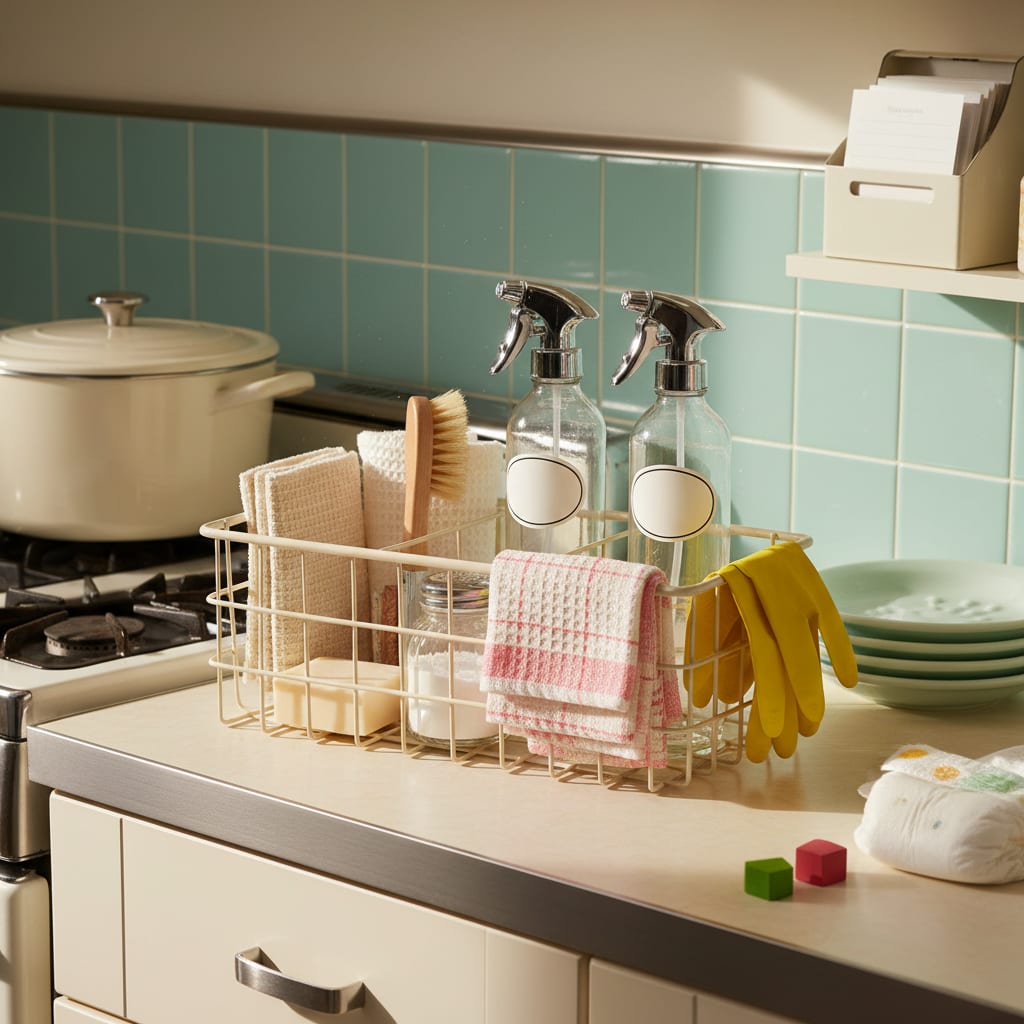
A good cleaning caddy holds twelve items: an all-purpose spray, a vinegar spray, a glass cloth, four general cloths, a scrub brush, an old toothbrush, a sponge, a plastic scraper, and a pair of rubber gloves — all in one open-top tote you can carry one-handed. That’s the entire kit for 90 percent of household cleaning. The caddy’s real job isn’t storage; it’s eliminating the supply run. Every trip back to the cabinet under the sink is an off-ramp from the task, and in a house with a toddler, every off-ramp gets taken.
Why a caddy beats a cabinet
My grandmother’s version was a wire tote that lived on the cellar stairs — the tools went to the room, never the reverse. The logic still holds, and it’s the same logic behind every timed session on this site: a 15-minute burst only works if minute one is cleaning, not gathering. Whether you run a weekly day-per-task schedule or a zone cleaning rotation, the caddy is the hardware those rhythms run on. Grab, clean, beep, done.
The discipline is what stays out. A caddy with every product you own is a chemical junk drawer with a handle — too heavy to carry, too crowded to see into. Twelve items, and everything else lives near its single point of use (toilet brush by the toilet, oven cleaner with the oven).
The 12 items
- All-purpose spray — one bottle handles counters, tables, switches, fingerprint archaeology. Ours is the homemade all-purpose cleaner; any well-liked store version works the same here.
- Vinegar spray (half water, half white vinegar) — glass, faucets, hard-water film. Know its don’t-list — stone, waxed wood — before it rides along; the full map is in cleaning with vinegar.
- Glass cloth — one flat-weave (a flour-sack towel) or microfiber cloth reserved for glass and mirrors only, because a cloth that’s touched soap will haunt every window afterward.
- Four general cloths — cotton or microfiber (MR.SIGA’s twelve-pack restocks the whole rotation at once), folded in a stack. Four means you’re never rewiping grime with a dirty cloth; used ones go over the caddy’s edge for the wash.
- Scrub brush — one stiff wooden-handled brush (Redecker’s beechwood scrub brush is the buy-once version) for grout edges, sink corners, dried mystery spots.
- Old toothbrush — the precision instrument: faucet bases, track grooves, high-chair crevices. Free, irreplaceable.
- Sponge — one, with a scrubby side (a Scotch-Brite Zero Scratch is safe on most surfaces), retired to dish duty the moment it smells like regret.
- Plastic scraper — an old store card or pan scraper. Lifts stickers, dried oatmeal, and crayon starts without scratching. The most underrated item on this list.
- Rubber gloves — Casabella’s Waterblock gloves or similar, riding in the caddy, because gloves stored elsewhere are gloves not worn.
- Bar of castile soap (or a small squeeze bottle) — Dr. Bronner’s unscented bar is the classic — the gentle generalist for anything the sprays shouldn’t touch; its whole résumé is in castile soap uses.
- Baking soda in a shaker — a repurposed parmesan-style shaker of baking soda for scouring sinks and tubs. Gentle grit, no canister spills in transit.
- Small trash bag, rolled — the room’s debris leaves with you, not on a separate trip.
Choosing the caddy itself
Open-top, one sturdy handle, divided wells, and small enough to force the twelve-item discipline — roughly shoebox footprint. That can be a farmhouse wire tote, a hardware-store plastic caddy like Casabella’s, or an enamel-look bucket with a divider; the aesthetics are yours, the shape requirements aren’t. Skip lidded boxes (friction) and enormous totes (they refill themselves). If it can’t be carried one-handed while holding a two-year-old with the other arm, it fails the field test.
Park it where cleaning starts — under the kitchen sink or the hall closet’s front position, never the garage.
The junior caddy
A small second caddy — two cloths, a spray bottle of plain water, a duster — turns “help me clean” from supervision into parallel play. My five-year-old’s caddy is the pink one, her jobs are baseboards and cabinet handles, and the water-only bottle means enthusiasm can’t create damage. Retro homekeeping was always multigenerational; the tools were just sized wrong for it until now.
Restocking: the two-minute audit
The caddy decays quietly — cloths migrate, the sprayer dies, the toothbrush walks off. Attach a two-minute restock to a rhythm you already run (mine rides the Sunday reset): cloths swapped for clean, bottles topped up, casualties replaced. A caddy is a system, and systems get maintained on schedule or abandoned by surprise.
FAQ: cleaning caddies
What should be in a cleaning caddy?
An all-purpose spray, a vinegar-water spray, a glass cloth, four general cloths, a scrub brush, an old toothbrush, a sponge, a plastic scraper, rubber gloves, castile soap, a shaker of baking soda, and a rolled trash bag. Room-specific products stay at their point of use instead.
What shouldn’t go in the caddy?
Anything single-room: toilet brush, oven cleaner, wood polish, specialty stone products. They live where they’re used. The caddy carries only the tools that work in every room — that’s what keeps it light enough to actually carry.
Do homemade cleaners work in a caddy kit?
Yes — the kit above runs on a homemade all-purpose spray, vinegar solution, castile soap, and baking soda, with plenty of store-bought equivalents if you’d rather buy than mix. The caddy doesn’t care what’s in the bottles, only that there are few of them.
Where should the cleaning caddy be stored?
At the house’s cleaning starting line — under the kitchen sink or front-and-center in a hall closet, always in the same spot. Out of a toddler’s reach or up on a shelf if little hands are part of your household equation.
Next cards in the file
Nursery Organization: Set Up for the 2am You
July 17, 2026
Line Drying Clothes: How to Hang, Dry and Save
July 31, 2026

The Nap-Time Reset: What to Clean in One Nap
July 31, 2026