Hot Water Bottle in a Child's Bed: Is It Safe?
No baby should ever have a hot water bottle, heat pack or electric blanket, in the cot or out of it. For older children, current guidance keeps Grandma’s habit and changes one step. Use the bottle to warm the bed, then take it out before the child gets in. NHS Greater Glasgow and Clyde’s paediatric burns team asks parents not to let a child sit on the bottle, press it with their feet, or take it into their bed. New Zealand’s Starship children’s hospital says the same: for children, warm the bed only and remove the bottle before bedtime.
Why the rule is stricter than it was
In January 2024 the burns clinic at the Royal Hospital for Children, Glasgow, reported treating eleven children for hot water bottle burns that winter, more than double the winter before. Its burns nurse linked the rise to families using bottles as a cheap way to keep warm, and noted that mistakes happen when filling is rushed at bedtime.
Writing in The Conversation, burns researcher Dr Lisa Martin of the University of Western Australia names three ways bottles hurt people:
- Spills while filling.
- Leaks and bursts when the bottle is cuddled or rolled on. A sleeping child does both.
- Contact burns from a bottle placed directly on skin.
The Glasgow team adds one every parent will recognise: children love squeezing the bottle, and a hard squeeze can spill water over their hands or burst it.
Babies: never, and here is why
The consumer group Which?, in an October 2025 piece written with the Lullaby Trust and the home-safety charity RoSPA, puts it plainly: babies’ skin “burns deeper, more quickly and at lower temperatures than an adult’s”, so even a covered bottle can do serious damage, and you should never use one for a baby under 12 months. It calls electric blankets for that age a “definite ‘no’” too, and Tasmania Fire Service states that electric blankets are not safe for babies.
The burn is only half the problem. The American Academy of Pediatrics’ safe sleep guidance asks for a sleep area with no soft objects or loose bedding, and warns that overheating raises the risk of SIDS. A bottle in a cot breaks both rules at once.
The AAP’s alternative is clothing: layers, or a wearable blanket such as a micro-fleece HALO Sleepsack, with one layer more than you are wearing. The baby sleep environment post covers the rest of the room, and Betteroo’s guide to when a loose blanket becomes reasonable explains why the first year’s cot stays bare.
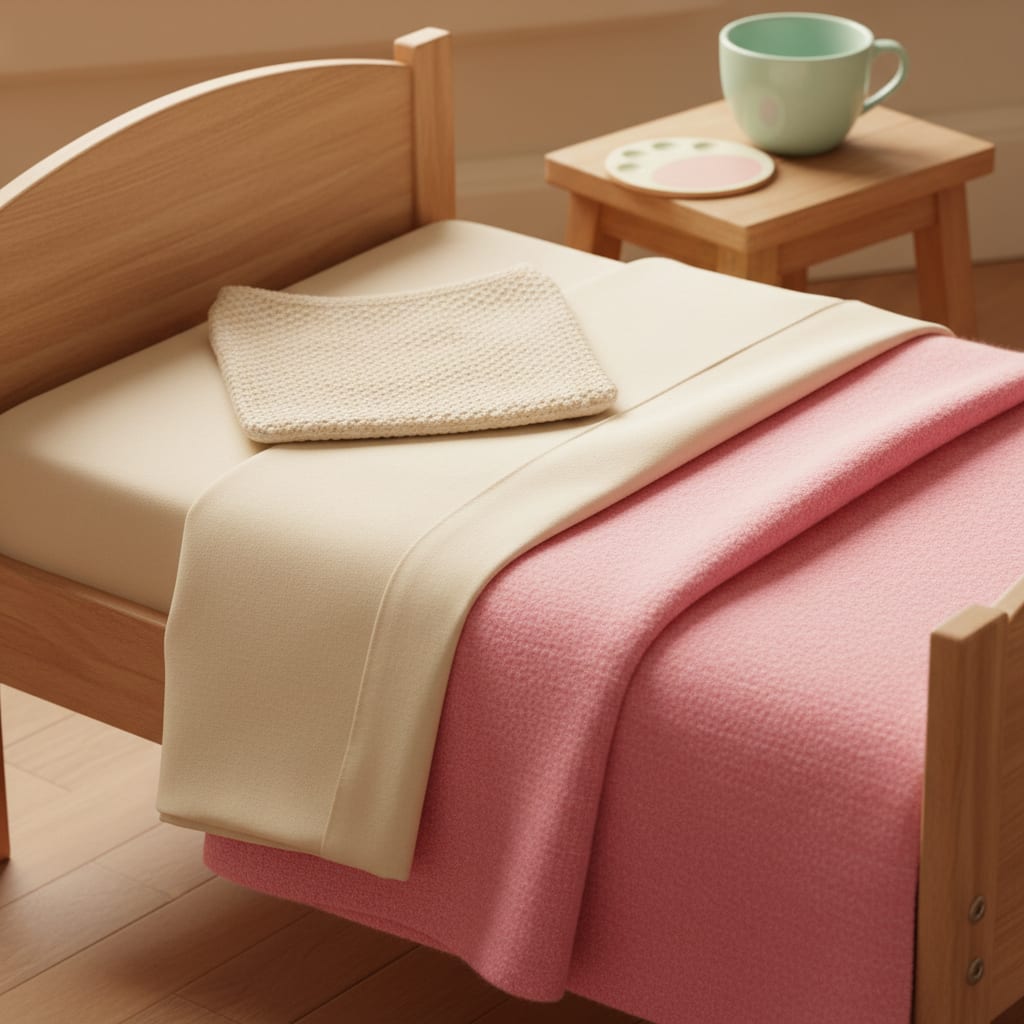
Warm the sheets before anyone gets in. The bottle went in at bath time, under the covers where the feet would go, and the bed was ready when the child was.
The same warm bed, with the last step made firm: the bottle comes out before the child goes in, every night, and never goes near a baby's cot at all.
Older children: warm the bed, then take it out
Starship’s guidance says to avoid hot water bottles for young children where possible, and where one is used, to warm the bed only and remove it before bedtime. Tasmania Fire Service tells adults the same. So the bottle belongs to the bath-time routine, not the night:
- Fill it (method below) while the bath runs, away from the children.
- Put it in its cover, under the covers at the foot of the bed.
- At the last story, take it out, empty it and hang it up.
- Let the child into a bed that is already warm.
Flannel sheets, such as this cotton flannel twin set, feel warm from the first touch where percale feels cold. A toddler who kicks covers off does better in a warmer-weight sleep sack like the HALO TOG 2.0 fleece sleepsack than under a heavier blanket, and Betteroo’s guide to matching a sleep sack’s weight to the room helps pick the rating.
If you are reaching for a bottle because the bedroom runs cold before dawn, fix the room: the 4am cold-room audit covers the thermostat schedule, draughts and bedding. If the furnace itself is out, see getting through furnace replacement week.
How to fill a hot water bottle safely
From the Glasgow burns team, Starship and Tasmania Fire Service, which agree on almost all of it:
- Never use freshly boiled water. Glasgow says boiling water degrades the rubber and makes a split more likely, so let the kettle water cool to warm. Starship and Dr Martin say hot tap water only.
- Fill only about two thirds, then gently squeeze out the air before closing it.
- Check the stopper is seated and the bottle does not leak.
- Never let a child fill it or hold it while you pour. The kettle is heavy and easy to drop, Glasgow warns; Tasmania says not to fill near children at all.
- Always use a cover, or wrap it in a towel. Keep a layer between the bottle and skin.
- Never heat it in a microwave or oven, and never use one in a bed with an electric blanket.
- Check the date and the rubber. Glasgow says the month and year of manufacture are inside the funnel, and to stop using a bottle two years after it; Starship and Tasmania say replace every 12 months. Starship also advises a bottle made to British standard BS 1970:2012. Check for wear before every use, and bin any bottle that shows it.
Wheat bags and microwave heat packs
Dr Martin notes that wheat bags burn when overheated or used on bare skin, and have occasionally caught fire after repeated reheating without cooling fully. Which? adds that the grain can keep heating after it leaves the microwave, so a bag tucked under bedding could start a fire. Some are made to look like soft toys; RoSPA’s advice to Which? is that “these are more for adults and shouldn’t be left where young children can come into contact with them.” Treat a heat pack like a bottle, only more so.
If a burn happens
The NHS says to hold the burn under cool running water for 20 minutes, as soon as possible, and remove clothing or jewellery near it unless stuck to the skin. The AAP’s burns guidance says no ice, butter, grease or powder; the NHS adds no creams or oils, and do not burst blisters.
Call your pediatrician for anything more than a superficial burn, the AAP says, and get immediate medical attention for burns to the hands, mouth or genitals. For a large or deep burn, call emergency services.

FAQ: hot water bottles and children
At what age can a child use a hot water bottle?
Never under 12 months, according to Which?, writing with RoSPA and the Lullaby Trust. For older children, Starship advises avoiding them where possible, and the Glasgow burns team asks parents not to let children take one into bed. The safe use is warming the bed and removing the bottle first.
Can I put a hot water bottle in my baby’s cot to warm it first?
No source we read treats that as a safe exception. The advice is simply not to use hot water bottles for babies under 12 months, and Which? warns a bottle risks a baby “getting too hot or even being burned”. A cot does not need warming: dress the baby for the room in layers or a sleep sack instead, as the AAP suggests.
How long do hot water bottles last?
Sources differ: NHS Greater Glasgow and Clyde says two years from the manufacture date inside the neck; Starship and Tasmania Fire Service say 12 months. Check for wear before every use.
Are microwave heat packs safer than hot water bottles?
Not for children’s beds. Wheat bags can burn when overheated, and Which? warns the grain can keep heating after microwaving and could start a fire under bedding. Never for babies, never left in bed.
Sources loaded and read on 2026-10-19: NHS Greater Glasgow and Clyde (Jan 2024 notice), Starship Safekids, Tasmania Fire Service, Which?, The Conversation via UWA, AAP HealthyChildren, NHS.