To clean a dishwasher, work from the bottom up. Take out the filter and rinse it under warm water. Clear the holes in the spray arms with a toothpick. Wipe the door seal with a soft cloth and warm water. Then, with the machine empty, put 2 cups of white vinegar in a dishwasher-safe cup on the bottom rack and run a full cycle with no detergent. A cup of baking soda on the floor and a short hot cycle the next day finishes it. Whirlpool says to clean a dishwasher about every 30 days, and to save the vinegar for when it needs a deep clean.
What you need
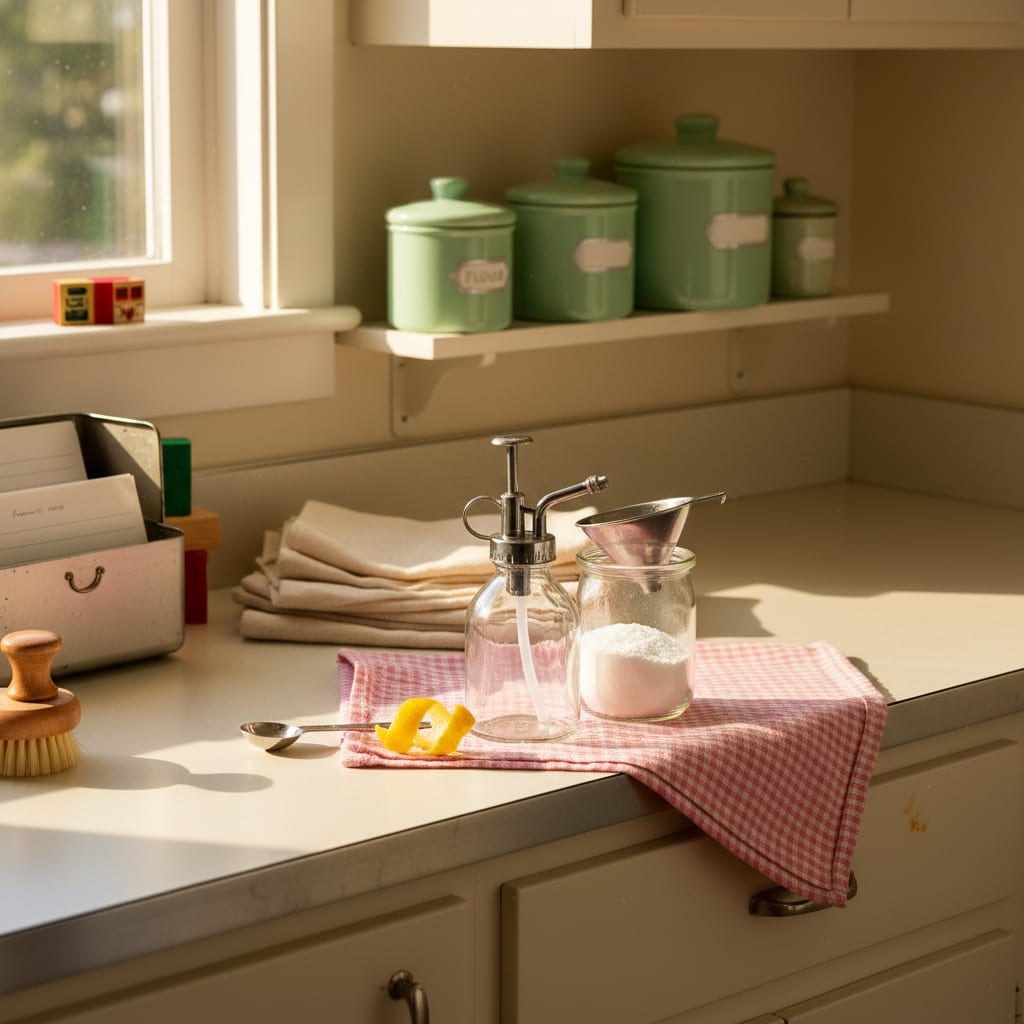
The whole job comes out of the cleaning cupboard:
- White vinegar, 2 cups
- Baking soda, 1 cup
- An old toothbrush and a soft cloth
- A toothpick or a straightened paper clip
- A dishwasher-safe glass or measuring cup
- Warm water with a squeeze of dish soap in a bowl
And your model’s manual. Filters lift out differently from brand to brand, and spray arms unclip differently too. Whirlpool’s help pages point back to the owner’s manual, and that is the right order of authority here: the maker first, the card file second.
Step 1: Clean the filter
Start with the filter, where food and grease collect. Bosch says it “is located at the bottom of the dishwasher tub.” Its filter-cleaning page describes its design: “Rotate the filter knob to the left and lift up to remove.” Then:
- Lift the filter out and separate the parts. Bosch says to “remove the filter from the screen and clean the pieces individually.”
- Rinse it under warm water. Whirlpool’s dishwasher cleaning page says to rinse it “to eliminate food particles and grease”.
- Scrub the mesh with warm soapy water and a soft brush. Bosch says “warm, soapy water and a scrub brush”. Go gently on fine mesh.
- Put it back securely. Bosch’s last step is to “dry the filter and place securely back in the dishwasher.”
Bosch recommends cleaning the filter “every few months”.
Step 2: Clear the spray arms
The spray arms spin and push water through rows of small holes. When those holes clog with food or hard-water scale, the dishes on that side come out gritty. Roto-Rooter’s dishwasher cleaning guide gives the method:
- Remove the spray arms, checking your manual for how they come off.
- “Use a toothpick or soft wire to clear clogged holes.”
- Scrub the arms with “an old toothbrush dipped in vinegar or soapy water”.
Rinse each arm under the tap and hold it up to the light. You should see light through every hole. Roto-Rooter suggests the blunt end of a straightened paper clip for stubborn holes. Clip the arms back on and spin each one by hand. It should turn freely.
Step 3: Wipe the door seal and the edges
The rubber seal around the door collects grease and crumbs in its folds. Whirlpool says to “use a soft cloth or sponge with warm water and thoroughly wipe the door seals.” Run the cloth along the bottom edge of the door too, where drips land and never get sprayed. The toothbrush gets into the corners of the cutlery basket and around the detergent cup.
Keep the vinegar off the seal for this step. Rubber degrades with regular acid contact, which is why cleaning with vinegar puts machine seals on its “occasionally, not weekly” list.
Step 4: The vinegar cycle
With the machine empty and the filter back in, Whirlpool’s method is: “Put 2 cups (500 mL) of white vinegar in a glass or dishwasher-safe measuring cup on the bottom rack. Run the dishwasher through a complete washing cycle using an air-dry or an energy-saving dry option. Do not use detergent.”
Roto-Rooter puts the same 2 cups on the top rack. On a Whirlpool, follow Whirlpool. On another brand, follow that brand’s manual if it says anything. Bottom rack is a reasonable default when it does not.
The maker’s caution is the part worth copying onto the card: “Vinegar is an acid; using it too often could damage your dishwasher. It’s better to do so only when you need to cleanse your dishwasher deeply.” So the filter and the arms are monthly, and vinegar is a once-in-a-while deep clean. If your manual forbids vinegar on your model, it wins. Whirlpool’s alternative is a dishwasher cleaner tablet; it names its own brand, and an Affresh dishwasher cleaner is the worked example if you would rather skip the acid entirely.
Step 5: The baking soda rinse
Roto-Rooter’s next step: “Sprinkle a cup of baking soda on the bottom and run a short cycle the next day.” It says the vinegar breaks down grease and soap scum, and the baking soda deodorizes and gently scrubs the interior.
Do them on separate days, as written, not in the same cycle. Mixed together they mostly fizz. The cupboard has more uses for the box in baking soda cleaning.
Never add bleach to the vinegar
Some guides use bleach for a moldy dishwasher. Roto-Rooter’s warning comes with it, in capitals: do not use bleach if the interior is stainless steel, “and never mix bleach with vinegar or baking soda.” Vinegar and bleach together release chlorine gas. If a machine is bad enough to want bleach, it is a separate day, with the window open, nothing else in the tub, and the manual’s permission.
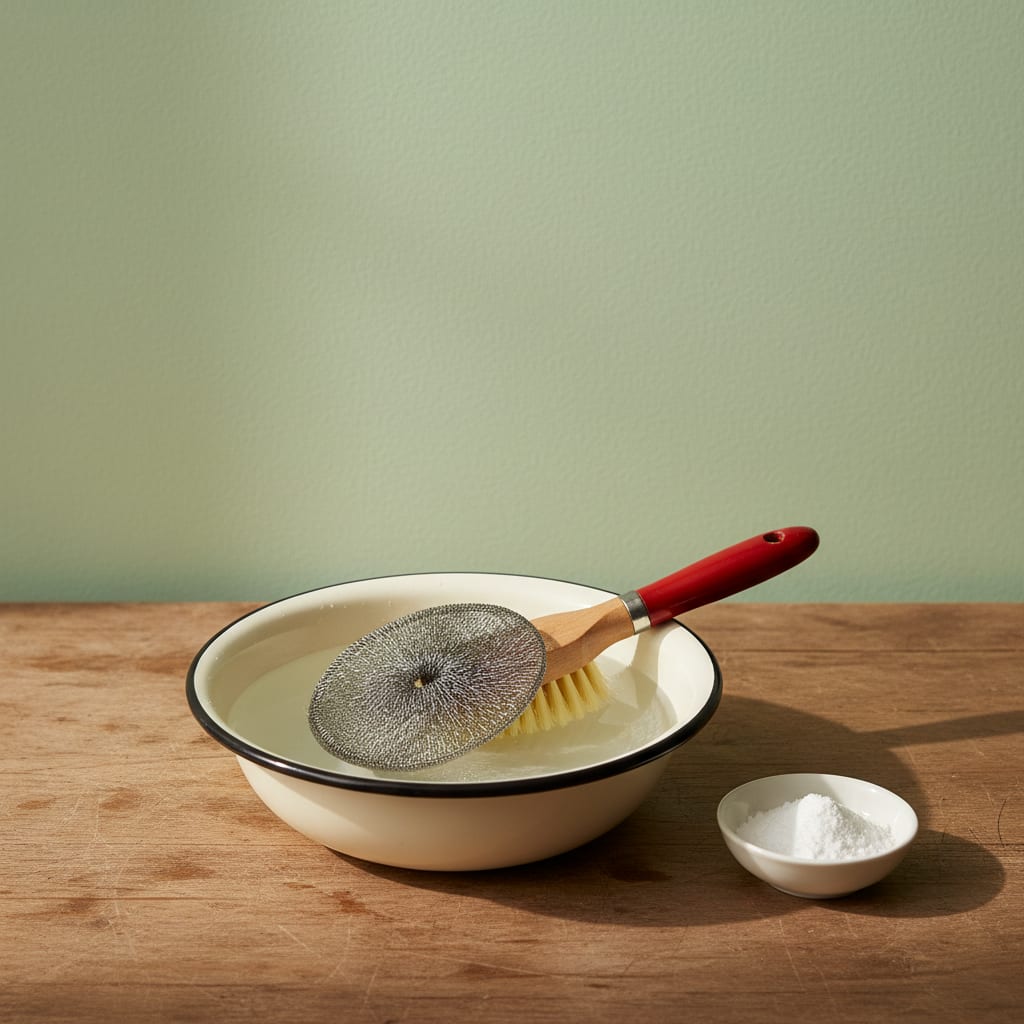
No dishwasher at all. Hot soapy water, a rinse basin and a dish rack on the drainboard, and the sink scoured with baking soda on Friday.
The filter comes out on the first Friday of the month, with a toothbrush for the arms. Vinegar goes in a glass on the bottom rack a few times a year, never more.
How often to clean a dishwasher
Whirlpool says dishwashers “should be cleaned approximately every 30 days for optimal performance”. Bosch puts the filter at every few months. In practice that splits into two jobs:
| Job | How often | Card |
|---|---|---|
| Rinse the filter, check the arms | Monthly | Friday kitchen day, first week |
| Wipe the door seal and edges | Monthly, with the filter | Same day |
| Vinegar cycle, baking soda next day | When it smells or films | Not on a schedule |
The monthly part slots into the kitchen week of the monthly cleaning schedule, which already lists the dishwasher filter. The washing machine wants the same treatment on its own schedule: how to clean a washing machine covers its drain filter and gasket.
Hard water is the other reason a machine films. Whirlpool says “a water softener is strongly recommended if your hardness is 15 grains or more.” If the white film comes back within days of a vinegar cycle, test your water before you blame the machine.
FAQ: cleaning a dishwasher
Can I put vinegar in my dishwasher?
Usually, yes. Whirlpool’s own method is 2 cups of white vinegar in a cup on the bottom rack and a full cycle with no detergent. It also warns that vinegar is an acid and should be used only for an occasional deep clean. Check your manual first.
Where is the dishwasher filter?
At the bottom of the tub, as Bosch puts it. On many models you turn it to the left and lift it out, as Bosch describes. Your manual shows the exact design.
Can I use vinegar and baking soda at the same time?
Not in the same cycle. Run the vinegar cycle first, then sprinkle a cup of baking soda on the floor and run a short hot cycle the next day.
Why does my dishwasher still smell after cleaning?
Check the filter again, and the drain area under it. A filter that was rinsed but not scrubbed, or not locked back in, is the usual reason.
Sources loaded and read on 2026-11-19: Whirlpool, Cleaning the Dishwasher Interior (200, 659KB); Bosch, How to Clean your Dishwasher Filter (200, 350KB); Roto-Rooter, How to Clean Your Dishwasher (200, 503KB).
More cards under Old-Fashioned Methods in the file.