Playroom Organization on a Budget (Less Is the System)
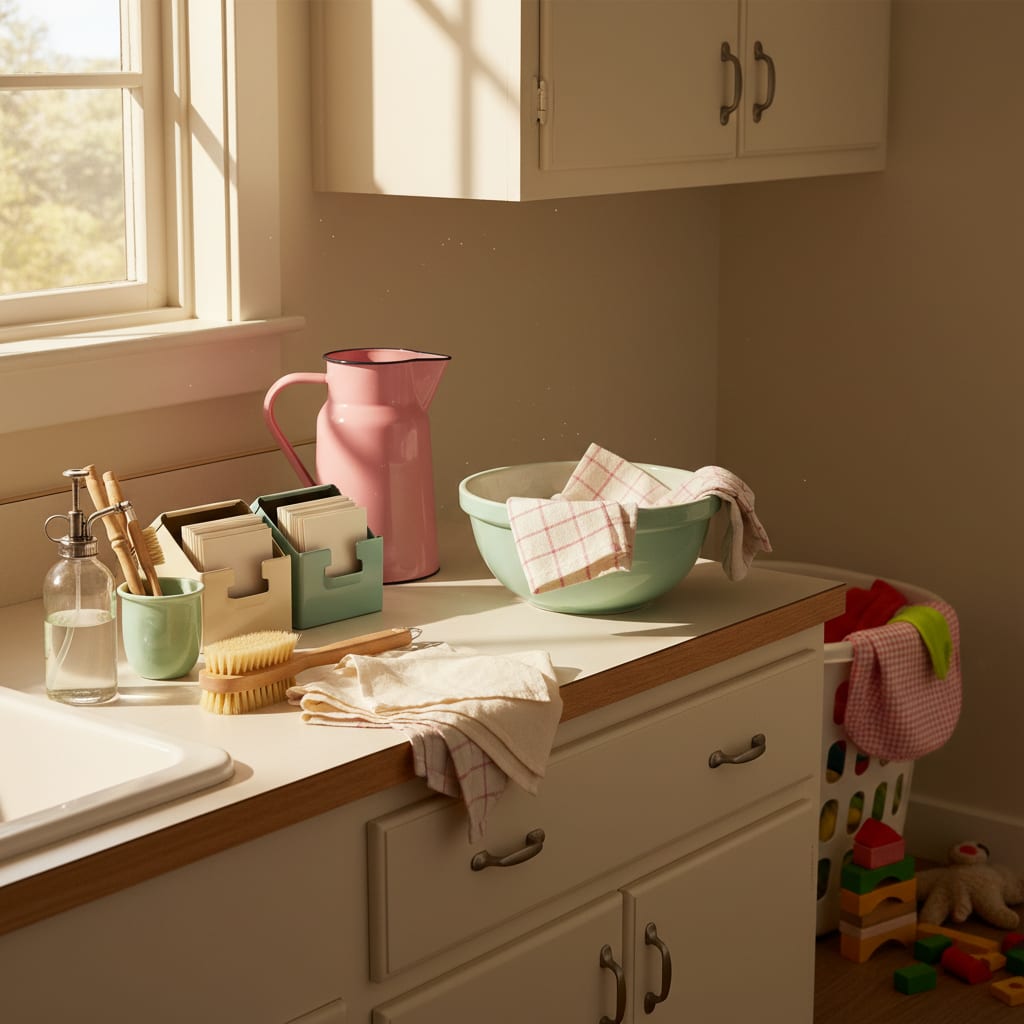
The cheapest playroom organization idea is also the best one: put fewer toys in the room. Less is the system. Once the visible inventory fits on one low shelf unit, almost any storage works — and until it does, no amount of matching baskets will hold. Build four loose zones (build, pretend, art, quiet), give each category one open bin at kid height, keep the floor clear as a rule rather than a goal, and run a ten-minute reset every evening. Total spend: one shelf unit and six bins, or nothing at all if you shop your own house first.
Start with subtraction, not shelving
The order matters more than the products. Edit first, contain second — buying bins for a room you haven’t edited just gives the clutter a nicer address. Pull everything out, sort broken from outgrown from never-played from keepers, and be honest about which toys have been touched since spring. If that sentence made your stomach drop because the last attempt ended in tears, the gentler script for doing this with a child is in how to declutter toys without a meltdown; the short version is that you do the invisible edits alone and the visible ones together.
Then put roughly half of what survives out of the room entirely — a closet, a garage shelf, under a bed. That off-stage half is not storage limbo. It’s the rotation supply, and swapping a bin every few weeks is the closest thing to free new toys that exists.
Four zones, drawn with furniture
You don’t need a designer’s floor plan; you need the room to suggest what happens where. Four zones cover almost every family:
- Build. Blocks, magnetic tiles, train track. Needs floor — the biggest clear stretch in the room, ideally on a low-pile rug that keeps pieces from skating.
- Pretend. Kitchen, dolls, dress-up, animals. Needs a wall and a container per family of things; the play kitchen or a shelf back makes a natural boundary.
- Art. A small table, one caddy of supplies, a wipeable surface. Keep paint and anything glitter-adjacent in the adult-height zone — that’s not organization, that’s self-preservation.
- Quiet. A floor cushion, a basket of books, a lamp. The smallest zone and the one most often skipped; it’s also the one that buys you twenty minutes on a rainy afternoon.
Furniture draws the lines. A low shelf turned perpendicular to the wall makes a corner. A rug is a room. Zones are why kids drift from thing to thing instead of dumping everything in the middle — the room tells them where each activity lives.
The storage, honestly costed
One low, open shelf unit does most of the work. A nine-cube organizer like ClosetMaid’s Cubeicals sits at kid height, holds a category per cube, and can be laid on its side for an even lower profile with a display surface on top. Any low bookcase you already own does the same job; the requirement is height and openness, not brand.
Open bins, no lids. A lid is a wall, and a wall means you do the tidying forever. Soft-sided fabric cubes drop into a cube unit and are quiet when a two-year-old flings one, which matters more than it sounds. Dishpans, produce baskets, a laundry basket cut down — all fine. Bins should be shallower than you’d think; nothing can be buried in a shallow container.
Photo labels instead of word labels. Tape a photo of one block to the block bin. Pre-readers can run the whole system with photo labels and cannot run it without them.
Skip: toy boxes (everything sinks), lidded totes for daily toys, the fifteen-bin sorting system for tiny bricks, and anything that requires an adult’s sorting brain to maintain. The full storage logic — broad categories, kid height, container-as-limit — is in how to organize toys, and the playroom is just that system given a whole room to spread out in.
Budget sources that aren’t a compromise
Shop the house first: the linen closet has spare baskets, the kitchen has a dishpan, the garage has a shelf. After that, thrift stores and buy-nothing groups are genuinely better than retail for playroom storage, because you want sturdy and ugly-proof, not pristine. Milk crates, wooden crates, a chest of drawers with the drawers removed to make cubbies. One caution from experience: check that secondhand furniture is stable and can be anchored to the wall before it goes in a room where children climb. Anything tall enough to tip gets an anchor strap, no exceptions — that’s the one line where “make do” doesn’t apply.
The reset is the real system
A playroom is organized if it can go from disaster to done in ten minutes without an adult sorting. That’s the whole test. Ours resets inside the evening pickup from the daily cleaning routine: timer on, one bin per person, things go back to their category, done when the timer sings. Broad categories and open bins are what make that toddler-executable — “cars go in the car bin” is a job a two-year-old can hold in their head; “sort by set” is not.
If the reset routinely runs past ten minutes, don’t buy more bins and don’t lecture. Too many toys are out. Rotate a bin off-stage and try again tomorrow.
When there is no playroom
Most of us are organizing a corner, not a room. The zones still work — they just shrink. Build zone: the rug in front of the couch. Pretend: one shelf and a basket. Art: the kitchen table, with a caddy that arrives and leaves. Quiet: a basket of books by the bed. The rules that matter in a small space are the same, only stricter: less out, everything visible, and one clear surface the toys are not allowed to colonize. A small house doesn’t need a playroom. It needs a smaller visible inventory, swapped often.
FAQ: playroom organization
How do you organize a playroom on a budget?
Edit the toy inventory first, then contain what’s left in whatever open, shallow, kid-height containers you already own. One low shelf unit and six bins will organize almost any playroom; the savings come from owning fewer toys, not cheaper bins.
How many toys should be out in a playroom at once?
About what fits on one low shelf with each bin holding a single visible category. Keep the rest off-stage and rotate. If nightly cleanup takes longer than ten minutes, too many are out.
What’s the best storage for a playroom?
Low, open, shallow, and labeled with photos. Cube units with soft bins are the reliable default; toy chests are the reliable failure, because everything below the top layer stops existing.
How do I get kids to clean up the playroom?
Make the system operable without you — broad categories, photo labels, kid height — then run cleanup as a timed nightly game with a defined end. Kids maintain systems they can run themselves; they abandon systems that need an adult to sort.
Next cards in the file
Nursery Organization: Set Up for the 2am You
July 17, 2026
Furnace Replacement Week: How to Protect Bedtime
September 7, 2026
Zone Cleaning: The Old Method That Beats Marathon Days
July 19, 2026