To clean a microwave, steam it first. Put a cup of water with the juice and peel of one lemon, or half water and half white vinegar, in a large glass measuring cup. Heat it on high until it boils for a few minutes, then leave the door shut while it cools. The steam loosens the spatters, and the walls then wipe clean with a soft cloth and warm water. Wash the turntable in mild soapy water. Wipe the waveguide cover gently and never take it out. Skip scouring pads and oven cleaner: the makers say neither belongs in a microwave.
Why steam works
A microwave is easier to clean than an oven, and the reason is in Wolf’s microwave cleaning guide: “little heat is generated to the interior surfaces. Therefore, there is no baking and setting of spills or spatters.” The splashes are dried on, not baked on. The card-file idea is that a few minutes of steam softens them, so they wipe off instead of needing to be scrubbed.
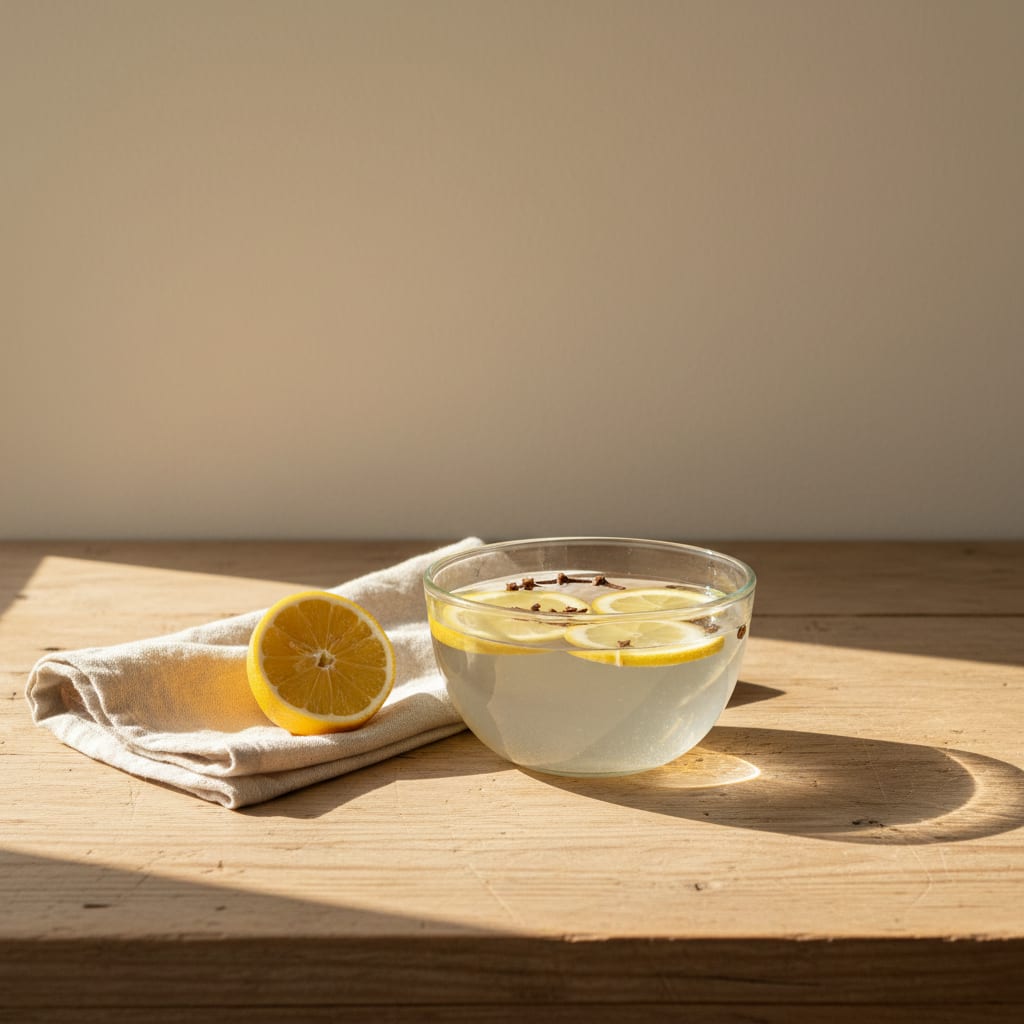
The lemon steam method
Wolf’s own method is a lemon steam, and it is a good one to copy exactly:
- Combine “1 cup (240 mL) water, grated peel and juice of one lemon, and several whole cloves in a 2-cup (480 mL) glass measuring cup.”
- Heat it: “Boil for several minutes using 100% power.”
- Wait: “Leave in the oven until cool.”
Wolf gives that recipe for removing odors; in this kitchen it doubles as the steam clean. The cloves are for the smell; leave them out if you have none. Use the 2-cup size Wolf names. A heavy glass one like the Pyrex Prepware 2-cup measuring cup has a handle for lifting it out.
Lift the cup out by its handle, slowly, once it has cooled.
The vinegar version
The card-file version uses vinegar instead of lemon: a cup that is half water and half white vinegar, heated the same way and left to stand with the door closed. It is the microwave line in cleaning with vinegar.
Lemon or vinegar, the work is the same. Neither one is a disinfectant. They loosen and deodorize, and the cloth does the cleaning.
Wipe the inside
When the cup is out, wipe the walls, ceiling and floor of the cavity. Wolf says: “To clean interior surfaces, wipe with a soft cloth and warm water.” For anything the steam did not shift, “For heavier soil, use baking soda or a mild soap. Rinse thoroughly with hot water.”
Work from the ceiling down, so drips land on parts you have not wiped yet. Rinse the cloth often. Then wipe the inside of the door and the seal around it, where splashes collect in the corners.
What not to use, in Wolf’s words: “Do not use abrasive or harsh cleaners or scouring pads,” and “Do not use chemical oven cleaners.” A paste of baking soda and water on a soft cloth is as abrasive as this job should ever get. For more from the same box, see baking soda cleaning.
The turntable
Take the glass turntable and the ring under it out. Wolf says to “wash turntable, turntable support, and accessory racks in water with a mild soap,” and that the support can go on the upper rack of the dishwasher. “For stubborn stains, use a mild cleanser and a non-abrasive scouring sponge.”
While the turntable is out, look at the floor of the cavity around the center spindle. Wolf points out that “the turntable motor shaft is not sealed, so excess water or spills should not be allowed to stand in this area.” Wipe it with a wrung-out cloth, not a wet one, and dry it before the turntable goes back.
The waveguide cover: gently
On many microwaves there is a small, flat panel on one inside wall: the waveguide cover. Your manual shows where it sits. Wolf says it “is made from mica, so it requires special care,” and gives two rules:
- “Carefully wipe the surface of the cover with a soft damp cloth to remove any food spatters immediately after they occur.”
- “Do not remove the waveguide cover.”
The reason to bother is in the same section: “Built-up spatters may overheat and cause smoke or possibly catch fire.” So this is the one part of the microwave worth wiping every time something splashes, not only on cleaning day. No scrubbing, no paste, no soaking: a soft, damp cloth only.
No microwave. A pan of water with a lemon simmered on the back of the stove to sweeten the kitchen after fish.
The same lemon, in a glass cup in the microwave, left to steam with the door shut. Then one soft cloth, warm water, and the turntable in the sink.
The outside, the door and the buttons
Wolf’s method for the outside is mild soap and water, rinsed and dried with a soft cloth, and it adds that “diluted white vinegar can also be used to clean the microwave exterior.” The door window gets a soft damp cloth on both sides. A stainless front follows the same with-the-grain routine as the fridge in how to clean stainless steel appliances.
Two cautions for the front:
- Control panel: “Spray on a cloth before wiping the control panel.” Wolf adds: “Do not spray cleaners directly on the control panel.”
- Stainless trim: Wolf says to wipe it often with a soft damp cloth, polish it dry, and apply any stainless cleaner “to a soft cloth” rather than straight onto the trim.
Wolf also says to “disconnect the power cord before cleaning, or leave the door open to inactivate the oven during cleaning.” Unplugging is easiest on a countertop model. On a built-in one, an open door does the same job.
How often to clean a microwave
| Job | How often |
|---|---|
| Wipe the waveguide cover | Every time it is splashed |
| Wipe up spills | The same day |
| Steam clean and wipe the cavity | Weekly in a busy kitchen, with the Friday kitchen jobs |
| Turntable and support | Weekly, with the steam clean |
| Outside and control panel | Weekly |
A cover over the bowl when you reheat saves most of the weekly job. The lid is a much easier thing to wash than the ceiling.
FAQ: cleaning a microwave
How do you clean a microwave with lemon?
Put the juice and grated peel of one lemon in 1 cup of water in a 2-cup glass measuring cup. Boil it for several minutes on full power, leave it inside until it cools, then wipe the inside with a soft cloth and warm water.
Can you use vinegar to clean a microwave?
Yes. Half water and half white vinegar in a glass cup, heated and left to steam, loosens grease the same way. Wolf also lists diluted white vinegar for cleaning the outside.
Can I take out the waveguide cover to clean it?
No. Wolf says not to remove it. Wipe it gently with a soft damp cloth whenever food splashes it, because built-up spatters can overheat and smoke.
What should you not use to clean a microwave?
Abrasive or harsh cleaners, scouring pads and chemical oven cleaners, per Wolf. Use a soft cloth, warm water, mild soap or a little baking soda.
Source loaded and read on 2026-11-19: Sub-Zero Wolf, Microwave Cleaning (200, 164KB).
More cards under Old-Fashioned Methods in the file.