What to Use Instead of Laundry Detergent in a Pinch
The best emergency substitute for laundry detergent is another mild surfactant you already own: about a tablespoon of shampoo, body wash or hand soap, dissolved in water before the clothes go in. After that, in descending order of usefulness: bar soap shavings, washing soda plus a rinse, oxygen bleach powder, and plain hot water with a long agitation. What you must not do is put dish soap in a washing machine — it foams until it comes out of the door. All of these are one-load stopgaps, not a system.
The rule that governs all of them
Detergent is a blend of surfactants, enzymes, builders and anti-redeposition agents, each doing a distinct job. Anything you substitute covers one or two of them and none of the rest.
Shampoo brings surfactants but no builders, so it struggles in hard water. Washing soda brings builders but no surfactants, so it softens water without lifting oil. Oxygen bleach attacks stains but doesn’t hold loosened soil in suspension, which is why grey water settles back onto the clothes. Knowing which piece is missing tells you how the load will disappoint you — and lets you patch it, since soda plus shampoo covers more ground than either alone.
The substitutes, ranked
| Substitute | Dose per average load | Where | Honest verdict |
|---|---|---|---|
| Shampoo, body wash or hand soap | 1 tbsp, dissolved first | Machine or sink | Best all-round stopgap; watch for suds |
| Bar soap, finely shaved | 1–2 tbsp of shavings, dissolved in hot water | Sink, or machine on a warm cycle | Works in soft water, scums in hard |
| Washing soda | ½ cup | Machine, with the water running | Softens and boosts; not a cleaner on its own |
| Oxygen bleach powder | 1 scoop | Machine, dissolved first | Excellent on stains and smell, weak on grease |
| Borax | ½ cup | Machine | A booster only; pair it with something surfactant |
| Baking soda | ½ cup | Machine | Deodorizes; the weakest of the powders for cleaning |
| Plain hot water, long cycle | — | Machine | Better than people expect on lightly worn clothes |
Shampoo, body wash or hand soap
The closest relative to detergent in an ordinary house. One tablespoon is genuinely the dose — these foam generously, and a machine full of foam washes badly and rinses worse.
Dissolve it in a cup of warm water first and pour that into the drum, never the dispenser drawer, where it will clog. Skip conditioning shampoos and two-in-ones: those agents are designed to deposit onto fibres.
Bar soap shavings
The genuinely old method, and it works — with the caveat the whole soap-versus-detergent question turns on. Soap reacts with the minerals in hard water to form a curd that lodges in fabric, greys whites and stiffens towels. In soft water it’s fine; in hard water it’s a slow-motion problem, laid out in why homemade laundry soap can wreck your wash.
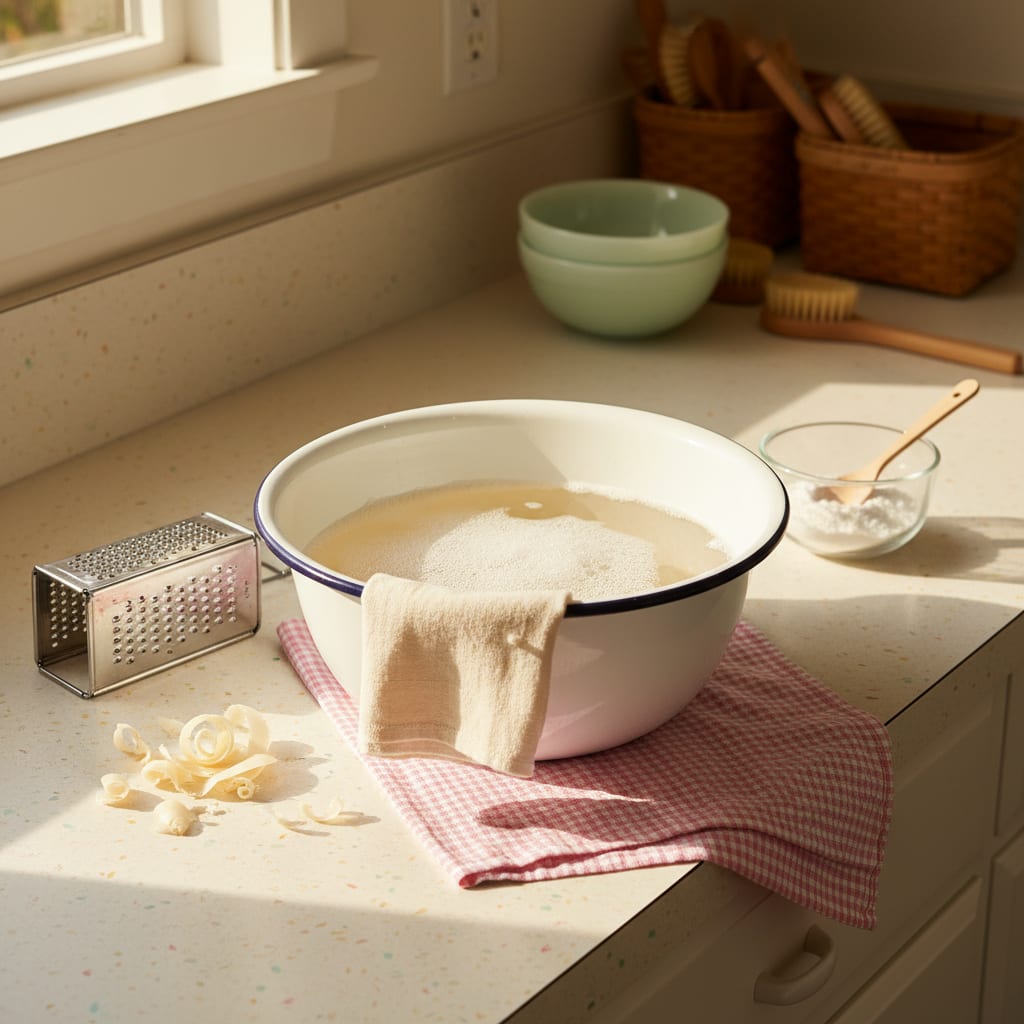
Shave it fine on a box grater, dissolve the shavings fully in hot water, and add a vinegar rinse to clear what stays behind. A plain unscented castile bar is the pleasantest version — the same bar that does a dozen other jobs in castile soap uses.
There was no substitute question, because there was one product: a bar of laundry soap, grated as needed, on a shelf beside the washboard. When it ran out you borrowed from a neighbor, and the water was softened with soda ash rather than by a machine.
The card file's version is a shelf, not a recipe: a box of washing soda and a tub of oxygen bleach live in the laundry cupboard permanently, so "out of detergent" is a Tuesday inconvenience rather than a trip to the store at nine at night.
Washing soda and borax
Neither is a detergent. Their value is as force multipliers: half a cup of washing soda alongside your tablespoon of shampoo makes that tablespoon behave like considerably more, because the soda takes the water’s mineral load and the surfactant spends itself on dirt.
Washing soda is strongly alkaline. Keep it off wool and silk entirely, keep it away from skin for any length of time, and don’t scale it up on the theory that more is better — a heavy alkaline dose is hard on both fibres and colors.
Oxygen bleach powder
Sodium percarbonate — the base of the oxygen-bleach tubs — releases hydrogen peroxide in warm water, which is what lifts stains and clears the smell out of a load. A scoop of an oxygen bleach powder gets towels or kids’ clothes genuinely fresher. It’s color-safe on most modern dyes but not all, so a hidden-seam test on anything dark is worth thirty seconds.
Where it falls down is grease and body oil, which need a surfactant: collars and cooking-splashed clothes come out smelling clean and still faintly filmy.
Plain hot water
It’s free: a long, warm, well-agitated cycle with nothing added gets lightly worn clothes perfectly acceptable. It won’t touch stains or grease, but it beats improvising with something corrosive.
What not to put in the machine
Dish soap. The one to be firm about. Hand dishwashing liquid is engineered to foam and a machine doesn’t know when to stop: a tablespoon in a front-loader pushes foam through the door seal, the suds cushion the load so it never really washes, and it takes several rinse cycles to clear. A drop for one item in a sink is fine. In the machine, no.
Dishwasher detergent, pods included. Far too harsh: it’s built for ceramic and steel, and it will strip dye and damage fibres. The dishwasher-pod question is answered in the FAQ below.
Shampoo with conditioner in it, for the reason above, and any hair product marketed as smoothing or repairing.
Bleach as a substitute. Chlorine bleach is a whitener and a disinfectant, not a cleaner, and it lifts no soil at all. It also must never meet vinegar, in the same load or in back-to-back cycles.
Anything homemade, unrinsed. With shaved soap, the vinegar rinse is the step that keeps soap out of the cloth.
Turning the emergency into a shelf
Running out is a stocking problem, not a chemistry problem. Keep two cheap dry powders in the cupboard: washing soda and an oxygen bleach. Paired with a tablespoon of whatever soap is in the bathroom, they’ll carry a household through a week.
If you find yourself here often, the honest next step is either buying detergent in a size you actually finish or mixing your own with clear eyes about its limits — the working recipe and its real trade-offs are in the homemade laundry detergent post. And when the new bottle arrives, dose it properly: the reason many people run out early is set out in how much laundry detergent to use.
FAQ: detergent substitutes
Can you use dishwasher pods for laundry?
No. A dishwasher pod is automatic dishwasher detergent in a dissolving film, made for plates and glasses, not cloth. The Carpet and Rug Institute, ruling it out even for spot-cleaning carpet, notes that many automatic dishwasher detergents “contain bleaching agents that destroy dyes and some fibers” (CRI’s detergent notes), so a pod in the drum risks faded, weakened clothes. If you’re out of detergent, a tablespoon of plain shampoo is the better stopgap.
Can I use shampoo instead of laundry detergent?
Yes, for one load: about a tablespoon of plain, non-conditioning shampoo, dissolved in warm water and poured into the drum. More than that and the machine will foam.
Can you use dish soap in a washing machine?
No. Dish soap is built to foam, and a washing machine will fill with suds that cushion the load and can escape the door. A single drop is fine for hand-washing one item in a sink; nothing more.
Will baking soda alone wash clothes?
Not really. Baking soda deodorizes and mildly softens water, but it lifts almost no soil. Treat it as a helper alongside a surfactant, not as a substitute for one.
Is vinegar a substitute for laundry detergent?
No. Vinegar is a rinse aid — it clears residue and cuts musty smells, but it doesn’t lift dirt. A load washed in vinegar alone comes out wet and no cleaner than it went in.
What did people use before laundry detergent existed?
Bar soap, grated into hot water, with washing soda to soften the water and sunlight to bleach the whites. It’s still the basis of every homemade recipe, hard-water limitation included.