Airing the Bedroom Before Bed: Does an Open Window Help?
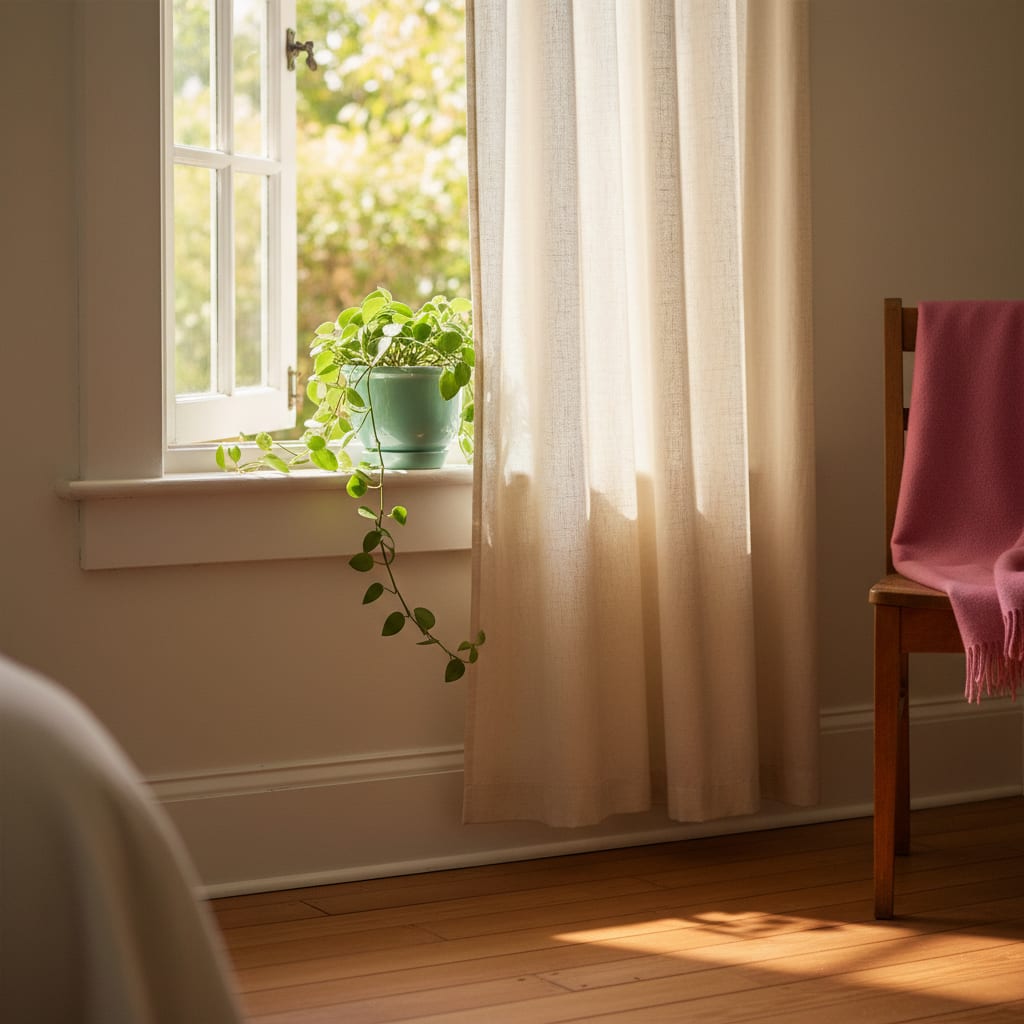
Airing the bedroom before bed is worth keeping. Ten minutes with the window and the bedroom door open replaces the stale air in a small room. Small adult studies found an open window kept night-time carbon dioxide far lower and helped some measures of sleep, such as falling asleep faster; none studied children. Air the room while the bath runs, then close or crack the window for the season. Keep it shut on smoke or high-pollen nights, and never where a child can reach a window that opens more than 4 inches.
Where the habit comes from
Airing is one of the oldest cards in my grandmother’s tin file, and it sits in the old-fashioned cleaning tips as a daily job. Nobody measured anything; a room that had held sleeping children all night smelled close, so the window went up. The modern measure is carbon dioxide. Sleepers breathe it out all night, so in a closed bedroom it climbs until morning, and researchers use it as a stand-in for how much fresh air a room gets.
What the open-window studies actually found
- Denmark, 2014. A team at the Technical University of Denmark (DTU) studied 14 single-occupancy dormitory rooms, one week with the window open and one closed. Night-time carbon dioxide averaged 660 ppm open and 2,585 ppm closed. There was no significant effect on overall sleep quality or next-day performance, but with the window open people fell asleep faster on the wrist actigraph, rated the air fresher and had less nasal dryness (and drier lips).
- The Netherlands, 2018. An Eindhoven University of Technology study in Indoor Air followed 17 healthy young adults with a bedroom window or door open, then both closed. Carbon dioxide averaged 717 ppm open and 1,150 ppm closed, with the open rooms only slightly cooler (19.7°C against 20.1°C). Reported sleep depth and one actigraphy measure differed significantly.
- A 2024 controlled study. Thirty-six young adults slept in simulated bedrooms at three ventilation levels. Compared with 750 ppm, at 1,000 and 1,300 ppm they were awake 5 and 7.8 minutes longer, with less deep sleep at 1,300. The authors, from Shanghai Jiao Tong University and DTU, concluded bedroom ventilation giving 1,000 ppm or more should be avoided.
These are small groups of healthy adults and the effects are modest. An open window will not fix a child’s sleep; it does improve the air.
Children’s bedrooms run stuffier than you’d think
Bekö and colleagues at DTU measured carbon dioxide in the bedrooms of 500 Danish children aged 3 to 5 as they slept (Building and Environment, 2010). About 57% slept with less air exchange than Denmark’s minimum for new homes, only 32% of rooms averaged below 1,000 ppm overnight, and in 23% the level passed 2,000 ppm for at least 20 minutes. That study did not measure sleep. To see your own number rather than guess, a carbon dioxide monitor such as the Aranet4 shows the overnight climb.
The window went up wide in the morning and again at bath time, whatever the weather, and the bedroom door stood open so the draught ran through the room.
The same two airings, with the bedroom closed up again before a child gets into bed in winter. The room is fresher, and the heat stays in.
The bedtime airing routine
It takes about ten minutes of an evening you already have, and hands the evening reset a fresher room.
- Open the window and the bedroom door when the bath starts. With both open, the air has a way through the room rather than just in.
- Throw the covers back so the bed airs too.
- Keep the child out of the room while it airs, which the bath does for you.
- Close up before pajamas in cold weather. A short, wide airing changes the air without the room sitting cold all night.
- Decide the night setting: closed, cracked, or door open, by the season and the child (below).
Window open all night, by season and age
Babies. Room temperature comes first. Aim for about 68 to 72°F (20 to 22°C), the range in Betteroo’s pediatrician-reviewed nursery temperature guide, checked with a room thermometer, because a baby who gets too hot is at higher risk of SIDS. In hot weather the Lullaby Trust, the UK safer-sleep charity, suggests opening the bedroom door and a window “if it’s safe to do so”; in winter, an extra layer. Dress the baby for the room the window leaves you.
Toddlers and older children. In mild weather a cracked window or an open door can stay all night. In cold weather, air before bed and close up. A room that cools too far by dawn is the problem the 4am cold-room audit deals with.
Summer. Open windows only when the outside air is cooler than the inside; the heatwave rhythm covers the dusk flush.
Window safety before any of this
Nationwide Children’s Hospital says over 3,300 US children a year are treated in emergency departments for window falls, which cause more severe injuries than any other kind of fall. Its prevention list:
- Window stops so the window opens no more than 4 inches.
- Window guards on second-story windows and higher, ideally with a quick-release for fire escape, such as Guardian Angel’s adjustable guard with quick-release egress.
- A screen is not a barrier. It is “NOT enough to keep children safe.”
- Furniture away from windows, so nothing becomes a step up.
The AAP’s HealthyChildren site adds that no crib or child’s bed should sit near a window, because of falls and cords, and passes on the CPSC’s advice to use cordless window coverings. The bed never goes under the window you air through.
When the window should stay shut
- Smoke. EPA’s wildfire advice is to keep windows and doors closed, then air the house when the outdoor air improves. AirNow treats an Air Quality Index of 100 and below as generally satisfactory, and above 100 as unhealthy, first for sensitive groups.
- Pollen, for a child with hay fever. The NHS says to keep windows and doors shut as much as possible when the count is high.
- Noise. If traffic wakes a light sleeper, air before bed and close up.
- Condensation is the opposite case. UK government damp and mould guidance says condensation forms when indoor moisture cools onto colder surfaces such as window frames, and counts homes where people feel unable to open windows among those at risk. That is a reason to air daily.

A good room is half of it. Betteroo’s guide to what changes in sleep once children leave the crib covers screens, big beds and the requests at lights-out.
FAQ: airing a bedroom before bed
Does sleeping with the window open help you sleep better?
In small adult studies it lowered night-time carbon dioxide a lot and improved some measures, such as falling asleep faster or deeper reported sleep. None found a large effect, and none studied children.
How long should you air a bedroom?
No source gives a fixed time. Ten minutes with the window and door open is a house habit; in mild weather, leave the window cracked.
Is it safe to leave a window open in a baby’s room?
Keep the room at about 68 to 72°F, the crib away from the window, no cords in reach, and the window opening no more than 4 inches. In cold weather, dress the baby for the room.
Should I keep the bedroom door open at night?
It helps the air move; the Eindhoven study counted an open door as an open condition. Whether it suits your house depends on noise and light.
Sources loaded and read on 2026-10-23: DTU Orbit (Strøm-Tejsen et al. 2014; Bekö et al. 2010; Kang et al. 2024), Eindhoven University of Technology research portal (Mishra et al., Indoor Air 2018), The Lullaby Trust, Nationwide Children’s Hospital, AAP HealthyChildren, EPA, AirNow, NHS, UK government damp and mould guidance (gov.uk).
Next cards in the file
Nursery Organization: Set Up for the 2am You
July 17, 2026
Furnace Replacement Week: How to Protect Bedtime
September 7, 2026
Speed Cleaning: The 30-Minute Company's-Coming List
August 7, 2026