Coming Home Late Without Waking the Toddler
It is almost never the door swinging that wakes them. It is the latch — a hard, brief click that goes into the jamb, the framing and the wall their bed sits against — plus the hall light coming on and the conversation that follows you in. None of the three is fixed by tiptoeing. Set the hall light before you go out, hold the handle down through the close so the latch is placed rather than snapped, land your keys on cloth instead of wood, and keep whatever needs saying in the kitchen with the door shut.
Why eleven o’clock is the worst hour for it
The same door at 8:15pm does nothing; at eleven it empties a bedroom. Two things changed in between, and neither is the door.
The first is where they are in the night. Deep sleep is front-loaded: the National Heart, Lung, and Blood Institute’s stages of sleep page notes that you usually spend more time in the deepest non-REM stage early in the night, with more REM later. A toddler who went down at half past seven spent that first stretch nearly unwakeable and is, by eleven, cycling through the lighter end of the night. The door has not got louder. They have got closer to the surface.
The second is the house. At 8:15 there is a television, a dishwasher, someone on the stairs; by eleven the place is silent, and a latch click is a step up out of nothing. Same principle as re-timing the wash so the spin doesn’t land in a nap — a sleeper registers the change in sound, not the decibels.
The three inputs, in the order they cost you
The latch. The bolt snapping into the strike plate is a small impact handed to the door jamb, which is nailed to the framing, which is the same framing as their wall. It is structure-borne — which is why a closed bedroom door does almost nothing about it. The sound is not in the air until it re-emerges inside the room.
The light. A hall overhead at eleven is the brightest thing to happen in the house for three hours, and the gap under a bedroom door is a letterbox pointed at the bed.
The voices. Arrival talk feels quiet, which is why it gets forgotten. It isn’t quiet, it’s new — two people at normal volume in a hall silent since nine.
Close the door without the click
- Hold the handle down through the close. Turn the knob or press the lever fully so the bolt is retracted, swing the door to, hold it against the stop, then release the handle slowly so the bolt eases into the strike instead of firing into it. Practise it twice in daylight and it becomes automatic.
- Do the deadbolt afterwards, slowly. The clunk at the end of the throw is the loud half.
- Tighten the screws. Loose strike-plate and hinge screws let the whole assembly rattle; five minutes with a screwdriver takes a surprising amount off.
- Add compression. Fresh foam or V-strip weatherstripping on the jamb cushions the slab against the stop and cuts the airborne slam too.
- Silence the interior doors too. The bedroom door you push open to look at them is the same problem in miniature. Adhesive strike-plate silencers like this door silencer plate give the bolt something soft to land on — the shape of the fix, not a miracle, and a badly hung door still needs hanging properly.
- Oil the hinges, and wind the storm door’s closer screw until it takes several seconds to shut rather than snapping home.
Set the hall before you go out
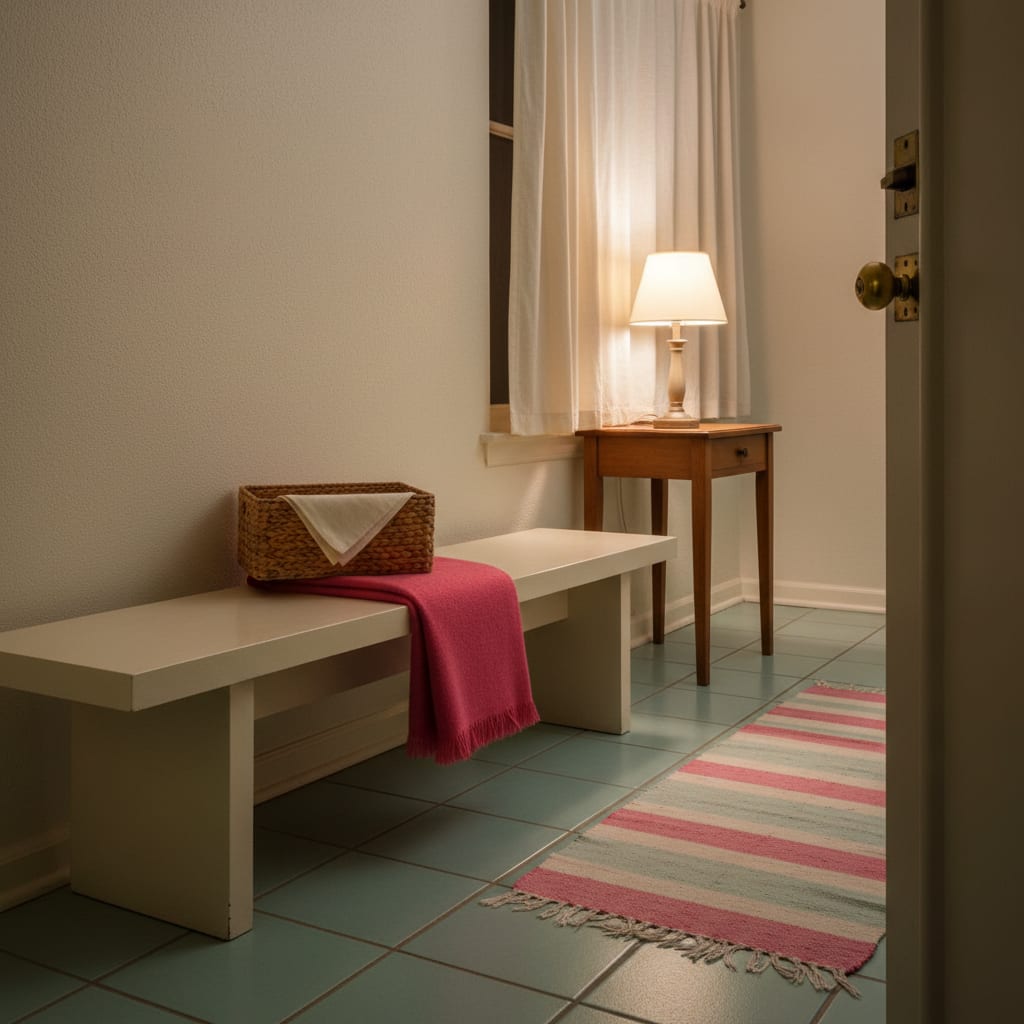
Turn the hall overhead off and leave one low lamp on instead — a small shaded lamp on the console, or a plug-in nightlight at floor level on the landing. The point is that whoever arrives never reaches for a switch. If nobody is home to do it, a plug-in timer does the same job.
Put a lined basket or a folded cloth where your keys land: keys dropped on a wooden hall table at eleven is comfortably the second-loudest sound in the house, a few feet from a bedroom door. Hard-soled shoes come off on the mat, before the hall, not in it. And if the child’s room faces the drive, headlights sweeping the ceiling as you swing in do the waking before you have touched the door — line the curtains, or park nose-out.
Nobody wrote an arrival routine down, because the door went at a known hour. The same shift, the same train, supper held to the same minute — everyone in the house had absorbed the sound of that door arriving when it was supposed to.
Shift work, commutes and a phone that moves the plan at nine mean the hour is no longer shared knowledge, so the arrival has to be a written sequence rather than a habit everybody already has — the same reason the evening reset gets carded instead of remembered.
The arrival card
Six lines, taped inside the coat closet door where whoever comes in will see them. That is the whole system.
- Hall overhead off, low lamp on — before anyone leaves.
- Park so the headlights sweep away from the bedroom window.
- Hard soles off at the mat.
- Handle held down through the close, released slowly. Deadbolt after, slowly.
- Keys and bag into the basket, not onto the table.
- Anything that needs saying happens in the kitchen, door shut.
Steps one and two are the skipped ones — and the two that cost nothing at eleven, because they happened at seven.
Raise the floor in the room
The other half of the answer is not at the door at all. A steady, unbroken sound in the bedroom lifts the baseline so a latch click is no longer a step up out of silence — the reasoning behind everything else in a child’s sleep environment, where controlling the room beats controlling the house. Steady is the operative word: anything that pulses or loops audibly is a series of small events, not a floor. The Yogasleep Dohm is the mechanical-fan version most often used for it.
When the door is only getting the blame
Run the honest test before you spend another evening on hardware: follow the whole card on two ordinary nights and see what happens.
If they sleep through, you have found it. If they still surface with the door handled perfectly, the door was a coincidence and the pattern is what to look at. Betteroo’s guide to why they pop back up soon after bedtime is the read if the waking sits closer to nine than eleven, and its two-year-old sleep schedule is a yardstick for whether the day behind that night is the right shape. A wind-down that has quietly stretched is worth auditing too — trimming a bedtime routine that got too long fixes more late wakings than any door does.

FAQ: the late arrival
Why does the front door wake my toddler when talking downstairs doesn’t?
Conversation is a steady sound the room’s baseline absorbs. A latch is a brief impact delivered into the door frame and the framing behind it, so it arrives through the wall rather than the air — and as a sudden change against a silent house.
Does closing their bedroom door help?
It helps with airborne noise — voices, the television, the hall. It does very little for the latch, because that sound travels through the structure and only becomes airborne again inside the room.
What is the quietest way to close a front door?
Retract the bolt fully by holding the handle down, close the door against the stop, then release the handle slowly so the bolt eases into the strike plate. Throw the deadbolt afterwards, slowly, as a separate movement.
Will a sound machine cover a slamming door?
It raises the room’s baseline so the click is less of a step up out of silence, which is often enough. It will not mask a door physically knocking the frame — that one is fixed at the door.
We come home at a different time every night. Is that the real issue?
Not for the reason people assume. An irregular arrival is awkward because nobody can build a habit around a time that keeps moving — carding the sequence gives you the consistency the hour can’t.