How to Clean Brass Without Stripping the Finish
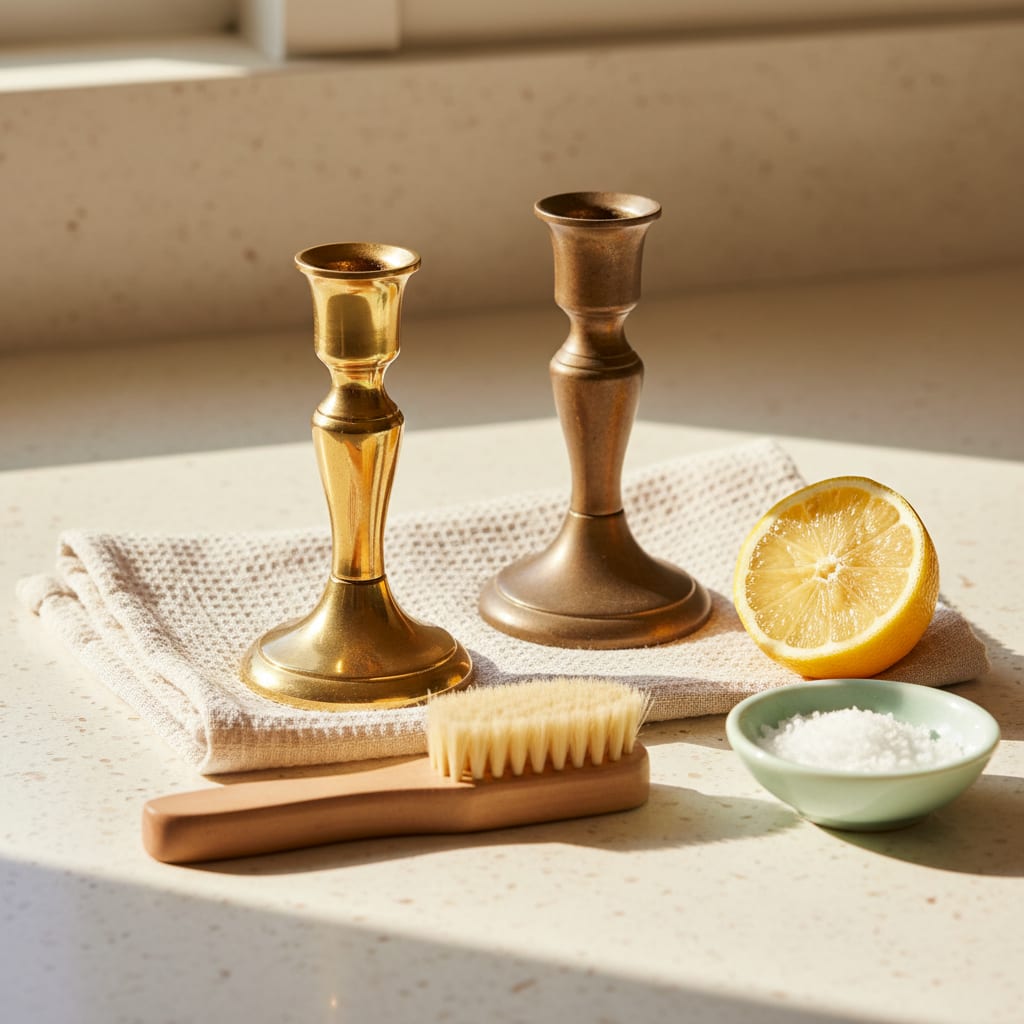
To clean brass, find out what you have before anything touches it. Wash every kind in warm water with a little mild dish soap, using a soft brush in the crevices, then dry it thoroughly. Polish only solid, unlacquered brass, and start with the gentlest method: a soft cloth, then a mild cream polish, rubbing lightly. Never polish lacquered brass, because polish removes the coating. Go gently on plated brass, which has only a thin skin of brass to lose. Antiques with an old, even patina are usually best cleaned and left unpolished.
Brass by type: which method is safe on each
The same tarnished candlestick can be three different objects underneath, and the right method depends on which. Arciform, a historic-home restoration firm, puts the risk plainly in its metal finishes care guide: “A polish that restores bare brass, for example, can damage lacquered or plated brass.”
| Type | How it usually shows itself | Everyday cleaning | Polish? |
|---|---|---|---|
| Solid, unlacquered | Darkens in recesses, brightens where it is handled | Mild soap and water, dry well | Yes, gently, if you want it bright |
| Lacquered | Even, glassy shine; when the coating fails, dark spots appear in patches | Soft cloth, mild soap and water | No |
| Plated | A different-colored metal shows through at worn edges | Mild soap and water, light touch | Sparingly, or not at all |
| Antique or patinated | Even brown tone, often original | Dust and gentle washing | Usually not; ask a professional if it matters |
Two warnings about the “how to tell” column. Arciform says a magnet “cannot reliably tell you whether a piece is solid brass, brass plated, bronze, or another alloy,” and that “color alone isn’t reliable either.” If a piece is valuable or you can’t tell, treat it as the most delicate type it might be.
Step one for every kind: wash it
Dust and grease sit on top of tarnish, and a wash removes them without taking any metal. The Canadian Conservation Institute (CCI), whose note on cleaning, polishing and waxing brass and copper is written for museum objects, treats cleaning and polishing as two separate jobs. Cleaning removes dirt, grease, old polish and fingerprints. Polishing is abrasive and takes metal off.
- Brush off dust with a soft natural-bristle brush; CCI suggests a soft or medium toothbrush for detail.
- Wash in warm water with a little mild dish soap, working the brush into engraving and around the base.
- Pick old polish out of crevices with a wooden toothpick. Dried polish packed into a pattern is the white crust on old candlesticks.
- Rinse and dry thoroughly with a soft cloth. Arciform’s everyday care for both lacquered and unlacquered brass ends the same way: “Dry thoroughly.”
For many pieces, that is the whole job. Look at it dry before you decide it needs polish.
Polishing bare brass, gentlest method first
CCI’s rule is to “always begin with the mildest and least harmful method”, because “repeated polishing results in loss of surface detail.” Its order, mildest first, is a paste of precipitated chalk and water on a soft cloth, then a jeweller’s cloth, then a wadding polish, finishing with a buff from a clean, lint-free cloth.
At home that translates to a soft cloth, a small amount of gentle cream polish and light pressure, turning to a clean part of the cloth as it blackens. CCI flags two things to avoid. Automotive and stainless-steel products “often contain very hard particles which can scratch the softer alloys of copper”, and “many metal polishes contain ammonia, which can dissolve copper in some conditions.” Brass is a copper alloy, so read the label. A cream sold as ammonia-free, such as HOPE’S Brass Polish, is a reasonable choice for unlacquered pieces. Wash and dry afterward so no polish dries in the details.
The lemon-and-salt card
My grandmother’s tin file has a card for brass: half a lemon dipped in salt, rubbed over the tarnish, then a rinse. It sits in old-fashioned cleaning tips for the same reason it has survived a century: lemon and salt are already in the kitchen.
What it is, chemically, is an acid with a coarse abrasive. Neither source above recommends it, and Arciform lists acids and abrasives among the stronger products you should not reach for until you know the metal and its finish. So it belongs on the first row of the table only: solid, unlacquered, everyday brass you are happy to brighten. Keep it off lacquer, plate and anything antique. Rinse the piece thoroughly so no acid is left in the crevices, and dry it straight away. Vinegar is in the same category. Ketchup, yogurt and the other pantry tricks are folklore, and nothing here vouches for them.
Lemon and salt on the candlesticks and the door knocker every autumn, rubbed hard, rinsed under the tap and set on the windowsill to dry.
A soapy wash first and a dry-off with a towel. Lemon and salt only on the plain unlacquered pieces, a gentle cream polish when it needs more, and the lacquered lamp base gets a damp cloth and nothing else.
Lacquered brass: wash it, never polish it
Lacquer is a clear coating meant to keep brass looking the same year after year. Arciform’s instruction is direct: “Do not use brass polish on lacquered brass. Metal polish can damage or remove the protective coating.” Clean it with a soft cloth and mild soapy water, and avoid abrasive pads, harsh chemicals and aggressive rubbing.
When lacquer starts to fail, dark spots or tarnish appear beneath or around the coating. At that point, Arciform says, restoring it “becomes a refinishing project rather than a cleaning task.” Stripping old lacquer is not a kitchen job either; CCI notes that removal “usually requires chemicals that are both toxic and flammable” and points to a conservator or a specialist company.
Antique brass and patina
A dark surface is not always tarnish. Arciform notes that older brass “can develop a stable patina over decades.” CCI’s advice for museum pieces is to decide first whether the object should look polished at all, and “if uncertainty exists on this point, it is safest to clean without polishing.” For an heirloom menorah or a pair of old candlesticks, that means a dust, a gentle wash and a dry. Polishing an even old patina away cannot be undone. If a piece may be valuable, ask a conservator or an antiques dealer before anything stronger than soap goes on it.
Keeping it from tarnishing again
- Handle it with clean hands. CCI’s museum practice is clean cotton gloves, because skin passes moisture, salts and oils to the metal.
- Dust it often. A dry, soft cloth on a regular round means less polishing later.
- Wax bare brass if you want it to stay bright. CCI describes a thin coat of microcrystalline paste wax, buffed with a lint-free cloth, as a protective layer for unlacquered metal.
- Clean it before it goes on the table. If menorahs or candlesticks come out for Hanukkah or Christmas, put brass on the week-before list in the holiday hosting house prep, next to the silver. Silver has its own method in how to clean silver, including the foil bath, which is a silver method, not a brass one.
FAQ: cleaning brass
How can I tell if brass is lacquered?
Lacquered brass has an even, glassy shine that stays consistent rather than darkening in the recesses. When the lacquer fails, dark spots form in patches under or around the coating. If you’re unsure, treat it as lacquered: soap and water only.
Can you use lemon and salt on brass?
Only on solid, unlacquered brass you are happy to brighten. It is an acid and an abrasive, so keep it off lacquered, plated and antique pieces, and rinse and dry the brass thoroughly afterward.
Does vinegar clean brass?
Vinegar is an acid like lemon juice, so the same limits apply: solid, unlacquered brass only, rinsed and dried at once. A mild soapy wash comes first.
How often should you polish brass?
As seldom as you can. CCI notes that every polish removes some surface metal and repeated polishing loses detail. Wash and dust routinely, and polish only when washing no longer satisfies you.
Sources loaded and read on 2026-10-27: Canadian Conservation Institute (CCI Notes 9/3, The Cleaning, Polishing and Protective Waxing of Brass and Copper), Arciform metal finishes care guide.
Next cards in the file
Furnace Replacement Week: How to Protect Bedtime
September 7, 2026
Toddler Wakes at 4am? Check the Overnight Heating
September 15, 2026
Rewiring or Replumbing? Bedtime Around the Works
September 19, 2026