To cut dust mites in a child’s bedding, wash the sheets, pillowcases and blankets every week, as warm as the care tags allow, then give them a hot tumble dry. Zip the mattress and pillow into dust-proof covers, keep the bedroom under 50 percent humidity, and dust and vacuum that room in the morning, not at bedtime. You don’t need to turn the water heater up to 130°F: the allergists’ own practice guide says weekly matters more than heat. And a nose that is stuffy every night is worth a doctor’s visit, because only a test says whether mites are the cause.
Is it dust mites, or just a cold?
The two look alike. The NHS page on allergic rhinitis says its symptoms “are similar to a cold”: sneezing, an itchy, runny or blocked nose, watery eyes and a cough. It names house dust mites among the common causes. The Asthma and Allergy Foundation of America’s dust mite allergy page calls a stuffy nose “one of the most common and troublesome symptoms”, and where mites set off asthma it adds coughing, wheezing and “waking at night due to asthma symptoms”.
The clue a homekeeper can watch for comes from the American College of Allergy, Asthma and Immunology’s dust allergy page: symptoms “can be present year-round”. A cold comes and goes. A nose blocked every night, all year, is the pattern to take to the doctor, who can confirm mites with a skin or blood test, per AAFA. The NHS adds that decongestants “should not be used by children under 6”. For a baby under one, a blocked nose is usually a cold, and Betteroo has a sensible page on clearing a baby’s stuffy nose that keeps the baby flat on their back in a bare crib.
The hot wash: where 130°F comes from
The National Institute of Environmental Health Sciences’ dust mite page says to “wash all bedding and blankets once a week in hot water, 130 to 140 degrees Fahrenheit, to kill dust mites.” AAFA says at least 130°F. It is also the allergy row in how often to wash sheets, which sets the weekly rhythm for every bed in the house.
The allergists’ own guidance is more careful. Their joint practice parameter on dust mites (Portnoy et al., 2013, for the AAAAI and ACAAI) says bedding “should be washed weekly” and that “high temperature is not necessary”. Its reasons:
- The 130°F figure came from a lab, not a laundry. It rests on mites sealed in capsules and dunked to find their scalding point, “not on washing blankets or clothing”.
- Water does most of the work. In a simulated wash, 90 to 98 percent of mites died even in cold water, “indicating that most mites died by drowning”. Warm 104°F water removed 98 percent of mite allergen from sheets in another study.
- Hot tap water burns children. The paper notes the Consumer Product Safety Commission recommends household hot water be set at 120°F; at 131°F a second-degree burn takes 17 seconds.
So leave the water heater alone and wash weekly, as warm as each tag allows. Some washers heat their own water to at least 131°F for three minutes, the paper says, which is worth looking for only if you are buying a machine anyway.
Let the dryer do the killing
Heat still helps, just not from the tap: the practice parameter reports that all the mites seeded into blankets died after 10 minutes in a clothes dryer, and 99 percent of mites in used comforters after an hour. AAAAI’s page on indoor allergens puts it in one line: wash weekly and dry “in a hot dryer”. Check the tag on anything filled; a thick comforter has its own method in how to wash a comforter.
A cold wash and line drying removed about 80 percent of mites in one study the parameter cites. Good, but on an allergic child’s bed the sheets go through the dryer and the line gets the towels.
Why every week? The paper says allergen washed out of blankets “generally reappears within 1 month”.
Cover the bed itself
Mattresses and pillows can’t go in the machine, so they get zipped in. NIEHS says to “encase your mattress and pillows in dust-proof or allergen impermeable covers”. On a twin bed, a zippered six-sided cover such as the Utopia Bedding twin encasement goes on in one go, with Hospitology’s zippered pillow encasement for the pillow. The parameter warns that “mite covers alone are unlikely to achieve a clinical benefit” without the rest of the plan, so they come with the weekly wash, not instead of it.
Three more bed details:
- Leave it unmade in the morning. AAFA says to leave the bed unmade “during the day to air out”.
- Replace pillows every two years, per AAFA, and swap feather or wool bedding for synthetic, per NIEHS.
- Bunk beds: the allergic child on top, with both mattresses encased, per the practice parameter, as long as the top bunk suits their age.
For a baby under one, the crib stays as safe sleep says: a firm, flat mattress, a fitted sheet and nothing else. Any crib mattress cover should be made for that mattress and fit tightly.
The soft toys
AAFA lists stuffed toys among the fabric items where the skin flakes mites eat collect, and NIEHS says to replace traditional stuffed animals with washable ones. For the toy a child sleeps with, that means a lovey whose tag allows a wash, plus a spare: the system in how to wash a lovey.
Freezing is the old trick for toys that can’t be washed. NIEHS says non-washable bedding “can be frozen overnight”, and the practice parameter adds the catch: freezing “kills them but does not get rid of the allergen”. A frozen toy still wants a wash or a shake outdoors afterwards.
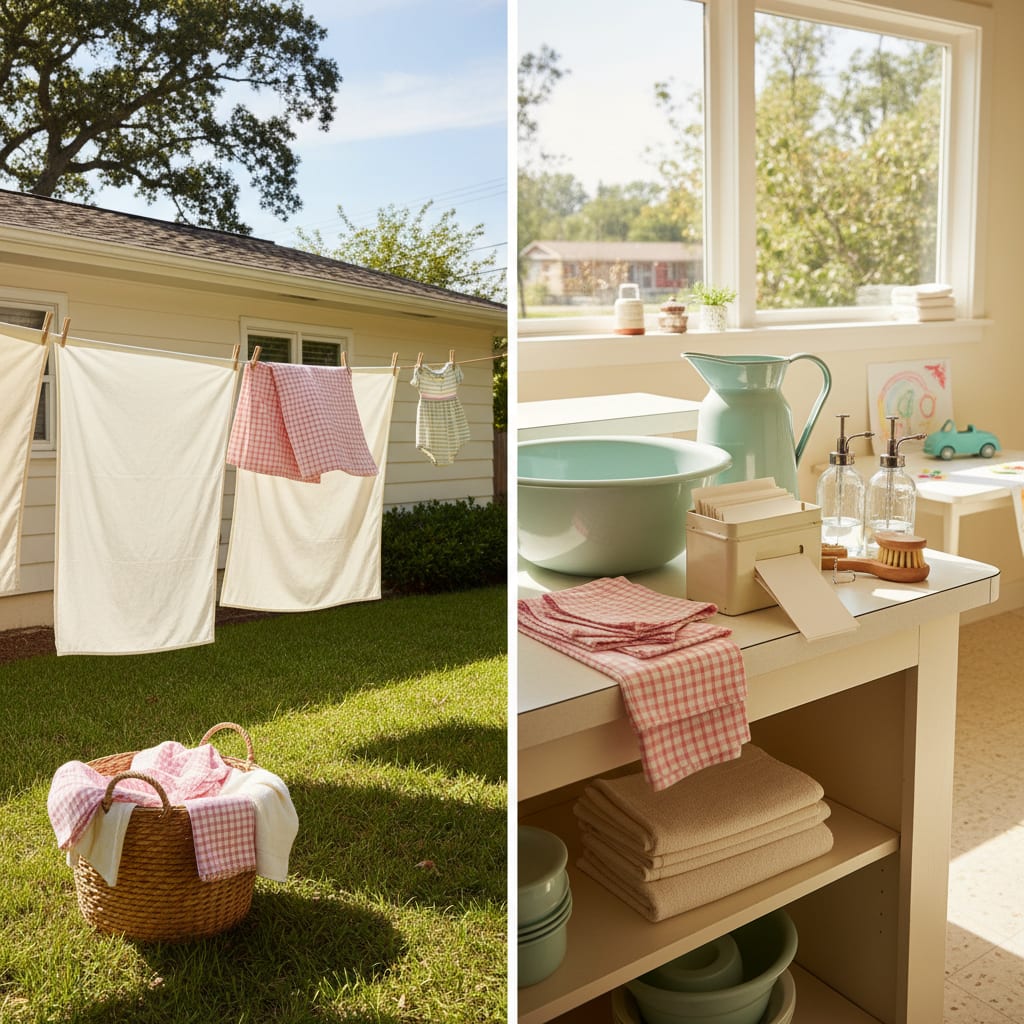
Spring and fall, the mattresses went over the porch rail for a beating, and the blankets hung on the line all day.
The mattress stays zipped in its cover. The sheets go in every Monday and through a hot dryer, and the bed stays unmade until lunch.
Keep the bedroom air under 50 percent
Mites need damp air. ACAAI says they “die when the humidity falls below 50 percent”, and NIEHS says to keep it at or below 50 percent with a dehumidifier or air conditioner. A small hygrometer such as the TempPro TP50 on the dresser ends the guessing. In winter, when a dry nose tempts you to run a humidifier all night, the same reading keeps both in check; the setup is in nursery humidifier for dry air.
Clean the bedroom in the morning
ACAAI says dust can take “more than two hours” to settle after a thorough cleaning, and advises cleaning while the allergic person is away: “avoid cleaning the bedroom of an allergic person at night.” So the bedroom’s dusting and vacuuming moves to the morning. Use a vacuum with a HEPA filter, as NIEHS, AAFA and ACAAI all advise, and dust with a damp cloth, per the NHS. The evening job is only turning down the bed.
 Clean sheets, clear nose, still waking? Check the schedule.
Betteroo builds a sleep plan around your child's age, with naps, wake windows and bedtime that change as they grow.
Take the sleep quiz →
FAQ: dust mites and a child’s bedding
Does washing in cold water get rid of dust mites?
Mostly. The allergists’ practice parameter reports 90 to 98 percent of mites dying in a cold simulated wash. A hot tumble dry afterwards finishes the job.
What temperature kills dust mites in bedding?
NIEHS and AAFA say 130°F water. The allergists’ paper says that is not needed in the wash, and that home hot water should stay at 120°F. Ten minutes in a dryer killed all the mites in its blanket study.
How often should an allergic child’s bedding be washed?
Every week. The allergen comes back within about a month, so the rhythm keeps it down.
Should a child with a stuffy nose see a doctor?
If it is there most nights, yes. The NHS says to see a GP when symptoms affect sleep, and only an allergy test confirms mites.
Sources loaded and read on 2026-11-15: NHS, Allergic rhinitis; AAFA, Dust Mite Allergy; ACAAI, Dust Allergy; NIEHS, Dust Mites and Cockroaches; AAAAI, Managing Indoor Allergen Culprits; Portnoy J et al., Ann Allergy Asthma Immunol 2013;111:465-507; Betteroo, Baby Congestion.
More cards under Laundry & Linens in the file.